Buying a Country House with a Private Well: Water, Records and Equipment
A private well is an entire supply system, not just a borehole. This guide shows how to verify its records, output, water quality, treatment equipment and operating risks before purchase.
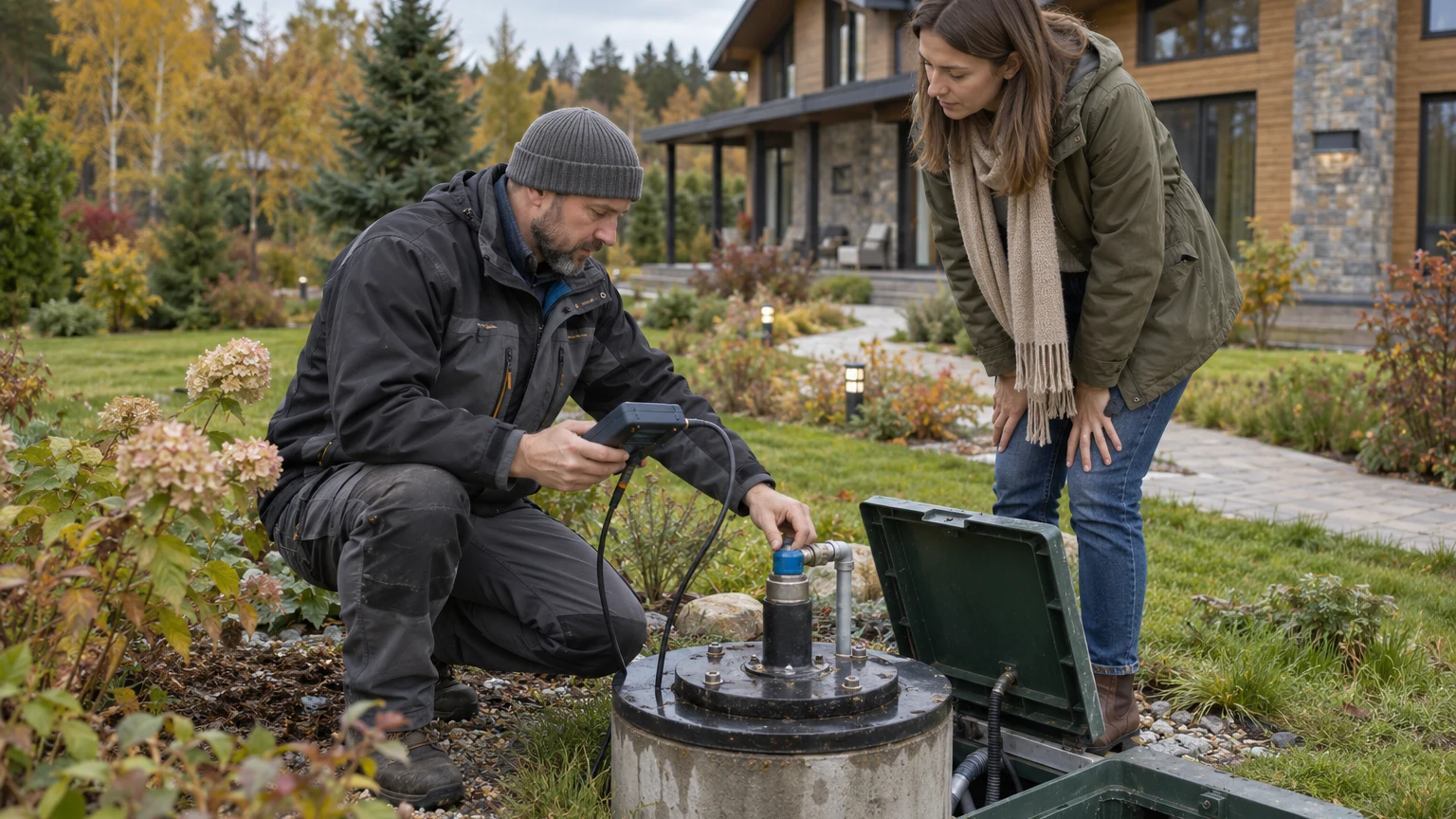
A private well is often presented as a simple advantage: independence from the community network and an abundant supply of clean water. A buyer is actually taking over a chain of assets — the borehole, casing and wellhead, submersible pump, cable, buried main, pressure vessels, controls, treatment plant, internal distribution and backwash disposal. The system may look healthy while one tap is open and fail when showers, irrigation and appliances operate together.
Due diligence should answer four separate questions. Is the right to use the source clear for this property and this operating arrangement? Can the system sustain the household's real demand? What does accredited testing say about raw and treated water? Can the equipment be serviced without major alteration to the garden or plant room? Neither pleasant taste nor a single old laboratory sheet answers all four.
This guide is a focused companion to the broader country-house acquisition checklist. It is not a substitute for a hydrogeologist, water engineer, accredited laboratory or property lawyer. Its purpose is to turn vague selling points into evidence, repeatable tests and clearly allocated actions before completion.
Identify the actual source and operating model
Start by tracing water backwards from the taps. The house may use a private borehole within the plot, a community well, a storage tank filled by delivery, a central network, or a combination with manual or automatic changeover. Marketing descriptions can call every arrangement “private water”, even though ownership, liability and continuity are entirely different.
For an individual source, establish the physical wellhead location, ownership of the equipment, the available description of the aquifer and construction, the intended uses of the water and every connected consumer. For a shared source, request the operator's identity, the supply agreement, metering arrangements, responsibility boundary, reserve provision and shutdown rules. An informal connection serving several houses is not merely a plumbing detail; it creates legal and operational dependencies.
Russian subsoil rules distinguish between different purposes, volumes and categories of groundwater use. The Subsoil Law contains provisions relevant to landowners and land users, while Rosnedra explains how competence and licensing questions vary by the source. Do not assume that a seller's claim about a “domestic well” proves that a particular exception applies. A lawyer should match the current law to the actual users, source and land rights.
- Individual well: verify the basis of use, construction evidence, equipment and maintenance history.
- Community well: add the operator, contract, charges, reserve arrangements and network boundary.
- Dual-source system: understand changeover, backflow protection and the quality of each source.
- Unclear arrangement: treat the uncertainty as a material issue, not missing paperwork of no consequence.
Build a system record, not a single-document file
Ask for the drilling contractor's records: the well passport or equivalent construction document, casing arrangement, available filter details, the original pumping-test information, date of work and a reliable location reference. The form and completeness will depend on age and regulatory context. Missing a familiar template does not by itself establish a breach, but the buyer still needs to know what evidence supports the claimed depth, construction and output.
Collect the submersible pump model and installation depth, cable and motor protection, pressure-vessel specification, control settings and treatment equipment schedule. Useful evidence includes commissioning records, invoices, manuals, service reports, fault history, pump replacement and media replacement. A neat photograph is not identification: visually similar vessels and pumps may have very different duties.
Create a timeline. When was the well drilled? Has the pump ever been lifted? Were there episodes of sand, air, pressure loss, long disuse or microbiological concern? Was the latest sample taken before or after treatment service? A result obtained immediately after heavy flushing may not describe ordinary operation, while a test performed before a major system change no longer describes the current configuration.
- Evidence for the source and its applicable legal regime.
- Construction record and dependable plot location.
- Original and later pumping-test data, where available.
- Schedules for the pump, controls, vessels and treatment plant.
- Laboratory reports for raw and treated water.
- Service history, repair records and independent contractor contacts.
- Pipework, drain and electrical diagrams.
Where evidence is lost, do not rebuild facts from recollection. Let the engineer define new diagnostic work, and let the legal adviser decide what representations, access and completion conditions are needed.
Inspect the wellhead, chamber and buried route
The external inspection starts with access and surface-water control. Review ground falls, the cover, seals around pipes and cables, corrosion, standing water, condensation, frost damage, insects and rodents. A chamber containing unexplained joints, suspended cables or a permanently running sump pump deserves a cause, not cosmetic cleaning.
Plot the well in relation to vehicle routes, buildings, drainage and wastewater assets. The separate guide to groundwater, levels and site drainage is relevant here: a chamber that is dry during the viewing may behave differently during snowmelt. The inspection should also establish whether there is space and lifting access to retrieve the pump safely.
Follow the buried main into the house. Compare depth and frost protection with as-built information rather than “it has never frozen”. Examine the foundation penetration, isolation valves, draining provisions and unrecorded branches. A qualified electrical specialist should review the supply cable, protective devices, motor protection, earthing and any backup-power interface.
Test the whole system under a realistic load
Well depth is not available yield, and a powerful pump cannot create groundwater. The useful test concerns the complete chain — source, pump, storage, controls, treatment and distribution — under demand that resembles occupancy. An engineer should design the procedure around the construction and known history; an improvised prolonged pumping exercise can damage equipment or produce misleading figures.

Record starting pressure, control response, pressure-vessel cycling, pump start frequency and pressure at remote outlets. Observe noise, vibration, leakage, controller faults and abnormal heating. If the viewing permits only a kitchen tap to run, the high-demand condition remains untested.
A hydrogeological assessment may use static and pumping water levels, measured flow and recovery after pumping. Those figures are meaningful only with method and timing. An old test is useful history, not proof of present performance. Model the household peak, irrigation, tank filling and treatment flow together; the nominal rating of one filter does not guarantee pressure at the furthest bathroom.
Warning signs include short cycling, marked pressure loss, air discharge, sand, changing clarity, unexplained control resets and an inability to isolate equipment. Some causes are straightforward, others are not. The diagnosis should inform the purchase terms instead of becoming the new owner's first emergency.
Sample raw and treated water separately
Appearance, taste and smell cannot establish water safety. Rospotrebnadzor's laboratory guidance states that proper analysis is the reliable route to evaluating drinking-water quality and notes that well-water composition depends on the source and surrounding conditions. Russia's SanPiN 1.2.3685-21 provides hygienic water parameters; the current version, intended use and local risk profile should guide the sampling programme.
The buyer needs two distinct views. A sample upstream of treatment shows the load presented by the source. A sample at a downstream consumption point shows what occupants actually receive. Testing only treated water conceals the treatment plant's margin and the effect of a failed stage; testing only raw water does not assess the delivered result.
Agree the procedure with an accredited laboratory. It should specify the containers, outlet preparation, preservation, transport time and relevant parameters. There is no honest universal “small panel” for every well: geology, nearby activities, system materials, season and intended use all matter. Casual collection in a household jar is particularly unreliable for microbiological work.
- Record the exact point, date, filter condition and operating state at sampling.
- Do not describe a post-treatment result as the quality of the aquifer.
- Compare results across dates rather than selecting one convenient report.
- Investigate the source of a deviation before buying a treatment product.
- Avoid health conclusions until a qualified professional has interpreted valid results.
Audit treatment as an ongoing service process
Rows of vessels are visually reassuring, but every stage needs a reason grounded in analysis and design flow. Sediment filtration, correction of individual chemical parameters, softening and disinfection should be used where indicated. An oversized plant can also be burdensome: it consumes water and reagents, needs drainage and electricity, and still requires monitoring.
Ask the engineer to draw the flow and explain every vessel. Check bypasses, pressure readings, sampling points before and after key stages, leak detection and the route for backwash water. Compare controller settings with actual occupancy and demand. Salt bags or reagents are not automatically a defect, but the next owner needs safe storage, replenishment rules and a service schedule.
Confirm physical access for media loading, vessel removal and repairs. A plant room in which a tank can only leave after dismantling a doorway or manifold creates hidden ownership cost. As with ageing systems behind expensive finishes, visual order does not prove correct sizing, parts availability or complete documentation.
Connect the well to drainage, irrigation and resilience
Water supply cannot be accepted in isolation. Filter backwash creates a discharge that must be handled by the drainage or wastewater design. Irrigation creates a significant coincident demand and may need storage or zoning. Automatic pool, fountain and reserve-tank filling changes the pump's duty. Problems often emerge when several legitimate uses overlap.
Establish whether there is stored water for a pump outage, how that water is renewed and how secondary contamination is prevented. Storage can smooth a peak but cannot cure inadequate longer-term source capacity. Backup power and a clear manual mode also matter if the water system is included among the property's critical electrical loads.
When comparing homes along Rublevo-Uspenskoye Highway or Novorizhskoye Highway, do not transfer conclusions from a neighbouring plot. Nearby properties may have different wells, community networks and operating histories. Use the country-house catalogue to shortlist homes, then compare water systems from the evidence and tests for each property.
Turn findings into completion actions
A useful report does not end with “working”. Divide findings into four groups: evidenced and demonstrated; operational but due for routine service; repair or improvement required before handover; and not tested, therefore to be controlled by the transaction. Assign an owner, acceptance criterion and documentary output to every action.
- Accept: the source arrangement is clear, the test is repeatable, laboratory evidence supports the decision and equipment is identifiable and serviceable.
- Accept after service: design appears suitable but consumables, sanitation, calibration or planned component replacement is due.
- Improve before completion: the cause and remedy are understood and performance can be re-tested.
- Pause: access to the source or sampling is refused, connected users are unexplained, or the legal basis cannot be established.
The handover package should include chamber and cabinet keys, drawings, manuals, controller credentials, contractor details, spare consumables and meter readings. Remote-access accounts should be transferred or reset, and the first independent service should be scheduled with the new owner present.
A well becomes an asset not because it is deep or surrounded by expensive equipment, but because its operating basis is clear, water is properly tested, output is demonstrated under real demand and maintenance is manageable. That evidence supports an informed price and prevents the first season in the house from becoming an experiment with pumps, filters and drinking water.