Buying a House with a Pool: Air, Water and Service Costs
A buyer-focused audit of a private indoor pool, covering the basin, air handling, water treatment, controls, service records and a defensible ownership budget.
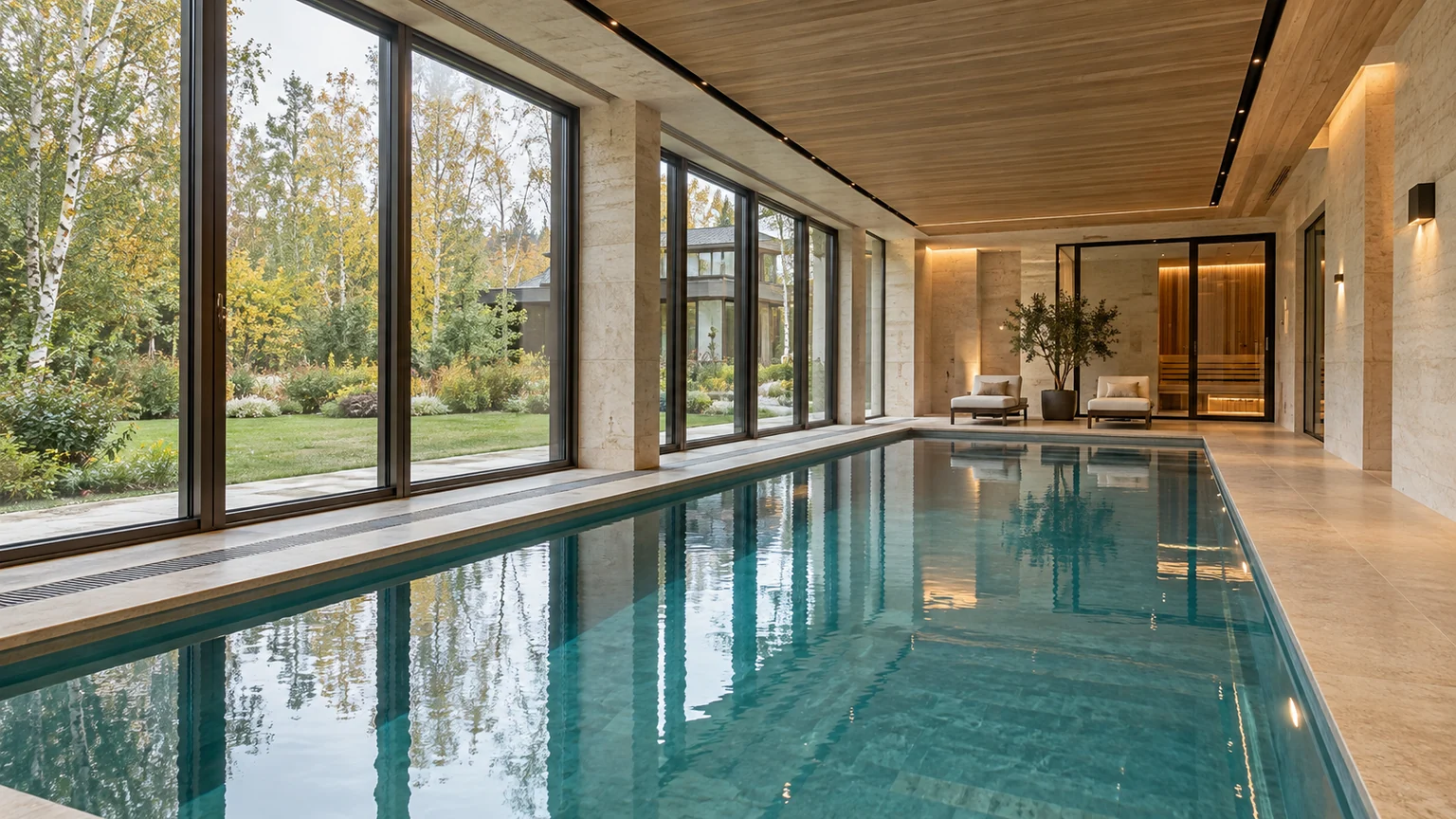
A pool is marketed as a finished amenity, but a buyer should treat it as a separate engineered asset within the purchase. Clear water and new finishes do not establish condition. The basin may hold water while concealed parts of the building envelope remain damp; a large dehumidifier may maintain one display reading without moving clean air across the water; recently installed treatment equipment may still lack a reliable as-built diagram or room for replacement.
Include the pool in the broader country-home due-diligence process, while appointing a pool specialist and a ventilation engineer for the technical work. This guide does not prescribe chemical set-points or replace a property-specific design. It shows what a defensible buyer deliverable looks like: a system inventory, measured operating evidence, service and incident history, a defect register, repair scenarios and an ownership budget tied to the actual plant and household pattern.
Define the asset before judging its appearance
Request plans and sections, basin construction details, overflow or skimmer design, hydraulic diagrams, pump and filter schedules, air-handling and dehumidification design, electrical information, control logic, commissioning records, equipment manuals and service history. For an altered installation, build a chronology: what was original, which components were replaced and who changed the control strategy.
The inventory extends beyond the water. It covers the balance tank where applicable, make-up and drainage arrangements, pumps, filtration, heating, dosing, UV or ozone equipment if installed, dehumidification, supply and exhaust air, room heating, electrical distribution, controls, cover, showers and plant room. Where the pool shares plant with the house, show the responsibility boundary on the diagram.
- Reconcile records with equipment: model, serial data, duty and the actual number of installed units.
- Test maintainability: establish whether a pump can be removed, a filter opened and a heat exchanger isolated safely.
- Record the use case: year-round or seasonal use, household pattern, water temperature, water features, spa functions and cover use.
- Separate ownership from service: identify rented equipment, remote subscriptions and obligations under specialist contracts.
The homes-with-pools collection is a useful shortlist, but one catalogue attribute covers very different assets. An outdoor summer basin, a compact spa and an indoor year-round pool require different investigations and have different operating profiles.
Inspect the basin and building envelope together
The specialist should examine accessible basin surfaces, joints, penetrations, overflow channels, movement locations and areas beneath deck edges. The task is not limited to finding an active leak. Look for movement, recurrent grout work, debonding, deposits, corrosion around embedded items, local repairs and unexplained level differences. A recently repaired joint deserves a documented explanation, not an automatic pass or fail.
Water loss cannot be inferred from one pencil mark over a few hours. Evaporation, backwashing, splashing, automatic make-up and the balance tank all affect the observed level. A valid test must isolate relevant causes and record plant state and duration. If the seller says the basin is watertight, ask for a dated method and result.
Continue into the room: glazing, roof, ceiling, external walls, interfaces, metalwork and accessible concealed spaces. Odour, darkened sealant, lifted finishes or corroded fixings are prompts for investigation, not diagnoses. Thermal and moisture instruments are useful only when environmental conditions and assembly details support interpretation. This is the same discipline used when looking beyond expensive finishes at older services.
Test air at the water, glazing and doors
An indoor pool creates a persistent moisture load. Dehumidification, room heating, outside air, exhaust and distribution must operate as one system. One relative-humidity reading in the middle of the hall says little about a cold glazing edge, roof corner, furniture recess or door into the residential accommodation.
The current CDC Model Aquatic Health Code addresses public aquatic venues; it is neither Russian law nor a private-home design code. Its engineering logic is nevertheless useful for structuring questions: the envelope is designed against condensation, materials and ductwork must tolerate a moist chemically active environment, and air balance should not export contaminated air into adjacent spaces. The designer responsible for the house must identify the current Russian rules and property-specific parameters that actually apply.
Ask for a test under a representative operating condition, including active water features and an open cover where relevant. Record outside conditions, water and air temperature, humidity at several locations, damper positions and operation of fans, dehumidification and heating. Professional airflow measurement or controlled smoke visualisation can reveal direction and short-circuiting. Air needs to reach vulnerable surfaces and follow the intended exhaust route.
- look for glazing condensation, cold bands and evidence from the overnight mode;
- check whether pool odour reaches bedrooms, wardrobes or the entrance hall;
- test supply and exhaust with doors closed and at different operating stages;
- confirm what happens when one unit stops and whether an alarm is delivered;
- inspect heat exchangers, filters, condensate drains and sensors for maintenance;
- obtain control trends rather than relying on the current screen value.
CDC notes that moisture removal does not necessarily provide enough clean outside air or exhaust chloramine-laden air. Chloramines can accumulate near an indoor water surface when airflow is poor. A strong “chlorine” smell is therefore not proof of vigorous sanitation; it is a reason to investigate water balance, use and ventilation together.
Follow the water through the treatment system
Build a simple process diagram: draw-off from the basin, balance tank for an overflow system, strainers, pumps, filtration, heating, any supplementary treatment, chemical dosing, returns, make-up, backwash and discharge. Mark flow direction, normal valve positions, sample points and interlocks. If the route can be explained only from one contractor’s memory, operation carries a continuity risk.
A laboratory report and a controller screen answer different questions. A laboratory result concerns a defined sample and method. A controller reports its sensor at one location and depends on cleaning and calibration. A manual test offers a practical cross-check. The buyer needs consistency among them, supported by dosing, make-up, backwash and incident records.
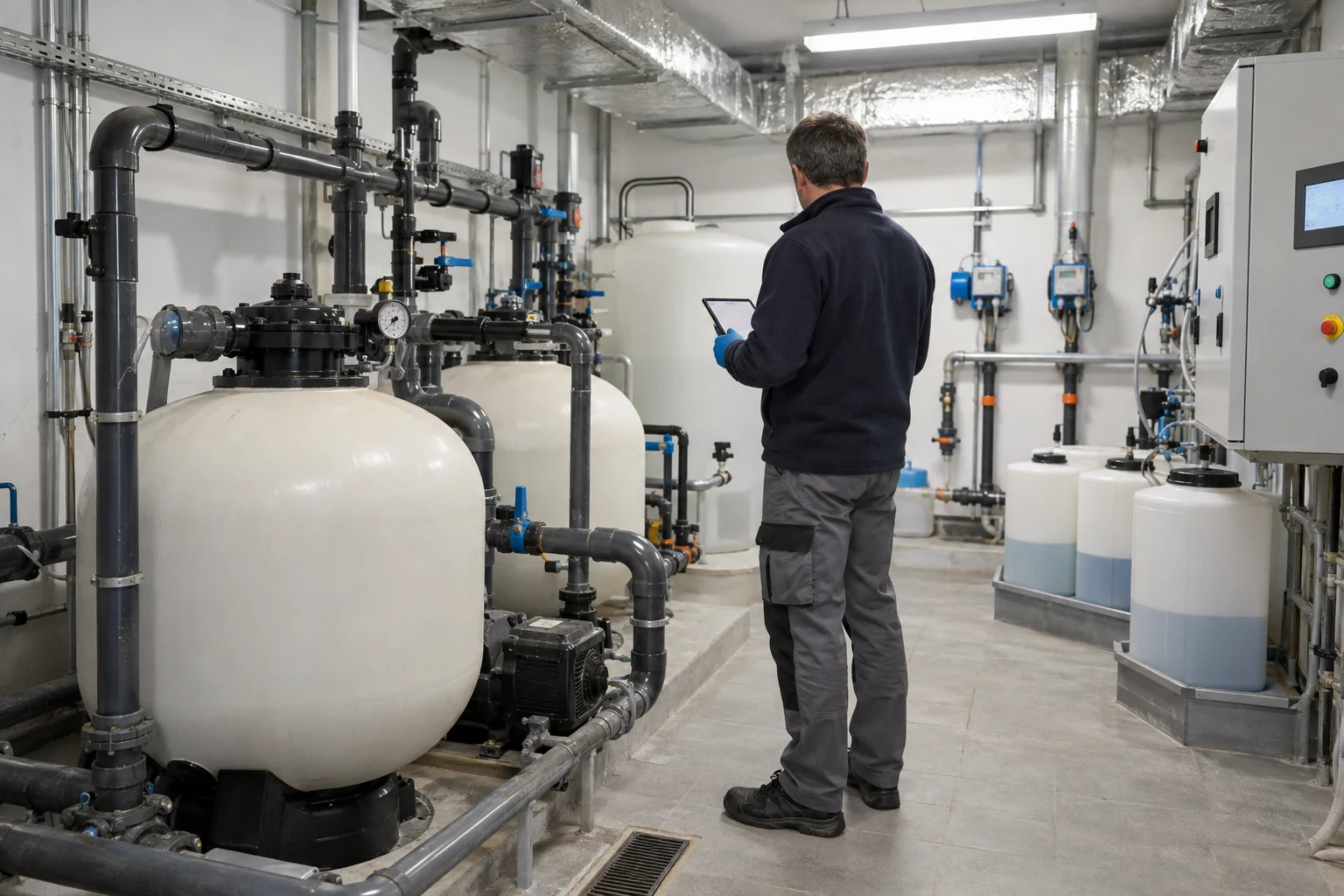
Do not grade the installation by its technology labels. UV, ozone, automatic dosing or cloud monitoring cannot replace sound circulation, filtration, water renewal and chemical control. Ask the specialist which functions are active, what measured outcome each delivers, what happens when flow is lost and how the installation reaches a safe state.
Russian public-pool guidance discussed by Rospotrebnadzor includes laboratory control of water, microclimate and air. A private home has a different legal and operating context, so public-facility requirements must not be copied blindly. The underlying discipline still helps a buyer: visible clarity is not a measurement, and an appropriate baseline analysis should be agreed with a competent laboratory for the actual source water, treatment process and users.
Make the plant room safe and maintainable
Inspect the plant room without accepting cosmetic excuses. Review floor drainage, ventilation, lighting, corrosion, leaking joints, cable condition, electrical protection and emergency isolation. Operate pumps across the agreed modes, collect meaningful readings and compare them with the design. Noise and vibration need a cause, not a subjective label.
Chemical storage requires its own review. Current CDC safety guidance emphasises physical separation of incompatible products, protection from moisture and heat, original labelled containers, ventilation, restricted access and stopping chemical feed when circulation flow is absent. It is US public-venue guidance, not a ready-made rule for a Russian residence; current local requirements and manufacturer instructions govern the installation. Even so, open acid beside a chlorine product, an unmarked container or dosing without a flow interlock is an obvious reason to stop acceptance and involve a qualified operator.
- safety data and supply records are available for every treatment product;
- incompatible materials are physically separated and protected from water;
- each dosing line can be traced unambiguously to its injection point;
- loss of circulation prevents further dosing;
- service access does not require stepping over open vessels or live cabling;
- trained staff can reach protective equipment, emergency contacts and the response procedure.
Run functional tests, not a guided tour
Agree a controlled operating script. Check circulation pumps, filtration and pressure conditions, water heating, make-up, balance tank, level controls, dosing, lighting, counter-current equipment and every installed feature. Then simulate only failures permitted by the manufacturer and responsible engineer, such as a pump stop, sensor loss, abnormal level or power interruption. The purpose is to observe interlocks, alarms and recovery, not to improvise an unsafe stress test.
Controls must be understandable beyond the original integrator. Request a set-point and access schedule, alarm history, trends for key variables, a configuration backup and the remote-support arrangement. Determine whether essential safe operation continues without a cloud service, SIM connection or previous owner’s account. Credentials and remote permissions should be changed through a documented handover.
For year-round operation, add a cold-weather scenario to the wider country-house winter-readiness review. What happens during freezing weather if utility power, heating or one critical unit fails? Which circuits sit on backup power, how does the plant restart and could simultaneous starting overload the system? Verify answers through diagrams, settings and a supervised test.
Build ownership cost from measurable drivers
There is no universal service cost. It depends on water volume and surface area, temperatures, agitated water features, cover use, source-water quality, household schedule, ventilation design, energy prices, equipment condition and service model. A seller’s statement that the pool “costs almost nothing” has no value without bills and operating records.
Collect monthly evidence for a representative period: electricity and heating fuel, make-up water and discharge, chemicals, laboratory work, routine service, consumables and repairs. If the pool lacks sub-metering, the engineer can construct an estimate from rated duty, measured operation and run-time data while showing uncertainty as a range. Compare covered and uncovered operation, ordinary swimming and water features, active seasons and standby.
- Routine operation: energy, water, treatment products, testing, cleaning and scheduled service.
- Planned components: filter media or elements, seals, sensors, dosing tubes, lamps and other manufacturer-scheduled items.
- Capital reserve: pumps, dehumidification, heat exchange, controls, basin finishes and remediation of affected building fabric.
- First-year exposure: deferred maintenance, uncertain leakage, unavailable spares and reconstruction of missing records.
Tie every major allowance to a defect, scope, contractor evidence and equipment lead time. A percentage of the purchase price is not a pool budget. Where discharge or leakage interacts with the site, combine this work with the plot drainage and seasonal-water assessment; never assume an unidentified outlet can accept additional flow.
Convert findings into purchase and handover terms
The final report should separate safety, risk to the building, comfort, efficiency and appearance. Each item needs an observation, evidence, inspection limitation, proposed action, responsible discipline and budget basis. The buyer can then decide whether the seller remedies it, provides a record, permits a repeat test, accepts revised terms or leaves an unacceptable residual risk.
The handover inventory includes installed plant, spares, chemicals, tools, covers, cleaning equipment, keys, accounts and contracts. On handover day, record water and air readings, meters, tank levels, active alarms and equipment state. Do not automatically inherit every contractor permission: responsibility and remote access should be granted afresh.
A concise decision gate:
- as-built diagrams match the installed system;
- the basin and envelope have been assessed, with unexplained moisture carried as an explicit risk;
- ventilation, dehumidification and heating have been tested under representative load;
- water quality is supported by measurements and an intelligible operating record;
- the plant room is safe and major components can be replaced;
- controls respond correctly to loss of flow, power and sensor signals;
- the annual budget uses actual drivers and separates capital replacement;
- defects, documents, access and included equipment are reflected in transaction and handover records.
When comparing properties in the country-home catalogue, treat the pool not as another room but as a connected system of water, air, structure, energy, chemicals and skilled service. A well-operated installation delivers comfort without constant anxiety. A poorly documented one transfers concealed moisture, uncontrolled water and contractor dependency to the buyer. The audit does not need to prove perfection; it needs to make condition, uncertainty and the true ownership commitment visible before completion.