How to Assess a Country-House Landscape After Its First Winter
A first winter exposes how levels, drainage, paving, planting and irrigation work together. This guide turns the spring inspection into a documented technical review rather than a cosmetic walk-through.
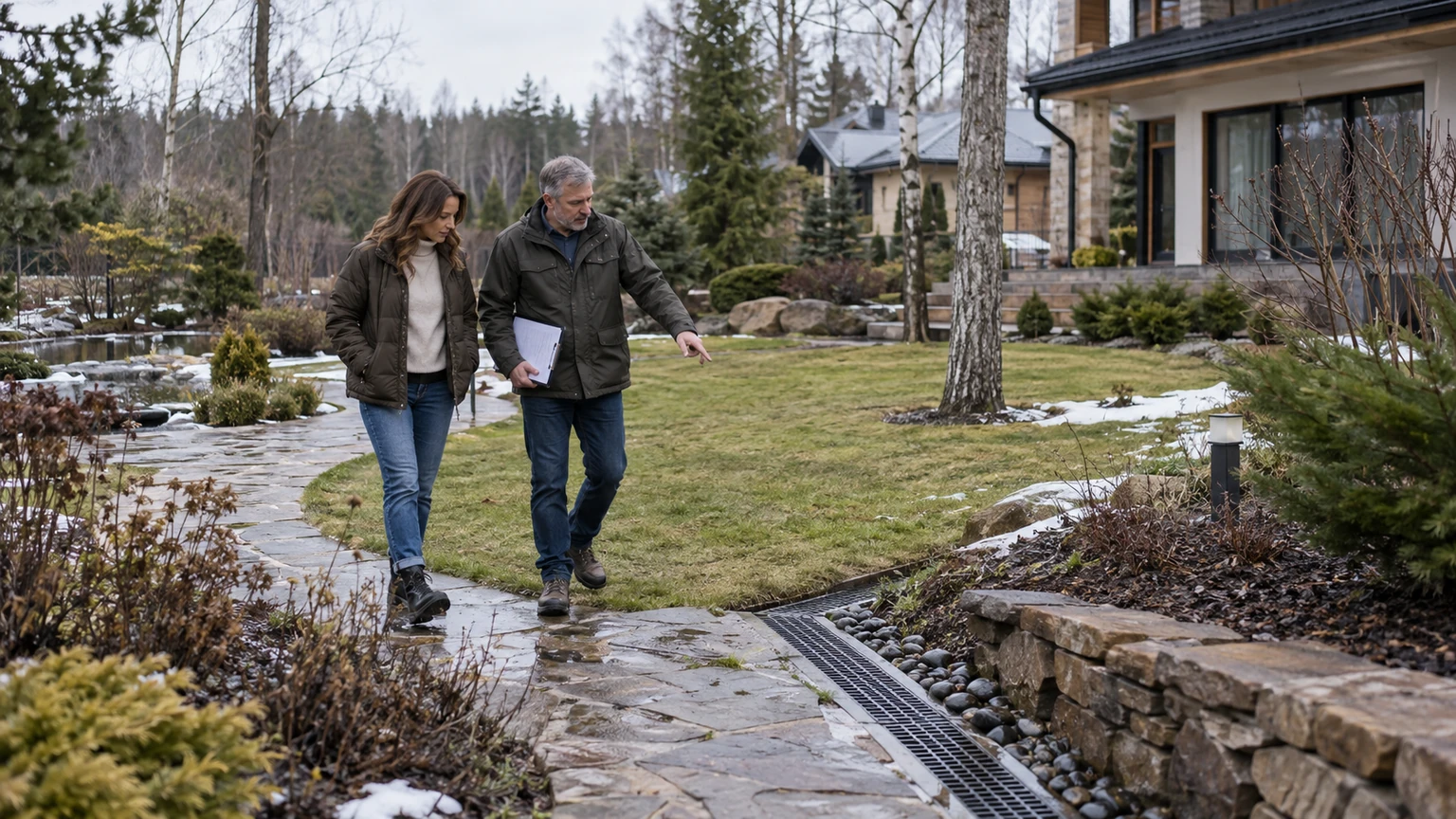
A new or recently rebuilt country-house landscape should not be judged only from a July photograph. Snow loads, freeze-thaw cycles, spring runoff and the restart of seasonal systems create its first genuine operating cycle. Local settlement, ponding, erosion, displaced edging, weak turf and planting damage become easier to identify.
One winter is not a universal warranty and does not prove long-term durability. A mild season may leave a weak detail untested, while unusual weather can produce an isolated symptom. The buyer’s task is therefore not to pass or fail the garden during one visit. It is to connect visible evidence with the design, as-built information, maintenance record and conclusions of appropriately qualified specialists.
This guide treats a completed landscape as one operating system. If the central concern is groundwater, drainage or protection of the building, use the dedicated guide to water, levels and seasonal plot risks. Where mature trees define the property, commission a separate dendrological inspection of the site. The narrower question here is how all landscape layers performed together through their first winter.
Treat the first winter as a test of interfaces
A convincing garden is more than its plants. Its performance depends on grading, compacted bases, surface-water routes, paving construction, soil preparation, plant selection, irrigation, lighting and access for maintenance. Failure in one layer often appears in another: a bad fall may look like failing turf, a blocked outlet like an unusually wet spring, and settlement above a service trench like a wave in the paving.
Russia’s current SP 82.13330.2016 addresses the design and combination of landscape-improvement elements. Its application to a particular private plot depends on the project, contract and professional advice, but its systems logic remains useful: surfacing, planting and runoff should not be accepted in isolation. SP 104.13330.2016 concerns engineering protection from flooding and waterlogging. It does not turn a visual survey into an engineering calculation; it reinforces the need to escalate material water risks beyond cosmetic repair.
Build an evidence file before the walk-through. Request the general arrangement and levels, grading strategy, paving plan, planting plan and schedule, drainage and surface-water layout, irrigation and external-lighting routes, as-built drawings, hidden-work records, equipment manuals, warranties and maintenance logs. Where documents are missing, record that uncertainty explicitly in the report and the transaction conditions.
- Design intent: what was meant to be formed, built and planted.
- As-built condition: where pipes, chambers, cables and outlets actually lie.
- Operation: when winterisation, recommissioning, pruning, treatment and repair occurred.
- Observed events: photographs after rain, thaw, snowmelt and irrigation start-up.
- Responsibility: who designed, installed, maintained and is authorised to approve remedial work.
Map symptoms before discussing remedies
Begin with observation rather than instant diagnosis. Plot standing water, cracks, settlement, erosion, displaced elements, exposed roots, missing plants, bark damage, weak turf and evidence of recent patching. For each item, take a context image, a mid-range view and a close detail. Record the date, weather and recent irrigation state.
Divide the grounds into catchments and operating zones: arrival court, terraces, lower ground, lawns, woodland edge, children’s area and service route. The same symptom has different significance in different locations. A short-lived wet patch in a remote hollow and water beside a lightwell or building threshold deserve different priorities.
Do not conceal a symptom before its mechanism is understood. Adding soil can alter a fall, new turf can hide waterlogging, and sealing the visible joint can redirect water into the construction. A competent specialist should set out plausible mechanisms, choose the relevant test and only then specify the intervention.
- Reference every issue to the plan and a permanent site feature.
- Separate observed fact from a seller’s or contractor’s explanation.
- Look for repetition along one level, trench or service route.
- Compare the location with the as-built information.
- Schedule a repeat observation after rain, irrigation or drying.
Follow water from the roof to a verifiable outlet
After snowmelt, do not begin with the largest puddle. Begin with the water sources. Trace downpipes, terrace and driveway channels, gullies, inspection chambers, open swales and final outlets. The route should remain intelligible and maintainable; water should not disappear into an undocumented pipe that nobody can inspect.
Check whether site levels direct runoff towards the plinth, external stairs, garage, lightwells or plant rooms. Inspect the plot boundary as well. A private drainage scheme should not simply export the problem to a neighbour or a shared road without a lawful and technically appropriate connection. Pumped systems need access, power, alarm logic, a failure scenario and a clear maintenance routine.
Read traces together. A silt line records an earlier water level; a scour indicates concentrated flow; a wet strip over a buried route may suggest leakage or blockage; a chamber that remains full deserves a review of levels and discharge. None of these observations establishes the cause on its own.
When purchasing, include the garden in the wider technical and legal due-diligence process. Responsibility is particularly important where a private system meets community infrastructure. Obtain the connection drawing, legal basis, maintenance contact and known incident history.
Inspect levels, paving and retaining structures
Winter reveals geometry as well as water behaviour. Walk hard surfaces slowly. Record rocking units, steps between adjacent slabs, open joints, settlement above services, displaced kerbs and falls that have changed beside entrances. Pay particular attention to interfaces with steps, terraces, aprons, gates and access covers, where different bases and structures meet.
Distinguish patina from loss of function. Colour variation in stone may be a material or maintenance matter; a rocking slab or reverse fall can create an operating risk. Ask for the base build-up and hidden-work documentation. Where a specialist recommends it, one agreed trial opening can be more informative than repeated assurances.
Review retaining walls together with soil and drainage. Cracking, rotation, bulging, efflorescence, erosion at the toe or persistent wetness behind cladding calls for assessment of the structure and its drainage layer. Repointing a visible joint does not explain ground movement. Restrict loads and obtain structural or geotechnical advice where deformation is material.
Use a measured survey when a dispute concerns levels, falls or movement. Visual impressions of “flat” or “unchanged” are unreliable on a large, modelled plot. A baseline and repeat survey can separate real movement from perception.
Use turf and soil as system indicators
Spring turf can be uneven for many reasons: snow cover, ice, waterlogging, compaction, disease, soil structure, shade, traffic, nutrition or irrigation error. Colour alone is not a diagnosis. Map the affected areas and compare them with topography, irrigation zones, winter routes and snow-storage locations.
With the owner’s permission, inspect a soil profile at several representative points. Compare the depth and structure of the growing layer, moisture, odour, debris, compaction boundaries and root condition. Laboratory testing should answer a defined question and be interpreted by an agronomic specialist; a generic panel of numbers rarely explains a landscape failure by itself.
Study the turf edge beside paving and beds. Raised soil can retain water against a surface, low levels can create a vulnerable step and drying edge, while a washed-out boundary can disclose runoff or a failing base. Linear settlement above buried services often points to trench reinstatement rather than the quality of the turf itself.
- Do not order wholesale returfing before checking water, soil and maintenance.
- Compare sunny and shaded areas as separate environments.
- Record the irrigation programme that actually ran, not merely the controller screen.
- Identify winter foot traffic, machinery routes and snow storage.
- Separate reinstatement from removal of the underlying cause.
Assess plants without forcing an early diagnosis
After winter, inspect tree stability, the position of the root flare, supports and ties, bark damage, unions, dead wood and machinery scars. Mulch should not conceal the trunk from inspection. A leaning tree needs an assessment of root-ball movement and ground cracking, not simply tighter ties.
Bud break varies by species, cultivar, microclimate and year. A leafless plant on one inspection date cannot automatically be declared dead. Confirm its identity, inspect living tissue, compare it with equivalent plants and observe change where necessary. The active GOST R 71473-2024 provides current Russian landscape-architecture terminology; consistent language helps make a defect schedule precise and reduces arguments about what was observed.
Reconcile the planting schedule with the site, but do more than count plants. Check whether each species has credible space, light and water conditions, and whether roof snow, de-icing material, vehicles or ponding place it under repeated stress. Involve a dendrologist or arborist where a valuable mature tree is unstable, split, badly wounded or capable of harming a person or building.
Commission irrigation as a complete system
Winterisation and spring recommissioning should appear in the service record. Before operation, inspect the source, pump, filters, pressure-control equipment, valve boxes, controller and visible parts of the main line. Run one zone at a time and observe pressure, overlap, direction, leakage, drainage and wind exposure rather than admiring a single working sprinkler.
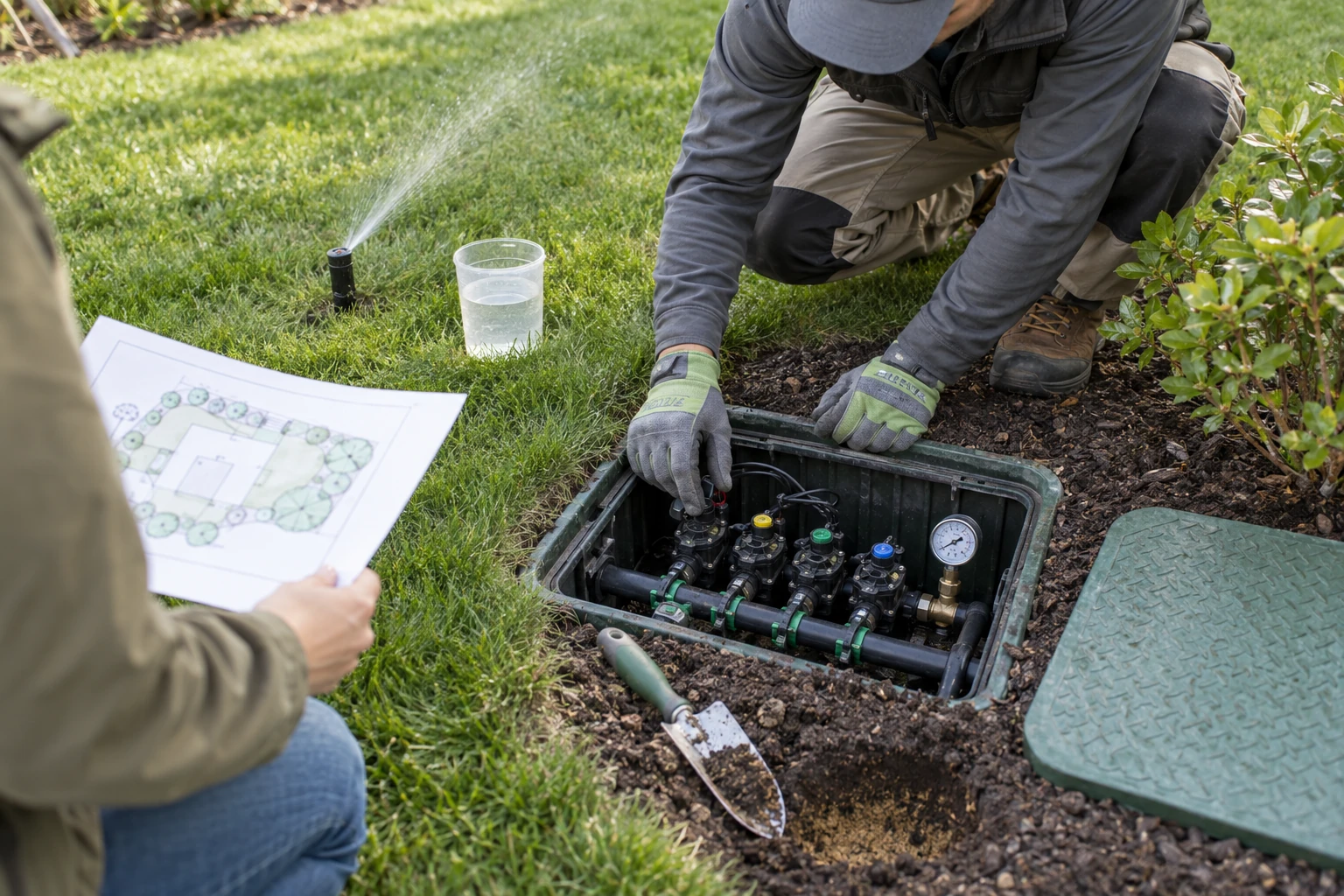
A controller schedule does not prove even delivery. Where coverage is disputed, a specialist can use collection vessels, boundary observation and measured flow. Treat lawns, shrubs, trees and shaded planting as separate horticultural conditions rather than forcing them into one automatic routine.
Match each valve zone to the as-built drawing. An undocumented system that requires random excavation for every repair is poorly maintainable even when it works today. Record isolation valves, drain or blow-out points, sensors, spare lines and the method of manual control when automation fails.
Operate the system only after obvious leaks have been addressed and within the capacity of the water source. Do not increase pressure for a dramatic demonstration or leave a newly restarted system unattended. Where design flow, pressure or supply is in doubt, use an irrigation engineer rather than a visual judgement of spray.
Include lighting, access covers and service logistics
Inspect external lighting both in daylight and at dusk. Run groups, scenes and sensors; look at housings, supports, junction locations and cable entries. Moisture traces, leaning fittings, unstable protection or damaged insulation require an electrician. Do not open sealed electrical assemblies or make measurements without the right competence.
Drainage, irrigation and electrical covers should open, remain visible and sit at levels that do not funnel water into them. Establish whether a pump, filter or valve can be removed without destroying paving and planting. High-quality landscaping does not eliminate technical infrastructure; it integrates it safely and legibly.
Walk the maintenance route. Where are tools and arisings stored? How can a replacement tree reach its planting area? Can a service vehicle approach without rutting the lawn? Who isolates irrigation and lighting during an incident? A garden that requires damage every time it is maintained is not operationally mature.
Separate defects, seasonal care and a changed brief
Bring the survey into one schedule without mixing distinct obligations. An installation defect is a departure from the design, contract or agreed standard. Seasonal care belongs to ordinary operation. A change of brief occurs when the owner wants a different use even though the original work is sound. Keep insufficient evidence as a separate category rather than inventing a cause.
- Fact: what is visible and where, supported by a location and image.
- Risk: what could be affected and how urgently action is needed.
- Test: which document, opening, measurement or specialist is required.
- Cause: confirmed, probable or not yet established.
- Response: repair, monitoring, maintenance or redesign.
- Acceptance: the measurable basis for closing the item.
Cost work only after identifying the mechanism. An apparently similar wet patch might call for channel cleaning, correction of levels, pipe repair or a revised drainage strategy; liability and cost differ radically. When comparing homes in the country-property catalogue, do not transfer a remedial allowance from one plot to another without evidence.
Final first-winter checklist
- Collect the design, as-built drawings, hidden-work records, manuals and service history.
- Undertake a dry inspection and a separate visit after rain or active snowmelt.
- Map every symptom and keep observation separate from explanation.
- Trace water from roofs and hard surfaces to a maintainable outlet.
- Check levels, interfaces, settlement, retaining work and buried-service routes.
- Compare turf condition with soil, topography, shade, traffic and irrigation.
- Refer valuable or potentially hazardous trees to the correct specialist.
- Run irrigation by zone and record components, pressure, coverage and leaks.
- Test external lighting, covers, equipment access and service circulation.
- Separate defects, routine care, client changes and unknown mechanisms.
- Assign responsibility, timing, remedial design and a reinspection criterion.
- Translate material findings into the transaction, warranty claim or works plan.
The first winter matters because it turns a decorative composition into an observable operating system. A sound landscape need not look immaculate on the day the snow disappears, but it should have controlled water routes, stable bases, viable planting, accessible engineering and a defensible maintenance history. Whether viewing homes on the Rublevo-Uspenskoye corridor or along Novorizhskoye Highway, treat the grounds not as scenery but as a living and engineered asset in their own right.