Country-Home Backup Power: Generator, UPS and Failure Scenarios
A buyer's practical framework for mapping essential circuits, checking the transfer path and testing a house's generator-and-UPS arrangement without unsafe improvisation.
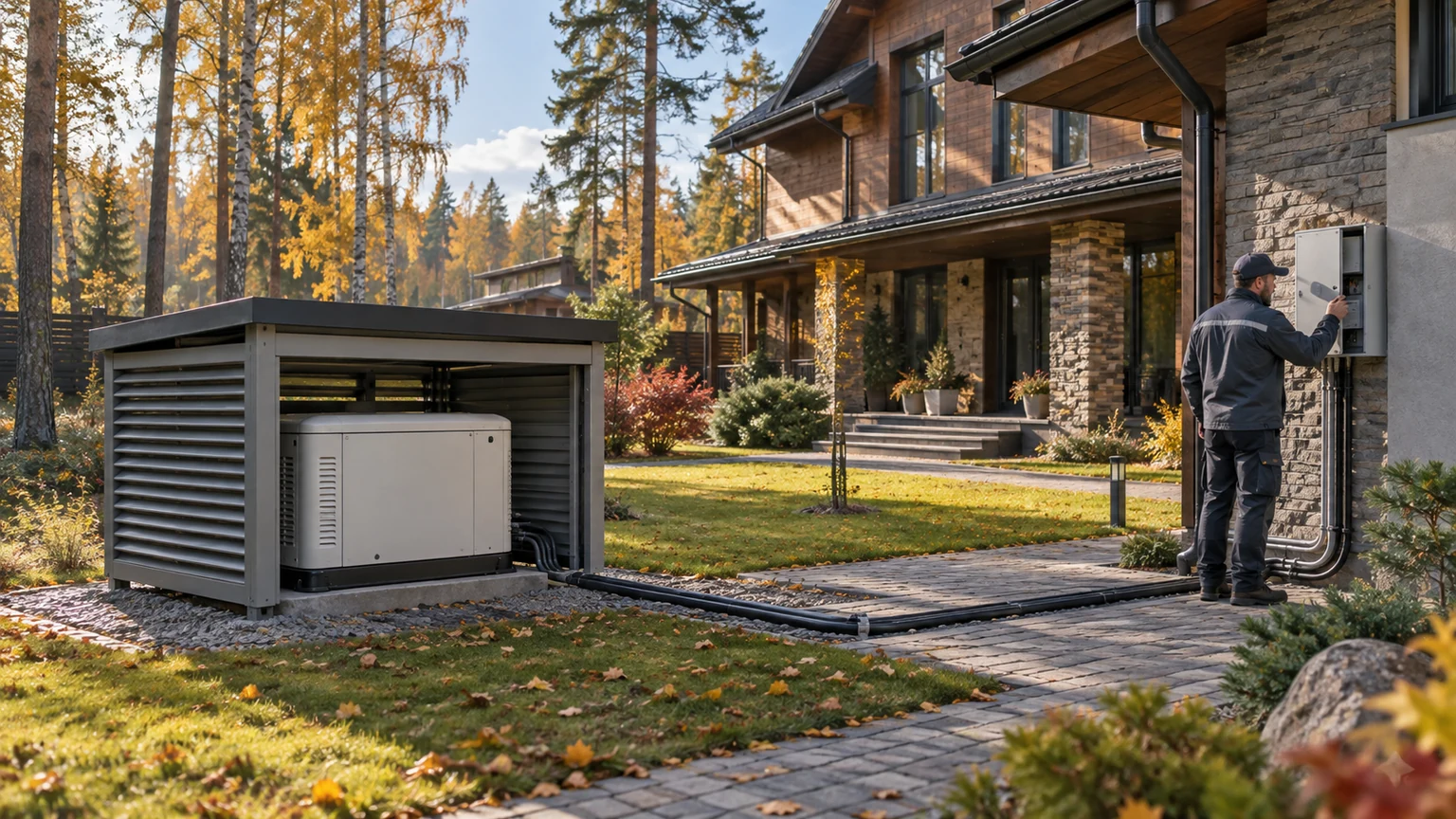
A generator on the grounds is not proof that a house will remain usable during a grid outage. Power must pass through a transfer device, distribution boards, controls, batteries and deliberately selected circuits. A running engine can coexist with a dark boiler room or a disconnected router if one link fails. The useful question for a buyer is not the generator's headline rating but which household functions survive each failure scenario and what evidence supports that claim.
This is a focused backup-power assessment, distinct from the broader inspection of concealed country-house systems. It gives an international buyer a practical way to brief the seller and an electrical specialist. Equipment manuals and a site-specific Russian design govern the installation; overseas safety guidance cited below is informative, not a substitute for local compliance review.
Map essential functions before selecting equipment
Work backwards from what the household must retain. A heating system may depend on a controller, pumps, valves and auxiliary equipment, not merely the boiler. Water supply may need a pump and its controls. Access and security involve gates, door releases, alarms and manual alternatives. Connectivity depends on the router and the equipment on the premises. A larger residence may have ventilation, drainage, fire notification or a dedicated server room. Establish actual electrical dependencies from drawings and site observation rather than guessing from a system's name.
Classify loads as uninterrupted, able to tolerate a short transfer pause, or deliberately shed during an outage. A decorative lighting circuit or EV charger is not automatically essential; a small controller may be. Ask the electrician to identify the exact circuit and protective device behind each function, normal demand, starting demand where motors are involved, and what happens if several devices restart together. Distinguish an essential function from the owner's preference to keep every amenity operating.
- Request a current single-line diagram and a clearly identified critical-load board.
- Record each function, its supply circuit and the interruption it can tolerate.
- Flag motors and pumps for a specialist's start-up-load review.
- Find out which loads will be shed automatically and which require an operator.
For homes along Rublevo-Uspenskoye Highway or the Novorizhskoye corridor, compare the tested configuration and maintenance record of each property. Geography does not tell you whether that particular house has a workable transfer scheme.
Understand the different jobs of a UPS and a generator
A UPS uses its battery to keep selected equipment operating through a loss of supply or a transition. The generator is a separate source that must start, stabilise and be connected by suitable switching. One does not prove the performance of the other. A router remaining online for a brief UPS test says nothing about the battery after it is depleted; an engine starting says nothing about whether the connected UPS accepts generator power.
Schneider Electric's UPS selection guidance separates load capacity from runtime: adding connected devices reduces available battery operating time. For the installed model, check both watt and VA ratings, actual load, battery condition, input tolerances, output characteristics and the manufacturer's guidance for the protected devices. A desktop UPS cannot be assumed to support a boiler controller or motor circuit. The design engineer should reconcile each device with its own manual and the installed electrical arrangement.
Schneider Electric also documents cases in which generator output quality makes some UPS models alternate repeatedly between generator input and battery. A complete demonstration therefore includes the actual handover: grid loss, UPS continuity, generator start, transfer, UPS acceptance of the new supply and subsequent battery charging. Read the event log rather than relying on engine noise or a dashboard icon.
Trace the transfer path and the critical circuits
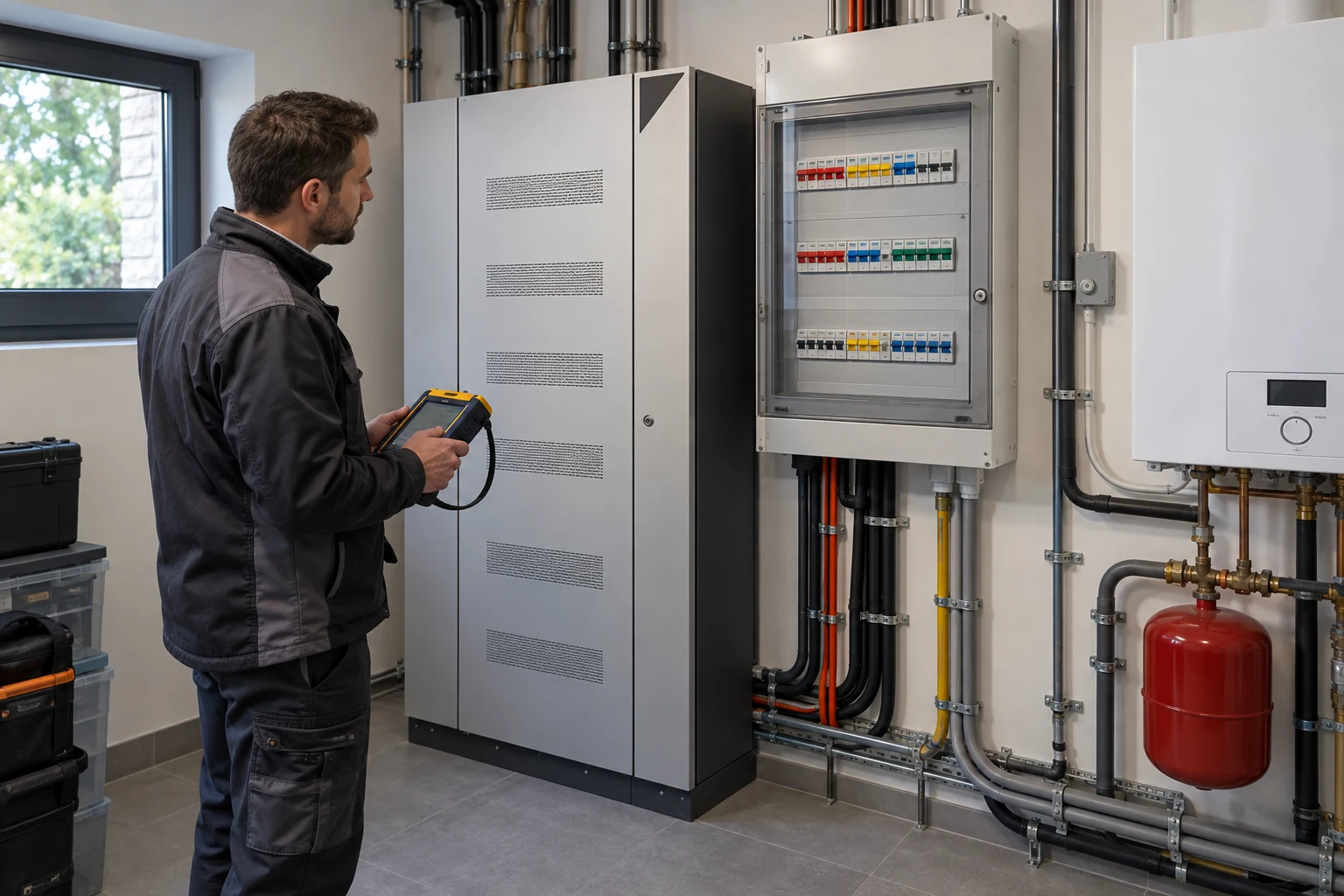
Have a qualified electrician follow the path from the utility intake to the loads. The file should contain an up-to-date single-line diagram, panel labels, location and type of transfer device, the protected-circuit schedule and a defined manual procedure if automation fails. The arrangement must prevent dangerous feeding back into the public network and return safely to normal supply. Plugging a generator into a household socket is not a valid substitute for engineered switching and creates serious hazards.
Multiple feeds, phases or outbuildings require explicit treatment: which source supplies which circuit, what fails when only one feed is lost, and what happens if the transfer device itself fails? Compare the drawings with additions made after refurbishment. A smart-home display may report status, but it cannot establish that the underlying wiring is correct. The buyer can witness a documented test; only a competent professional should open panels, isolate supplies or conduct measurements.
A broader seasonal review of heating, insulation and services is covered in the home winter-readiness guide. Here the question is narrower: will the selected electrical dependencies remain available when normal power is unavailable?
Assess generator placement as a safety issue
Russia's Ministry of Emergency Situations warns that generators produce carbon monoxide and calls for attention to the equipment manual, moisture and electrical safety. The CDC warns against operating portable generators inside a house or garage even with openings ajar, recommends outdoor placement away from openings and air intakes, and advises battery-powered or battery-backed CO detectors in the home. CDC placement guidance is not a universal Russian statutory clearance for every permanently installed unit. Ask the local designer to assess the specific model, exhaust direction, nearby openings, prevailing wind and applicable local requirements.
Inspect ventilation, maintenance access, protected outdoor siting or a properly designed generator space, exhaust routing, fuel arrangements and noise in relation to bedrooms and neighbours. A decorative enclosure must not obstruct airflow. Check whether snow or leaves can block vents and who is responsible for servicing the machine. Do not infer safe fuel storage or emissions performance from a marketing photograph: request the installation design and specialist sign-off.
Test several failures, not a single successful start
Agree a scenario protocol with the owner and service provider. The test record should identify the starting battery condition, connected loads, date, instruments, switching events, continuity of essential functions and anything that could not be tested. No fixed autonomy duration should be promised from tank size or equipment ratings alone: usable fuel, consumption under real load and battery health need verification. A short safe demonstration may show transfer behaviour while a longer endurance claim still needs separately evidenced calculations and operating records.
- Grid disappears: which functions remain live immediately and what does the UPS log show?
- Backup starts: does the generator start and the transfer device connect the agreed circuits?
- Running under load: does the UPS accept generator power, and do heat, water, communications and security remain stable?
- Start fails: which functions can the battery support, and who is notified?
- Grid returns: do switching, generator shutdown and battery charging follow the intended sequence?
Also establish the manual fallback procedure and who is authorised to operate it. Remote monitoring is valuable, but it does not repair a failed contactor or replenish fuel. For an intermittently occupied residence, assign named responsibility for exercising the generator, reviewing UPS alarms, servicing batteries and responding to an outage.
Translate the findings into a purchase decision
Request the generator and UPS manuals, design and as-built drawings, commissioning and test reports, transfer-device documentation, battery replacement records, incident logs and service agreement. Ask to see faults as well as successful routine tests. Confirm that controller access and alerts can be transferred to a new owner, with live credentials handled securely at handover rather than sent through a general email chain.
Build a concise decision register: confirmed functions, untested scenarios, safety concerns, repair needs and design limits. For each, state the evidence, consequence and next step. A contractor can quote a defined remediation or upgrade only after critical circuits and continuity requirements are clear. Buying a larger generator will not solve a failing transfer switch, incompatible UPS input or a deteriorated battery. Treat unsupported claims of whole-house autonomy as questions to resolve, not facts to include in the price.
Resilience is a verified chain of essential loads, protective devices, sources, switching and people capable of maintaining it. The strongest house is not necessarily the one with the largest generator, but the one whose outage behaviour is understandable, safely tested and properly documented.