Monitoring Cracks in a Country House: A Practical Geodetic Programme
A defensible crack-monitoring programme connects defect mapping, repeatable geodetic measurements, operating conditions and agreed response actions instead of relying on occasional photographs.

A crack in plaster, masonry, a plinth or a structural joint is an observation, not a diagnosis. Similar-looking marks can arise from finish shrinkage, thermal movement, moisture, foundation displacement or the response of a load-bearing element. One photograph and one ruler reading cannot establish cause or safety. A competent programme first identifies the structure and credible mechanisms, then selects measurements capable of testing those hypotheses.
Russia's GOST 31937-2024 provides a framework for condition surveys and monitoring of buildings, while SP 22.13330.2016 addresses soil bases and deformation observations and SP 47.13330.2016 covers engineering-survey information. For an owner, the useful lesson is not to apply isolated clauses personally. It is to commission a clear task: what will be measured, relative to which reference, at what accuracy, how frequently, who will interpret the series and which event will trigger action.
Monitoring complements broader country-house technical due diligence; it does not replace a structural survey. It is valuable when the cause remains uncertain, when an old stable defect must be distinguished from active movement, or when nearby loading, ground or drainage conditions have changed.
Separate observation from emergency response
Monitoring is appropriate only after a specialist has decided that continued observation is safe and informative. Sudden opening, falling material, an obvious geometry change, doors jamming together with new distortion, damage to a bearing detail, or movement after fire, impact, flooding or excavation requires immediate risk control and professional assessment. A measurement calendar must never become a reason to postpone necessary safety measures.
The opening visit connects each defect to the structural arrangement. Plans should identify materials, axes, openings, floor and roof supports, movement joints, extensions, below-ground spaces, retaining elements and service entries. Request design and as-built records, concealed-work evidence, repair history and operating events. Where the property has been altered, coordinate the investigation with the checks in our guide to buying a reconstructed house.
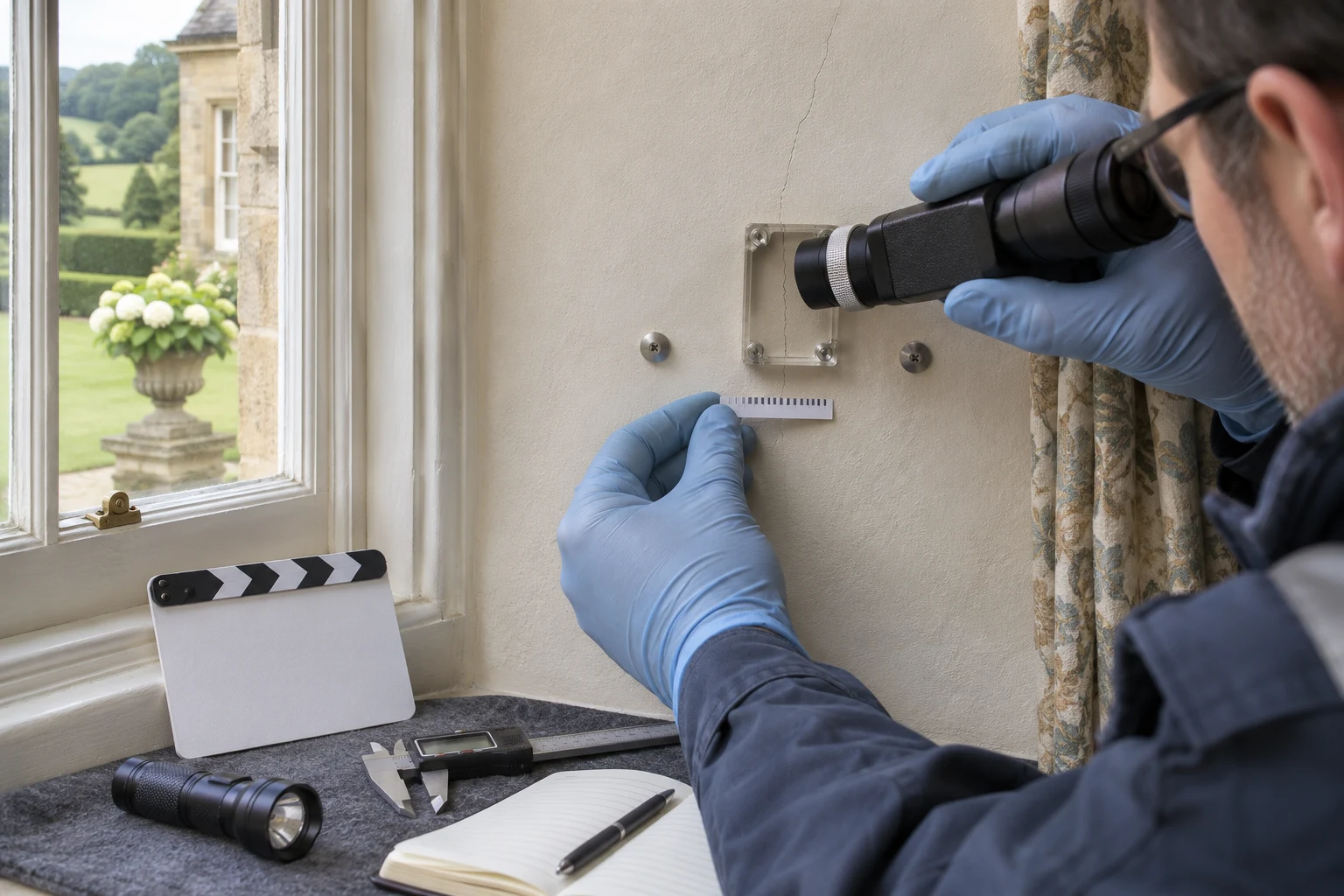
Create an individual record for every crack: identifier, exact location, orientation, extent, visible edge displacement, moisture, relationship to an opening or joint, discovery date and previous repairs. Photograph it from a repeatable position with scale and context. “Crack in the living room” is not an auditable location.
Turn concern into a measurable question
The programme begins with a question rather than an instrument. Is a particular crack still opening? Is one wing settling relative to another? Is a wall tilting? Is a retaining structure moving in plan? Does the change correlate with season, rainfall, drainage or neighbouring work? Each question needs different points, displacement components and observation periods.
Organise parameters into four groups:
- local defect: crack opening, edge shear and change in extent;
- element geometry: settlement, horizontal displacement, tilt, deflection or relative position;
- conditions: temperature, precipitation, moisture, water level, heating and drainage operation;
- events: excavation, vibration, leakage, freezing, load change, repair or system shutdown.
More data is not automatically better. The set should discriminate between possible causes. A local crack gauge records relative movement at its installation point, but does not prove whole-building foundation settlement. Conversely, façade levelling marks do not replace a close reading of a local joint.
Build a stable geodetic reference
Repeated observations are meaningful only against a stable reference. The surveyor designs control points outside the suspected influence area, monitoring marks on the building, sight lines and a coordinate and height transfer method. Points must remain accessible and protected from finishes, snow, landscape machinery and routine cleaning.
The brief should state the method, required result accuracy, instrument checks and calibration, observation geometry, acceptable visibility, repeat rules and closure processing. A change of contractor must not create an unrelated coordinate system. The archive needs the network diagram, mark descriptions and photographs, raw observations and reference data, not merely a chart.
On complex terrain, connect the programme to retaining structures, drainage and finished levels. Our guide to retaining walls on a sloping site explains why structure and water should be reviewed together. The instrument station itself must not be moving with unstable ground.
Set frequency from risk, not a generic calendar
There is no universal interval for every house. The initial frequency depends on condition, the expected rate of change, method accuracy and consequence. The programme then responds to evidence: a stable series may justify wider spacing, while acceleration can require shorter intervals, wider investigation or immediate action.
Define event-driven cycles as well as planned ones. Repeat observations may be appropriate after prolonged rainfall or snowmelt, local flooding, drainage repair, a heating-regime change, heavy work on the plot or nearby excavation. If a neighbouring project is the concern, establish a baseline before active work and coordinate it with the evidence described in our article on future construction beyond the boundary.
Record conditions for every cycle: date and time, indoor and outdoor temperature, precipitation, ground and drainage condition, point accessibility, repairs and unusual events. Without context, reversible seasonal response can be mistaken for permanent movement, or a genuine step change dismissed as weather.
Treat measurement uncertainty honestly
Every method has uncertainty. A report should therefore show not only the difference between two values, but the expected accuracy and quality of each cycle. If an apparent change is at the level of measurement noise, the defensible conclusion is that the data cannot yet support a confident statement.
Graphs are useful, but engineering interpretation still connects the trend with the defect map, structural inspection, ground information, water and operating events. A solitary anomaly calls for a review of raw files, mark condition, instrument setup and observation conditions. An inconvenient point must never be deleted without a documented technical reason.
Keep raw and processed information. Each cycle should retain field notes, instrument files, calculations, photographs, network diagrams, methodology version and a signed report. The owner needs an exportable archive that can be handed to another surveyor or structural engineer.
Agree response levels before data arrives
A threshold should not be copied from another property or based only on crack width. The designer or condition-survey engineer sets project-specific criteria for the element, material, structural arrangement and method. A practical matrix may distinguish routine observation, an unscheduled verification cycle, extended investigation with operating restrictions, and urgent safety action.
For each level, name the responsible person, notification route, permitted interim measures and authority to alter use. The surveyor is responsible for measurement quality but should not be expected to make a structural diagnosis alone. The structural engineer interprets the series with the survey evidence, while the owner or estate manager preserves access and marks and implements agreed actions.
The matrix must operate when the owner is unavailable. Contacts, backup communication, keys, room access and estate-manager authority belong in the operating procedure. This turns monitoring into part of property management rather than an isolated report.
Preserve evidence before repairing finishes
Filling a crack before investigation removes clues: edge form, staining, moisture, earlier repair layers and substrate relationships. If cosmetic work is necessary, first complete the map, photographs and specified measurements. Record repair material and date so that any recurring line retains a history.
A random brittle plaster tell-tale can only show its own failure; it does not create a reliable measurement series. Electronic sensors also need stable installation, range, power, communications, time synchronisation, backup storage and verification. A remote dashboard is useful only inside a validated programme.
Correct the cause after adequate diagnosis. The answer may be drainage restoration, movement-joint work, lintel repair, leak removal or designed strengthening of a specific detail rather than generic “foundation reinforcement”. When the base is in question, use the reasoning in our guide to assessing an existing foundation: one material test cannot describe geometry, ground, water and system compatibility.
How to accept the monitoring programme
Before work, the owner should receive a brief defining objectives, monitored elements, points, methods, accuracy, planned and event-driven cycles, and response levels. After the baseline cycle, expect a network and defect map, mark catalogue, raw observations, processed results, condition photographs and an engineering statement. Later reports should preserve the same structure and explain every methodology change.
Final checklist:
- safety and any urgent measures were considered first;
- each crack has an identifier and structural location;
- parameters answer a stated hypothesis;
- reference points have been checked for stability and protected;
- method accuracy can resolve a meaningful change;
- the schedule includes planned and event cycles;
- operating and environmental conditions accompany every result;
- thresholds and responsibilities were agreed in advance;
- raw data remains available to the owner;
- repair is followed by a verification cycle, not only fresh decoration.
Properties along Rublevo-Uspenskoye Highway and Novorizhskoye Highway vary in age, structure, ground conditions and alteration history. A location does not determine the cause of a crack or an acceptable result. The value of monitoring lies in a reproducible chain of evidence: baseline condition, stable reference, comparable cycles, engineering interpretation and a predetermined response.