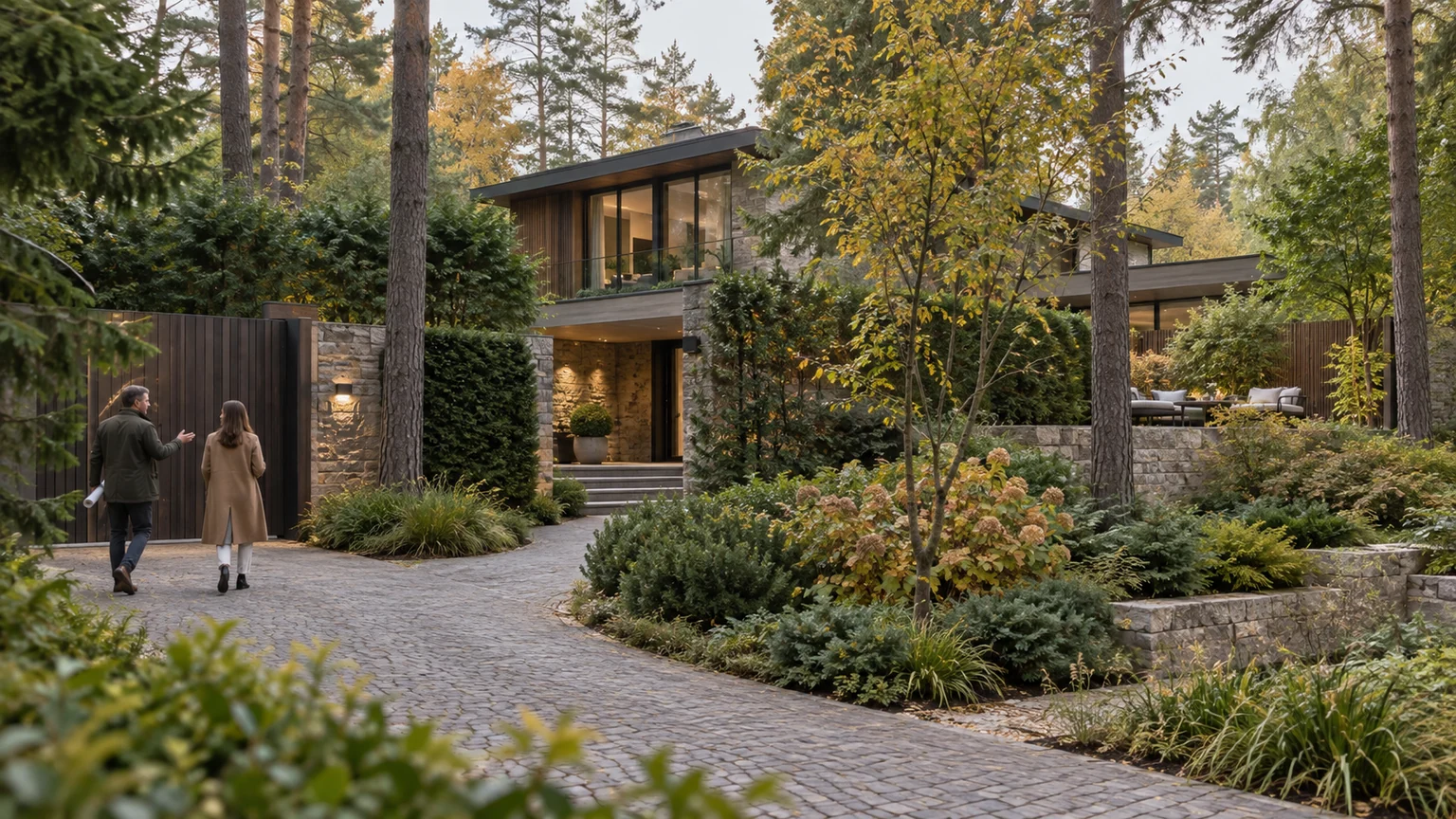
Buying a Wooded Country Plot: A Practical Tree Survey Before the Deal
A buyer-focused method for surveying mature trees, testing a future building layout, recording uncertainty and turning arboricultural findings into transaction decisions.
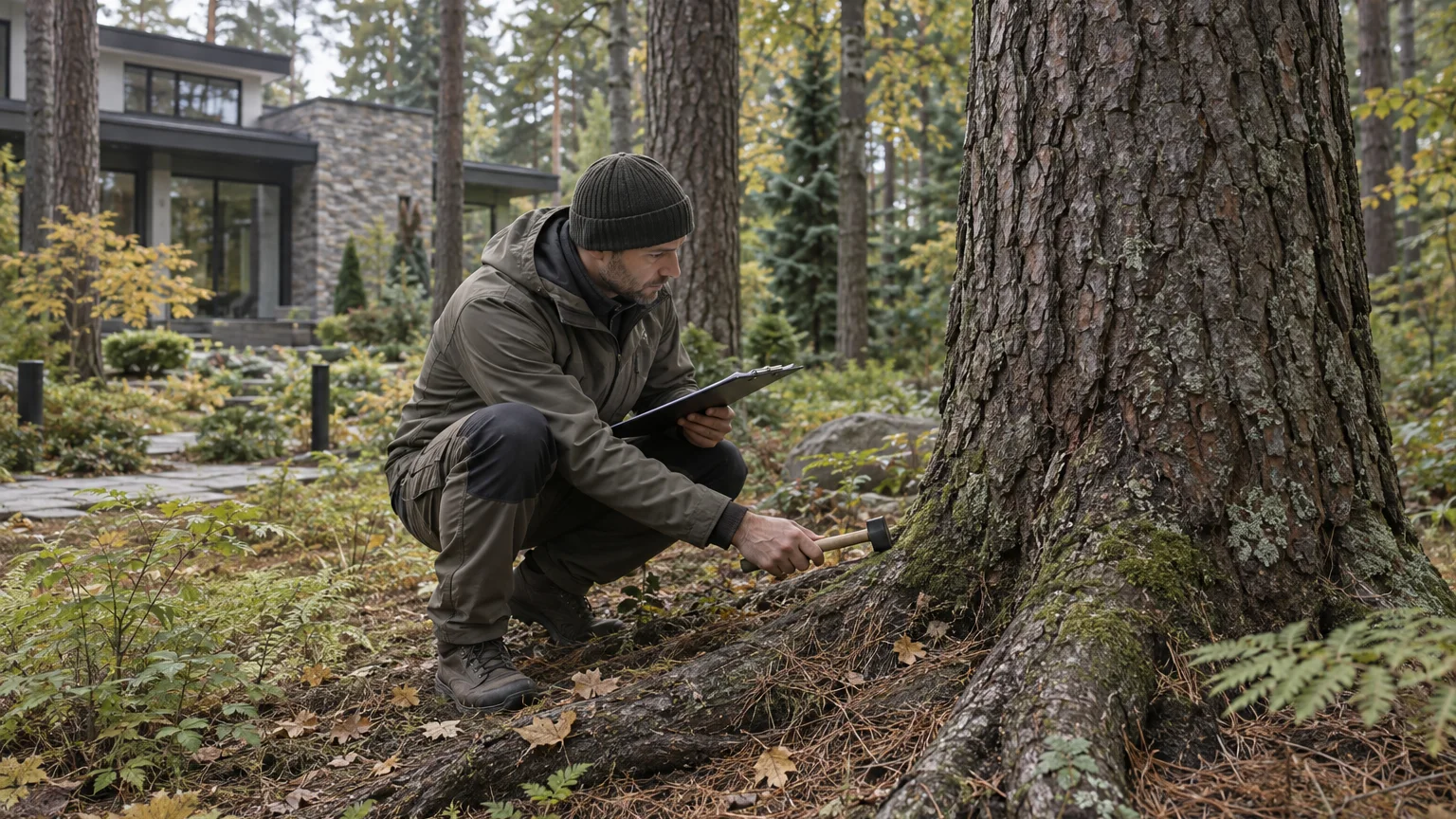
A plot of mature pines, oaks or birches can appear to offer instant value: established shade, privacy without a decade of waiting and a house that seems easy to place between the trunks. Tree count alone does not answer a buyer's important questions. Which trees are viable, which require monitoring or work, where will the proposed access and services conflict with roots, and will the landscape shown at the viewing survive construction?
A pre-purchase tree survey should not reduce the property to a “good” or “bad” label. Its useful outputs are a mapped inventory, individual records for significant trees, explicit inspection limitations and tested development scenarios. It complements the wider country-home due-diligence process; it does not replace title review, boundary surveying, ground investigation, design work or a competent tree-risk assessment.
Clarify what the seller means by mature trees
A listing may use the same language for an established natural stand and for large nursery trees transplanted relatively recently. Those situations require different evidence. For a natural stand, investigate site history, changes in soil level, nearby clearance and the condition of the understory. For transplanted specimens, request planting information, the preparation of planting pits, irrigation, support systems and maintenance records.
Do not begin by assigning a confident age or monetary value from appearance. An unsupported age estimate becomes false precision, while value depends on more than size. Species, vitality, crown structure, stability, position relative to the buyer's objectives and the demands of safe management all matter. A striking tree in the only workable building area may be a major design constraint; a visually modest boundary group may provide much of the plot's privacy.
Before the visit, request the site plan, current land records, any landscape design, historic photographs and records of tree removal, transplanting, soil filling, trenching, treatment, bracing or pruning. “The woodland has never been disturbed” remains a seller's statement until records and site evidence support it.
Combine legal, cadastral and environmental information
Trees cannot be reviewed independently of the land regime. Current title and cadastral information, surveyed boundaries, permitted use and recorded restrictions define the legal context. Public map layers are useful for initial orientation, but an on-screen overlay is not a legal opinion. If the plot adjoins forest land, a utility protection zone or another controlled area, a land lawyer or cadastral specialist should establish what applies using current documents and the rules of the relevant municipality.
Russia introduced updated sanitary-safety rules for forests and a new forest-pathology survey procedure on 1 September 2026. The Federal Forestry Agency notes, among other matters, updated photographic-record requirements for surveyed forest units. These are forest-law instruments, not an automatic inspection specification for every private garden. The transferable buying principle is narrower: identify the applicable land regime first, appoint a suitably qualified professional and preserve traceable source information.
- reconcile the cadastral boundary with the fence and a proper boundary survey;
- map trees near boundaries, access routes, external services and neighbouring structures;
- identify responsibility for trees outside the property being acquired;
- do not treat verbal consent to removal or transplanting as a verified permission;
- list every area whose legal status still requires specialist confirmation.
The legal review asks what may be done; the tree survey asks what condition exists and how trees interact with the site; the design test asks whether the desired use is achievable. One score should not blur those three answers.
Commission an inventory that designers can actually use
A useful schedule is more than a list of species. Each significant tree needs a plan reference, species identification, measurements appropriate to the chosen method, observations on crown, stem, root collar and visible roots, signs of damage, an assessment conclusion, inspection limitations and a recommendation. Photographs should connect to the same reference; otherwise the buyer may be unable to identify the subject later.
Practitioner competence matters more than a promise to deliver a woodland passport in a day. The International Society of Arboriculture presents tree-risk assessment as a systematic process of gathering and synthesising information before making reasoned recommendations. Its credential is not a substitute for Russian requirements, but the principle helps define a sensible brief: the assessor should explain the method, competence, level of assessment and limits of confidence.
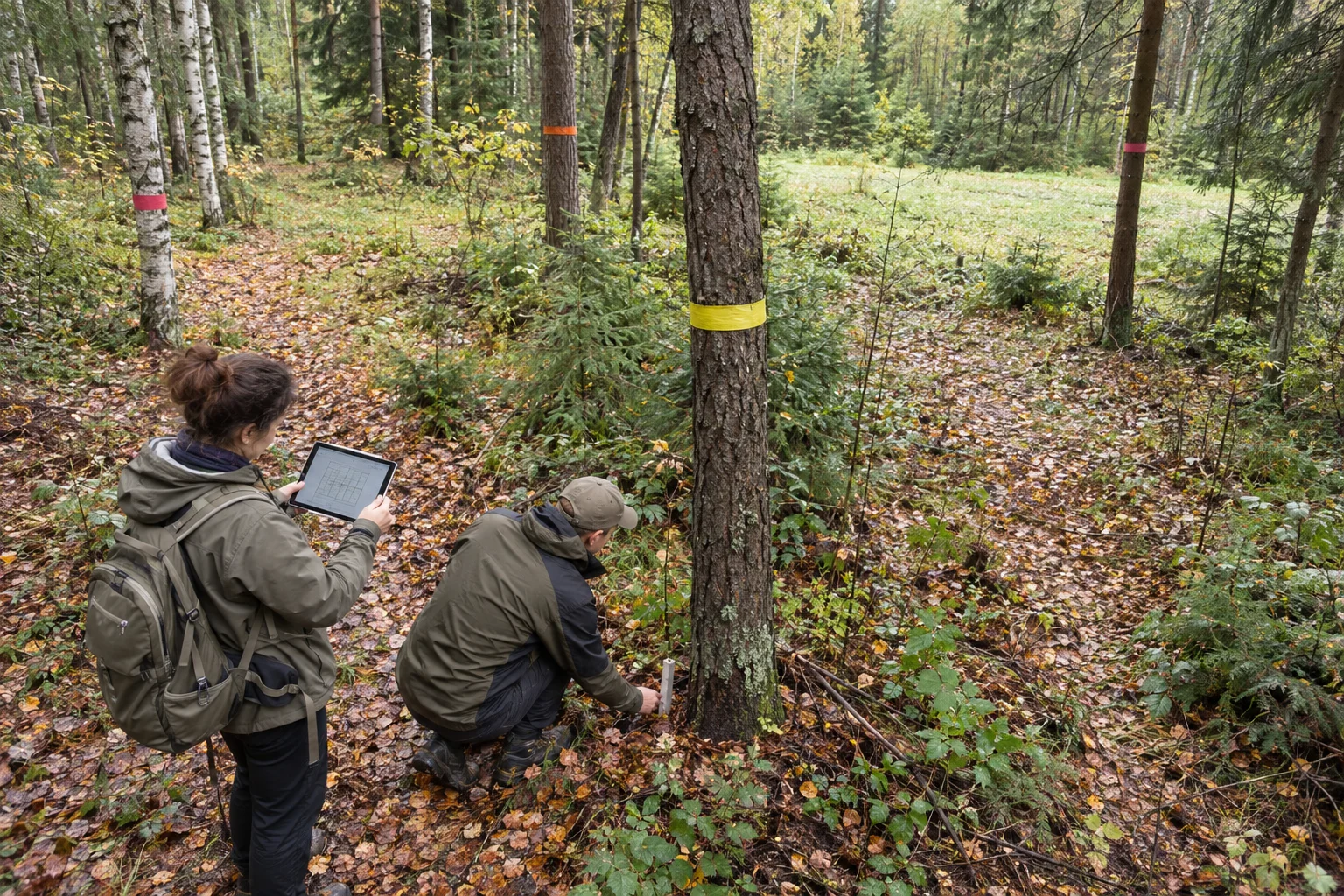
Ask for findings to be separated into at least four groups: retain without urgent work; planned care and monitoring; further investigation; and actions driven by safety or the development scheme. “Remove” without an explanation, applicable consent context and link to a target or design objective is too crude for a purchasing decision.
Inspect from the setting to the roots, stem and crown
The assessment starts with the site, not the bark. Record levels, ponding, soil compaction, recent filling or excavation, evidence of heavy machinery, changed exposure after neighbouring clearance and the targets that could be affected by a failed tree or branch. The same structural feature has a different practical significance in a remote corner and above an entrance, parking bay or play area.
At ground level, review the visible root collar, damage, cavities, fungal fruiting bodies, altered soil level and conflict with paving. On the stem, look for cracks, wounds, cavities, included unions, unusual lean and previous interventions. In the crown, note dead or broken sections, imbalance, weak unions and overall vitality. Buyers should not diagnose from one sign: a competent professional interprets the combination in the context of the species, site and potential consequence.
Advanced diagnostic tools are not a default package for every tree. They should answer a defined question raised by the initial assessment where the result can change a decision. The appointed specialist selects the method and location. Drilling, root excavation or bark damage should never be improvised before completion; any invasive step requires the owner's agreement and a written record.
Overlay a real construction scenario
The costliest mistake is to inspect the woodland today and place the house after purchase on an empty plan. Before committing, map at least working footprints for the house, terraces, garage or carport, turning area, guest parking, water and wastewater routes, electricity, surface-water drainage, retaining structures and the construction working zone. The architect, engineers and tree specialist need to review the same drawing.
Roots do not follow a universal formula based only on the crown edge. The fact that a foundation misses the trunk therefore does not prove that the tree can be retained successfully. Excavation, filling, trenches, compaction, altered drainage, material storage and a sudden increase in wind exposure can all change the tree's conditions. ISA's public tree-owner guidance identifies root severance, root-zone compaction, filling and grade or drainage change among common construction impacts.
- confirm that a viable building area remains while priority trees are retained;
- find service routes that minimise conflict with important roots;
- provide machinery access without using protected soil as a road or storage compound;
- reconcile proposed levels and drainage with current tree conditions;
- flag trees that will become newly isolated and more exposed after clearance;
- write protection measures into the design and works contract, not only the presentation.
When browsing properties by woodland, request a tree plan before the second viewing. When comparing homes along Rublevo-Uspenskoye Highway and the New Riga corridor, never transfer a conclusion from one plot to another: search geography says nothing about a particular stand's condition.
Record seasonal and access limitations
Broadleaf vitality is easier to observe with a developed canopy, while a winter visit can expose branch structure, previous damage and unions. Surface flow and ponding may be clearer after rain, but one wet day cannot describe the annual water regime. Some fungal fruiting bodies are intermittent. Record the date, weather, leaf state and accessibility in the report.
If the transaction timetable prevents a repeat visit in another season, state the limitation instead of disguising it with certainty. Request photographs from other seasons, maintenance records and a defined monitoring plan. For valuable or critically positioned trees, the parties can consider an additional specialist review before an irreversible transaction stage; their lawyers should draft the appropriate mechanism.
Warning signs in a survey are not limited to visible defects. Be cautious if trees are not tied to a plan, every specimen receives the same recommendation, inaccessible areas are omitted, the report promises an exact remaining lifespan, or extensive work is priced before the diagnosis and objective are explained.
Turn the survey into a transaction decision
The final schedule should work for the buyer, architect and future maintenance team. For each significant tree, record the reference, location, fact or observation, evidence method, uncertainty, recommended action, priority, dependency on the design and any consent question. Create a separate monitoring schedule: “observe” has little value unless it names the indicator, timing or event that triggers reassessment.
Price work only after defining its scope. Obtain proposals for further diagnosis, care, safe removal or replacement planting from appropriate contractors without presenting an early estimate as a fixed cost. Separate essential work, design compromises, recurring management and discretionary improvement in the commercial analysis.
A buyer may rationally accept a maintenance-intensive plot because its location and living scenario justify it. The problem arises when the price assumes an untouched mature woodland while the viable scheme requires substantial intervention. This is why homes in the country-property catalogue should be compared by the compatibility of trees, development and long-term operation, not by trunk count.
Pre-deposit checklist
- Boundaries and the land regime have been checked against current records.
- Trees outside the property and near external services are clearly distinguished.
- Every significant specimen has a reference, plan position and photograph.
- Vitality, structural observations and practical risk are not treated as synonyms.
- The report records date, weather, season and inaccessible areas.
- Further diagnostic methods answer specific questions rather than a generic package.
- House, access, parking, utilities and drainage footprints overlay the inventory.
- The concept considers roots, soil and water conditions as well as trunks.
- Retained trees have a protection strategy for construction.
- Recommendations are separated into urgent, planned, diagnostic and design actions.
- Consent requirements are checked for the specific place and proposed action.
- The budget reflects a defined scope and the deal records unresolved uncertainty.
The value of a wooded plot is not established by the number of mature trees in a photograph. It becomes defensible when the buyer knows which specimens can reasonably be retained, how they constrain or improve the design and what obligations will pass with ownership. A good tree survey makes that value traceable by connecting each tree to its place, evidence, scenario and next action.