Home Cinema Due Diligence: Acoustics, Ventilation and Systems
A practical pre-purchase audit of a dedicated home cinema: room acoustics, real listening seats, ventilation, power, the AV rack, controls and handover evidence.
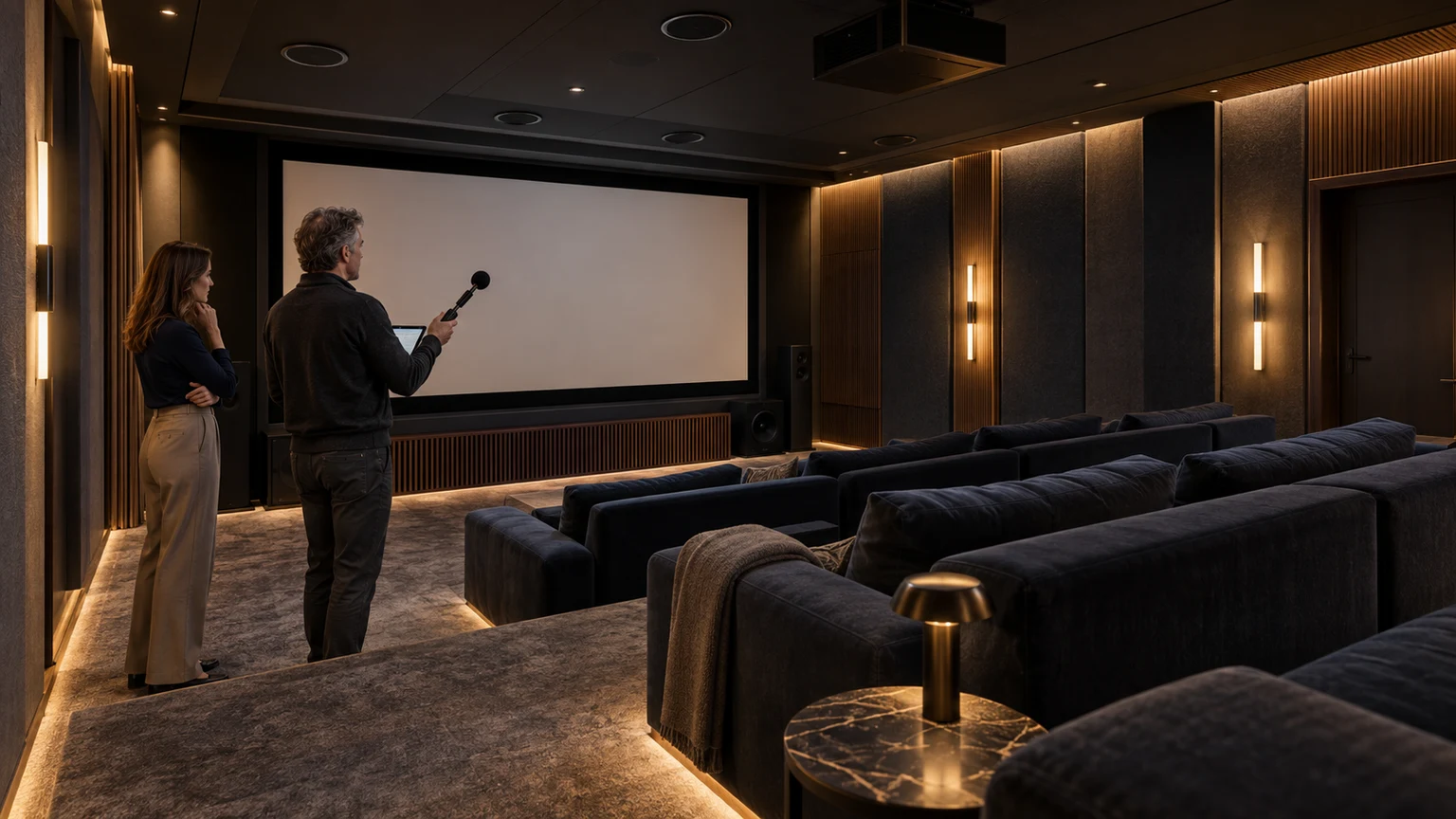
A dedicated home cinema is often presented as a finished luxury amenity: a large screen, several rows of seats, fabric wall panels and a full equipment rack. The appearance proves very little about performance. A buyer still needs to know whether the room remains comfortable through a feature-length session, whether low-frequency energy travels into bedrooms, whether the rack overheats and whether any component can be serviced without dismantling the interior.
Treat the cinema as a separate workstream within wider country-house due diligence. The building surveyor reviews the shell and access, an acoustician measures the room, the HVAC engineer tests airflow and plant noise, an electrician verifies circuits and protection, and an AV integrator checks the complete signal path. A demonstration by the seller or equipment dealer cannot replace these distinct checks.
Establish exactly what transfers with the property
Build an inventory before discussing sound quality. Separate construction-related items from removable equipment, licences and accounts. The screen, speaker fabric, brackets, cable routes, acoustic treatment and seating platforms may be integrated into the room. The projector, processor, amplifiers, media server, sources, remotes and network equipment may be excluded, leased, unsupported or tied to the seller’s personal accounts.
Request the room design, as-built drawings, cable and circuit schedule, acoustic report, calibration records, processor configuration, warranties and contractor contacts. If evidence is missing, do not infer value from a polished wall. Hidden cavities may contain abandoned cables or details that make a safe upgrade unexpectedly invasive. Apply the same discipline used when auditing a furnished home and its contents: the contract schedule should identify models, serial numbers, condition, accessories and the agreed handover state.
- Which elements form part of the property and which transfer as separate goods?
- Do the drawings describe the final installation rather than the original proposal?
- Which devices depend on a subscription, cloud service or personal account?
- Will administrator credentials, spare remotes, rack keys and calibration files transfer?
- Which products are already unsupported, and can they be replaced without rebuilding the room?
Separate sound isolation from in-room acoustics
These are different problems. Sound isolation limits transfer into bedrooms, corridors, the floor above and the garden. Acoustic treatment inside the cinema controls reflections, dialogue intelligibility, localisation and low-frequency behaviour. Thick decorative panels can improve the room while doing little about structure-borne transmission through slabs, doors, ventilation ducts and rigid fixings.
Russia’s current SP 51.13330.2011 addresses protection from noise and includes residential buildings within its scope. The designer must determine which provisions and test methods apply to the particular property and room. A buyer should therefore ask for the wall, ceiling, floor, door and penetration build-ups, then test adjacent spaces during actual playback rather than accepting the phrase “fully soundproofed.”
Use a repeatable sequence: quiet dialogue, a dynamic passage and controlled low-frequency material. One person remains in the cinema while another checks the nearest bedroom, stair, technical area and the exterior. Record rattling doors, furniture, grilles, lights and wall panels as well as audible programme sound. Keep a documented, safe playback setting so that remedial work can be tested under the same conditions.
Inside the room, assess every regular seat, not only the central chair. Speech should remain intelligible without constant volume changes, bass should not vanish or collapse into one note, and the sound field should not pull toward the nearest loudspeaker. An acoustician should use a known signal and calibrated measurement chain across multiple positions, then leave the data with the new owner.
Reconcile screen, seating and speaker geometry
The numbers in a surround-system label describe channel groups; they do not prove that the speakers are correctly located or commissioned. Dolby’s official home-theatre installation guide documents standard layouts and advises manual level checks after automatic calibration. It is a useful reference for installed topology, not a building certificate or a substitute for measuring the actual room.
Compare every physical loudspeaker with the processor configuration. A unit may be concealed behind finish, assigned to the wrong channel or aimed outside the seating zone. Ask the integrator to play an identification signal through each channel and verify polarity, delays and stored levels. Save the result with a date and configuration version rather than leaving it only inside the contractor’s phone application.
Inspect sightlines from every seat. A head in the preceding row should not block essential screen area, a riser should not create an invisible hazard, and doors and aisles should work with seats occupied. For an in-room projector, check fan noise and access to filters, lens and mount. For an enclosed projector, review cooling, the optical port, dust control and removal clearance.
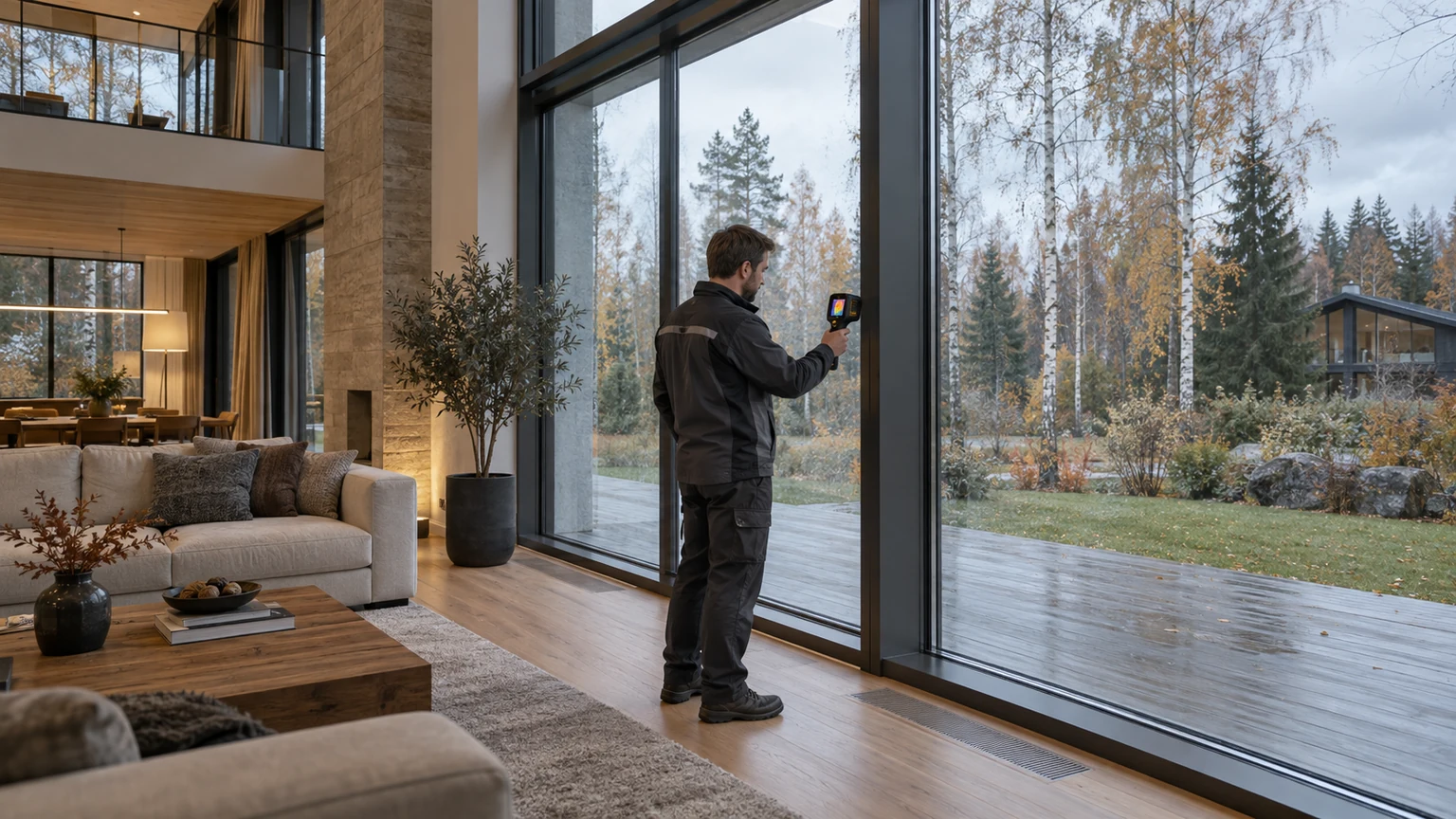
View the screen with the system both off and on. Look for waves, marks, tension problems, visible seams and reflections from adjacent finishes. Read operating data from the projector menu and reconcile it with service records and the manufacturer’s model-specific guidance; there is no single lifetime figure that applies to every light source. If glazing affects blackout, connect this audit with the wider review of panoramic glazing, solar control and serviceability.
Test ventilation under full operating load
A five-minute demonstration in an empty, cool room is not a ventilation test. During a real session, people, the projector, amplifiers, processors and sources all release heat, while a closed acoustic door changes airflow. The system has to remove heat and pollutants without draughts at the seats, intrusive noise during quiet scenes or a direct sound path through ducts into the rest of the house.
SP 60.13330.2020 covers heating, ventilation and air-conditioning design for residential buildings and has current amendments. It does not justify selecting one universal airflow number for every private cinema. The engineer should calculate the mode from room volume, occupancy, equipment heat gains, the wider house system and the requirements that apply to that project. For due diligence, obtain the design duty, supply-and-extract balance, rack-cooling strategy and measured performance.
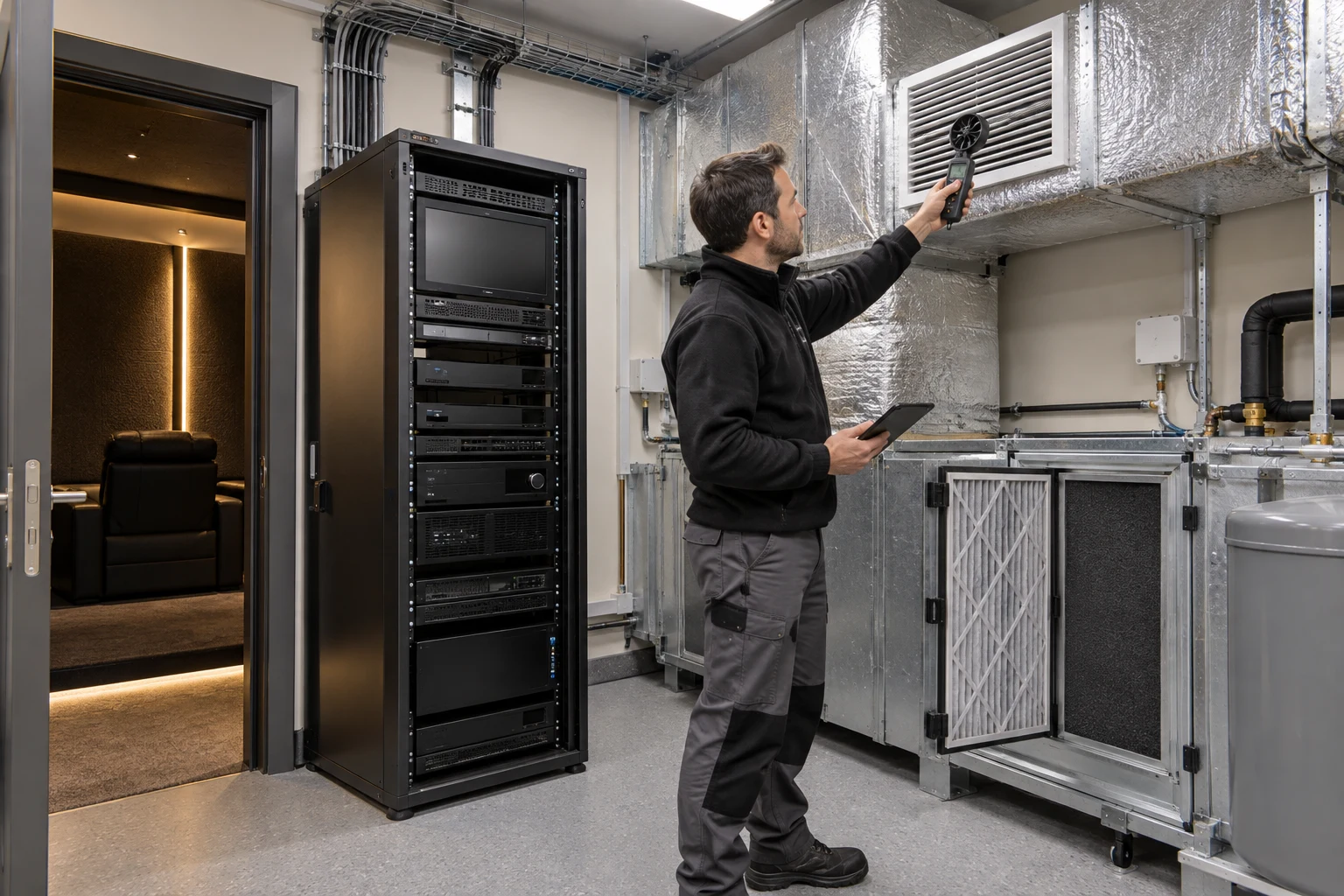
Run the cinema long enough for the systems to reach a representative condition, with picture, sound and the full rack operating. Record temperature and the direction of air-quality change before and after, measure airflow at grilles, check damper positions, listen at the seats and compare air temperature around the rack intake and exhaust. A carbon-dioxide sensor can reveal deterioration with the door closed and the intended audience present, but it cannot replace airflow measurement and balancing.
- Does a defined cinema mode work without an internet connection?
- Where are filters, silencers, balancing devices and condensate drains?
- Can a technician replace filters without removing acoustic wall panels?
- Does any duct connect the cinema directly to a bedroom and carry sound?
- Does rack cooling continue for the required period after playback stops?
Listen to ventilation at every available speed during a quiet scene and while paused. Switching the system off to demonstrate good sound merely hides the defect. If the room is comfortable only with its acoustic door open, its engineering is not ready.
Audit power, the AV rack and service access
Obtain the single-line electrical diagram and circuit schedule, then reconcile them with the actual distribution board and outlets. A qualified electrician should verify dedicated circuits, protection devices, connections, earthing, operating load and any backup-power interface. A cluster of extension leads is not an engineered distribution system. Russian emergency-services guidance specifically warns about overloaded outlets, weak connections and extension cables routed under carpets or through doorways.
The rack needs front-and-rear access or another documented safe maintenance method. Review cable bend radius, restraint of heavy units, connector strain, clear air intake and exhaust, filter condition and labels at both ends of every critical cable. Photograph the handover condition. A densely filled cabinet without drawings and thermal margin may need complete rework even if the screen currently lights up.
Simulate an orderly power loss and restart under an agreed procedure. Routine operation should not depend on the one technician who knows a secret sequence of breakers. Identify which devices sit behind a UPS, what must shut down gracefully and what the existing backup source is not intended to support. Coordinate the cinema with the property’s wider generator, UPS and backup-power strategy, because sensitive AV electronics and whole-house resilience are not the same design problem.
Pay attention to equipment that runs continuously: switches, controllers, storage and automation gateways. The buyer needs ownership of data, configuration backups, supported software and a replacement route. Administrator access and basic local control should survive removal of the seller’s personal account.
Test picture, control and failure modes
Assess picture performance after warm-up and with the normal blackout arrangement. Check focus across the screen, geometry, stable signal from every intended source and clean switching between formats. Do not copy generic brightness or colour values. Ask for the calibration record and verify that settings survive a routine restart or update.
Let the future everyday user operate the room. A clear activity should start the required devices, select the correct input, use a safe starting volume, set the lights and end the session cleanly. Disconnect the internet and repeat the essential steps locally. If cloud access is required to switch on lights, retract the screen or shut down the projector, document the dependency before purchase.
Check manual escape from each automation state: independent lighting, unobstructed doors, step illumination, safe control of motorised seats or blinds, and a reliable projector shutdown. Cables must not cross routes used in darkness. Fire detection, alarm integration and any other applicable life-safety provision should be assessed as part of the whole house by the relevant specialist, not inferred from the AV control panel.
Use one acceptance session and preserve the evidence
The strongest audit is a single scripted acceptance session rather than several disconnected demonstrations. Record the room condition, equipment versions and starting settings. Test startup, every source, every audio channel, several seats, blackout, ventilation under load, neighbouring rooms, loss of internet, orderly shutdown and restart. Describe each defect by its observable symptom rather than writing “poor sound” or “weak picture.”
- Evidence: inventory, drawings, designs, settings, warranties and service history.
- Room: doors, penetrations, risers, seats, finishes and access to screen and projector.
- Sound: channels, multiple seats, rattles, transfer to adjacent rooms and retained measurements.
- Air: full-load operation, grilles, temperature trend, noise, filters and rack cooling.
- Power: diagrams, circuits, protection, load, UPS and controlled recovery.
- Control: local use, administrator rights, spare remotes and manual overrides.
- Handover: photographic record, defect list, repair deadlines and a repeat test.
Classify the findings. Cosmetic damage and calibration may be service items. A device can be a local replacement only when cabling, power, cooling and geometry remain compatible. Ventilation, isolation or seating-platform changes affect the building fabric. Unsafe electrics, inaccessible equipment, chronic overheating or an unverified inventory should be resolved before a deposit.
Finally, consider alternative use and resale. A windowless, highly specialised room may be an excellent cinema but expensive to convert; that belongs in the broader assessment of unusual architecture and marketability. Whether a property is on Rublevo-Uspenskoye Highway or Novorizhskoye Highway, count the cinema as an asset only after technical verification, not at the seller’s recollection of its original installation cost.
A good home cinema is not defined by its chair count or its most dramatic demo clip. It completes a long session without discomfort, remains intelligible across the principal seats, avoids disturbing the house, keeps equipment within a stable operating environment and can be maintained by the next owner. Drawings, measurements and transferred access turn that repeatable performance into genuine property value.