Panoramic Glazing in a Country Home: Heat, Sun, Privacy and Service
A buyer-focused survey method for large glazed walls: verify the specification, test comfort, examine solar control, privacy, safety and long-term service access.
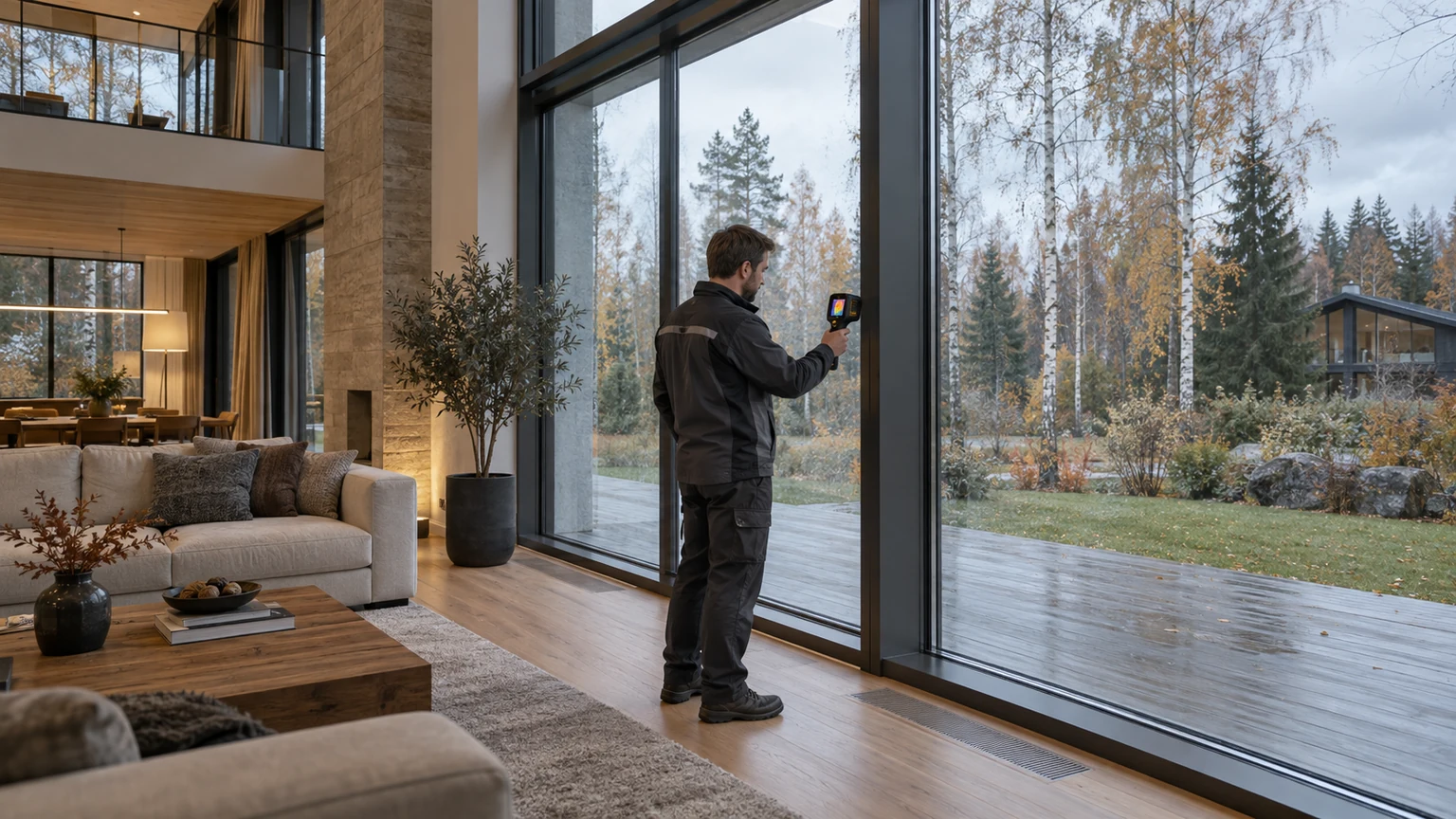
Panoramic glazing is often the first feature that sells a country home. Yet a glass wall is not a decorative upgrade that can be judged from a photograph. It is part of the external envelope and depends on the heating layout, ventilation, cooling, drainage, shading, controls and room plan. A quiet viewing on an overcast day will not reveal winter comfort near the facade, afternoon overheating, night-time privacy or the route required to replace a large insulating glass unit.
A serious buyer therefore surveys a system rather than counting panes. The investigation should identify the installed products, confirm how the edges and junctions were designed, observe the house under realistic loads and establish who can service it. Russia's active SP 50.13330.2024 addresses the thermal performance of the building envelope, while GOST 24866-2014 covers insulating glass units. Amendment No. 2 to GOST 24866-2014 took effect on 1 September 2026, so a report should identify the applicable edition rather than cite a standard number without context. A qualified designer must determine compliance for the actual house.
Build an evidence pack for every glazed section
Ask for the architectural package, window and facade schedules, glass and frame specifications, thermal and structural calculations, installed junction details, concealed-work records and commissioning documents for powered elements. Sliding doors need their own evidence: hardware, permitted leaf mass, threshold detail, drainage, adjustment procedure and emergency operation. Areas exposed to human impact or a fall risk require a documented safety-glazing strategy.
GOST 23166-2024 covers factory-made window and balcony units and includes performance, production, testing, installation and solar-control considerations. GOST 30826-2014 applies to laminated glass used for safety glazing. A standard reference is not a product schedule. The record should state the build-up of each insulating glass unit, coatings, spacers, cavity fill, frames, thermal breaks and declared performance of the complete assembly.
- match product markings and the contract schedule to the installed elevations;
- separate fixed lights, opening vents, doors and lift-and-slide units;
- identify where safety glass is specified and the design reason for it;
- obtain fixing, air-sealing, water-management and warm-line junction details;
- confirm warranty terms and a service contact for the exact system.
Missing records do not automatically prove failure, but they increase uncertainty. The surveyor may need to identify components from markings, examine agreed sample areas and list assumptions that remain unresolved. Make this part of the wider survey of concealed engineering behind premium finishes. A facade repair can involve the finished floor, perimeter heater, blind pocket, controls and external landscaping.
Survey the whole thermal boundary
A centre-of-glass number does not describe a finished glazed wall. Edges, spacers, frames, mullions, opening sections, fixings, sealants, thresholds and floor junctions all affect performance. Request calculations for the complete assembly at its actual dimensions. International literature often uses U-factor to express heat transfer, with a lower value generally indicating less transfer. It is useful for reading a foreign data sheet, but thresholds from a different climate and code system should not be substituted for the applicable Russian design assessment.
Inspect both faces of the facade. Water marks, failed sealant, distorted gaskets, draughts at mullions, cracked finishes or a persistently cold threshold all need investigation. Condensation on the room-side surface is not the same as moisture inside the sealed cavity: indoor humidity, surface temperature and airflow can produce the former, while condensation between panes can indicate seal failure. The remedy depends on a correct diagnosis.
Thermal imaging is helpful only under suitable conditions and with temperature, humidity and operating-state records. Sun, reflections, curtains and recently activated heating can create a persuasive but misleading image. Link the exercise to the seasonal readiness survey. Summer reveals solar control and cooling behaviour; cold weather is better for surface-temperature, junction and perimeter-heating observations.
Pay particular attention to the occupied zone beside the glass. A trench heater or underfloor circuit must be accessible, clean and controllable. Heavy curtains and furniture can disrupt the intended air movement. Listen for fans at night, inspect channels for dust and establish whether the owner turns equipment off to avoid noise. Comfort depends on radiant surface temperatures and local air movement, not only on the room thermostat.
Test sun control by elevation and time of day
Solar Heat Gain Coefficient, or SHGC, describes the fraction of incident solar energy admitted through a window in common international rating systems. Visible transmittance addresses daylight; it is not the same as heat control. A darker pane is not automatically a better design. Orientation, nearby trees and buildings, glazed area, room use, internal gains, shading and cooling capacity must be evaluated together.
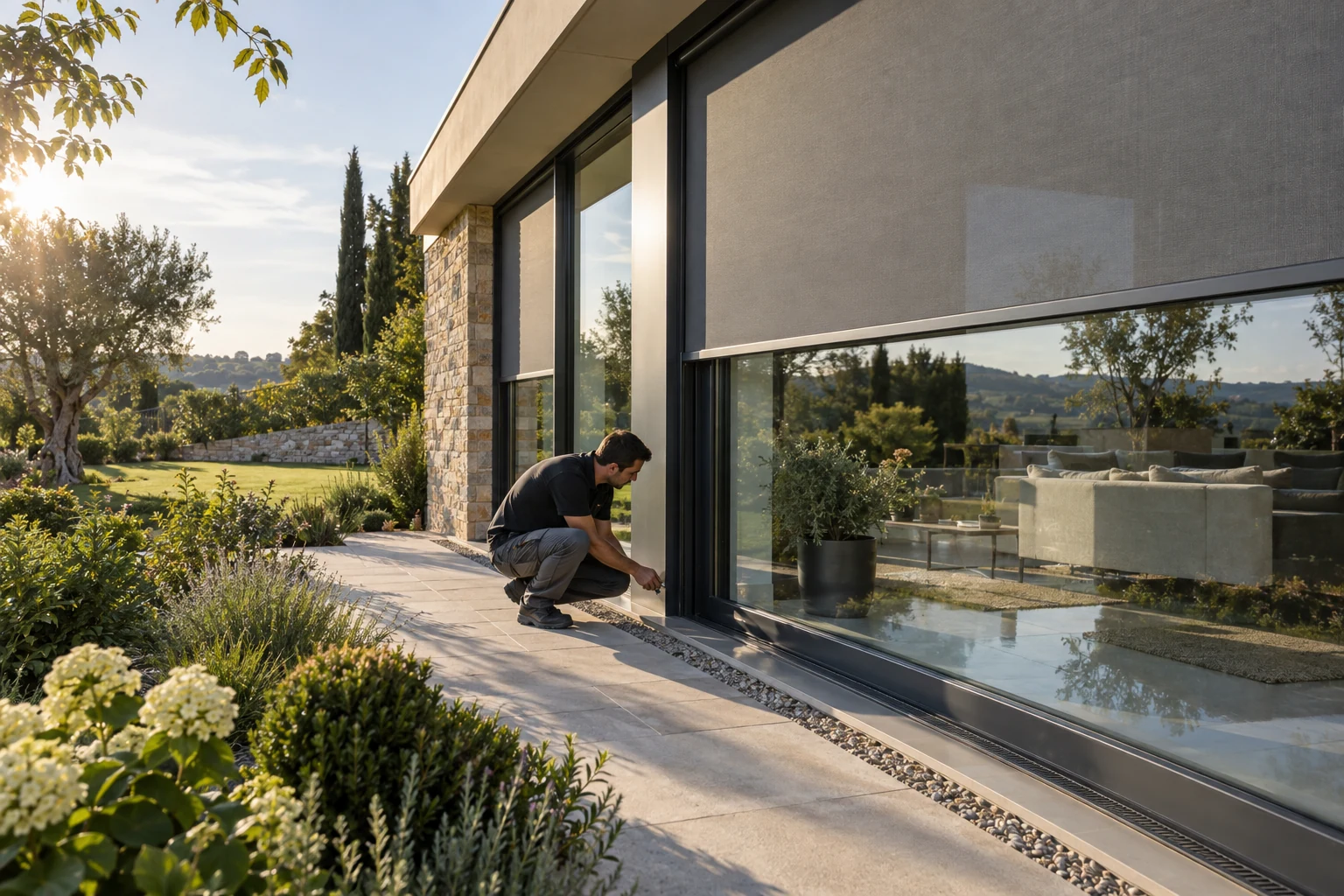
Create a time map for each important room. When does direct sun reach the facade? Who uses the space then? Can an exterior screen operate in wind, rain and an unoccupied house? What happens after a power cut? An internal blind can manage glare and privacy, but solar energy that has crossed the glass is already within the envelope. Exterior screens, louvers, overhangs and architectural shading act earlier, although their operating limits require project and manufacturer evidence.
Ask for a normal warm-weather demonstration with windows closed and the intended ventilation, cooling and shading modes active. Compare the zone close to the glass with the back of the room; a single domestic sensor is not a commissioning report. A large room can satisfy a wall thermostat while the seating area remains exposed. Coordinate this test with the house's ventilation, humidity and service assessment for a home with a pool, because facade controls, cooling and fresh-air delivery form one comfort strategy.
Privacy changes after sunset
Daytime reflections may hide an interior. At night, with lights on, the same facade can behave like a display window. Walk the legitimate external viewpoints: gate, neighbouring elevation, shared road, guest parking, staff route and camera positions. Repeat the exercise after dark with the owner's permission. Reflective films and tinted glass do not provide universal one-way privacy; their effect depends on the relative light levels on the two sides.
Define privacy room by room. A living room may tolerate an open view, while a bedroom needs blackout and controls within reach. Inspect blind pockets, power supplies and access panels. Can a motor be changed without opening the ceiling? Is there manual override? Do curtains or screens interfere with handles, safe egress or the ventilation strategy? An elegant blind that remains permanently lowered also changes the original daylight and view proposition.
Check reflections from within as well. Television, task lighting and decorative fittings can dominate the glass after dark. Outside, facade reflections may create glare on a terrace or towards a neighbouring home. Listing photography normally selects the favourable moment, so the buyer needs observations at more than one sun angle.
Safety requires a specified assembly
Do not identify safety glass by tapping it or judging its colour. Use product marking, schedules and a specialist's conclusion. The design must account for pane size and support, human impact, height difference, consequences of breakage and relevant environmental loads. Laminated and toughened products address different behaviours; generic words such as “triplex” are not a substitute for composition and purpose.
Where glass begins at floor level, borders a stair or protects a drop, establish whether it acts as the barrier or works with a separate guard. Examine exposed edges, chips, drilled areas, metal contact and evidence of impact. Improvised handles, stops or drilling into completed glazing are not minor handyman tasks.
Operate sliding leaves several times at a normal pace. Observe finger traps, travel, locking, compression and drainage at the threshold. Never force a binding heavy leaf. Check the track after rain and establish how debris is removed. If a door only moves when a service engineer attends, its technical status materially changes daily use.
Confirm the replacement and maintenance route
Before purchase, ask how the largest unit can physically leave and enter the building. Would the work require a crane, manipulator, vacuum lifter or temporary removal of a balustrade? Does the route survive the completed landscape? Trees, retaining walls, a pool or a pergola may make the original installation method impossible. Establish where equipment can stand and what approvals the estate management requires.
Inspect exterior sealants, pressure caps, drainage openings, flashings and leaf traps. Obtain a maintenance schedule for drains, gaskets, rollers, drives and controls. A tall facade is not maintenance-free; it needs an approved access method. An improvised ladder should never be treated as the long-term plan.
- list service parts and product references;
- confirm availability of seals, rollers, motors and control modules;
- record inspection intervals from manufacturer documentation;
- request the history of leaks, adjustments, glass replacement and automation repairs;
- trace delivery access from the estate entrance to the facade.
Separate the commercial estimate into defects, preventive work and optional improvement. Adjusting a leaf, repairing an external joint, replacing a screen motor and replacing a large glass unit are different scopes. A single allowance labelled “windows” is too vague for price negotiation or future ownership planning.
Use a second viewing as a controlled test
Choose conditions that expose the most important risk: direct sun for a western facade, cold weather for perimeter comfort or rain for water management. One visit will rarely provide every condition, so combine observations with documents, measurements and maintenance history. Ask the house to be operated normally in advance; a last-minute heating or cooling boost distorts the result.
- match design records and markings to every glazing type;
- inspect junctions, thresholds, drainage, sealants and water traces;
- run heating, ventilation and cooling with windows closed;
- operate vents, doors, blinds and exterior screens in their normal modes;
- review views and privacy from inside and permitted outside positions by day and night;
- confirm safety configuration and service access with competent specialists;
- turn findings into a defect, uncertainty and ownership-cost register.
Apply the same method when comparing homes along the Rublyovo-Uspenskoye and Novorizhskoye corridors. Architecture and landscape will differ, but the decision principle remains stable: comfort, safety and repairability should be demonstrated by evidence and operation, not inferred from the size of the view.
Good panoramic glazing is not the largest possible area of glass. It is a coordinated system in which the view, thermal comfort, solar control, privacy, safety and maintenance remain compatible.
The buyer does not need to redesign the facade. The practical goal is to obtain a legible specification, appoint an independent surveyor and test the operating scenarios that matter. Panoramic glazing can then remain an architectural strength instead of becoming a hidden liability after the first winter or sunny season.