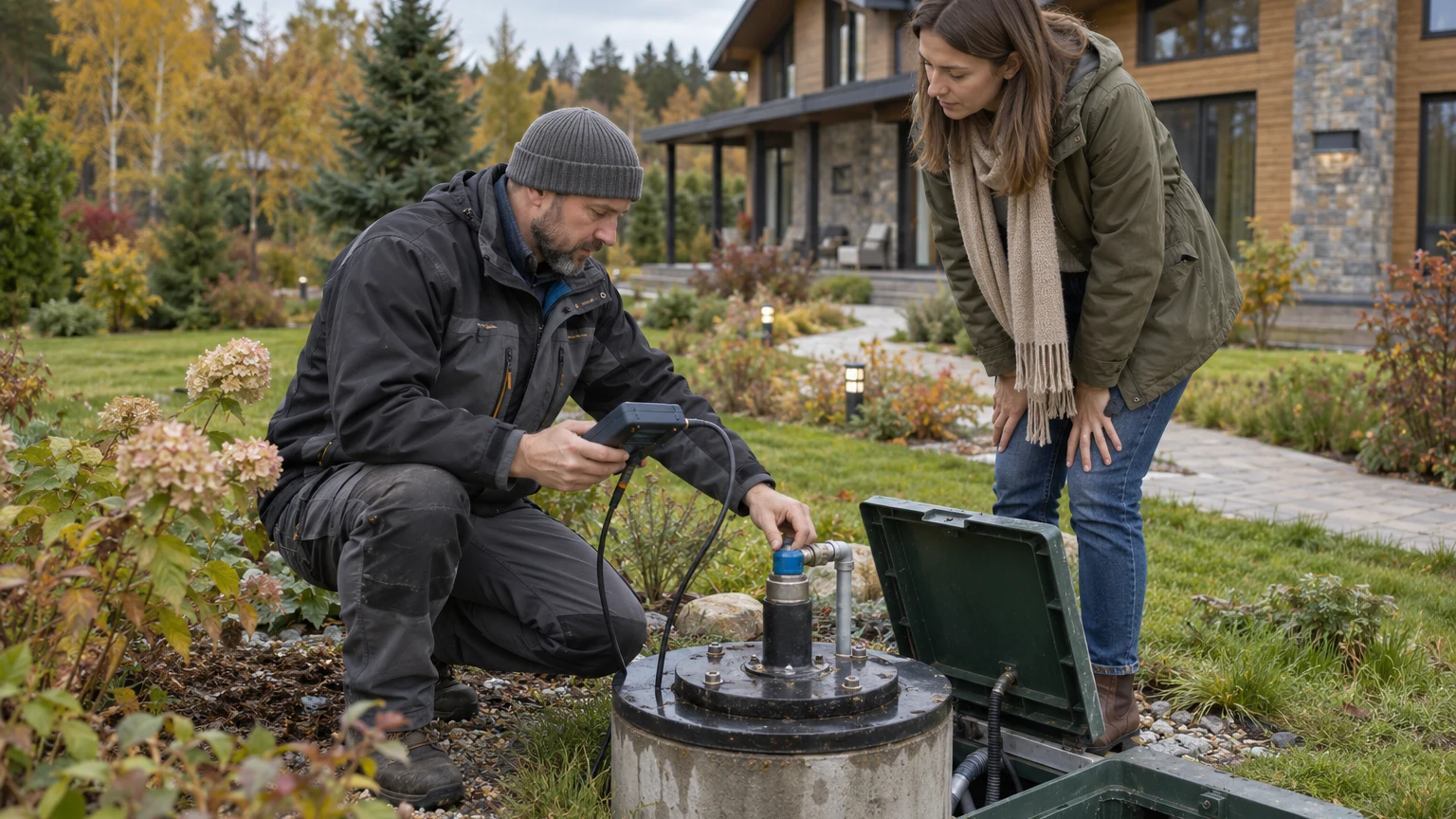
How to Assess a Country Home for Winter During Summer
A practical summer survey of heating, the building envelope, roof drainage, water systems and backup power, with a clear cold-weather follow-up plan.

Summer is the best time to repair a roof, façade or buried service, but it is a poor season for sweeping claims about winter performance. A boiler can start without an error while the distribution system remains untested under sustained demand. A dry wall may conceal a cold-weather condensation problem. The useful survey therefore separates three outcomes: what has been demonstrated now, what can be corrected before cold weather, and what must be verified during winter conditions.
This framework is suitable for an owner planning maintenance or a buyer assessing a completed country home. It is not a compliance certificate. Gas appliances, flues, electrical installations, structural defects and controlled system tests belong to qualified specialists using the project documents and manufacturer instructions for the individual property.
Build a system map and read last winter's evidence
Start with drawings, commissioning records, equipment manuals, service contracts, maintenance reports, alarm logs and building-management-system trends. A property selected from the country homes for sale catalogue should not progress to an expensive survey until the seller has identified what documentation is available. Where drawings are missing, ask the engineer to record the actual sources, circuits, valves, pumps, sensors and boundaries of responsibility.
Historic evidence can reveal more than a short summer visit. Review resource bills and service tickets from cold periods without treating consumption as a universal benchmark. Comparisons only make sense within the same house and with occupancy, weather, indoor settings, pools, ventilation and snow-melting loads considered. List recurring symptoms such as a cold room, window condensation, pressure loss, pump noise, gutter ice or repeated boiler resets.
- Create an inventory of systems and responsible contractors.
- Flag equipment without identification, manuals or service history.
- Record each winter incident with conditions, symptoms and the completed repair.
- Map the main house, guest buildings, garage and external services separately.
- Save current settings before maintenance begins.
Define what a summer inspection can prove
Warm weather allows visual inspection, material-moisture checks, service work and controlled tests. Surveyors can identify cracked joints, failed sealants, corrosion, old leak marks, poor water routes and equipment that cannot be maintained safely. A visit after rain is particularly useful for the roof, gutters, light wells, paved falls and low points in the grounds.
Heating can be started in a permitted service mode, controls can be checked against pumps and actuators, and backup power can be exercised. None of this proves that the house will maintain its intended conditions during prolonged cold. Reports should state exactly which mode ran, for how long, which readings were taken and what the test could not establish. Avoid a blanket conclusion such as “heating operational” when only a brief boiler start was observed.
Russia's Ministry of Emergency Situations advises owners to inspect the relevant building elements before the heating period, including stoves, flues, boilers and electrical networks. That supports a coordinated pre-season review rather than a series of isolated contractor visits in which nobody examines the complete operating chain.
Inspect the whole heating chain
Begin at the heat source and follow energy through fuel or electricity supply, boiler or heat pump, flue, pumps, expansion equipment, manifolds, pipework, radiators or floor circuits, sensors and controls. The engineer should compare the visible installation with available drawings, check access for maintenance, identify corrosion or leakage and note uninsulated sections in vulnerable spaces.
Any filling, venting, pressure or integrity test needs a method based on the design and the equipment documentation. Internet rules of thumb are not substitutes for system-specific limits. Ask for a record of initial and final readings, circuits included, test duration, photographs and limitations. A one-line note saying “pressure tested” is not sufficient evidence for a complex residence.
- Start every heat source in an approved service mode.
- Test the designed changeover between primary and backup sources.
- Confirm that pumps, valves and actuators receive commands and report status.
- Inspect every manifold and accessible emitter for air, noise, leaks and closed branches.
- Exercise only failures that the specialist considers safe to simulate.
- Schedule a separate cold-weather load test.
Owners should not dismantle gas equipment or improvise flue checks. A competent contractor should service burners, valves and combustion paths using current requirements and manufacturer instructions. If the property has a stove or fireplace, include flue inspection and cleaning in the plan; the MChS guidance identifies deposits in smoke channels as a fire concern.
Read the building envelope through water first
A summer envelope survey should trace water. Inspect the plinth, façade joints, window and door perimeters, service penetrations, terraces and junctions between materials. Indoors, map staining, salts, detached finishes, odour and elevated material moisture. Each mark needs a hypothesis that distinguishes rainwater, ground moisture, internal condensation and a service leak.
Infrared cameras are not magic scanners. The US Department of Energy's official consumer guide presents a home energy assessment as a combination of bill analysis, envelope and system inspection and, in a professional assessment, tools such as blower-door and infrared testing. It is a useful briefing model, not a Russian compliance standard. Conditions and interpretation matter; an unexplained colour image is not proof of either good insulation or a defect.
Use the summer survey to create a map for winter diagnostics. The brief should record indoor and outdoor conditions, prior heating operation, ventilation state, weather limits, target junctions and the way each anomaly will be confirmed. For a purchase, combine this technical work with the broader prime country-home due diligence process.
Inspect roof drainage and the grounds after rain
Dry weather makes access easier, while rainfall reveals the route of water. Inspect roof spaces, penetrations, valleys, parapets, outlets and gutters. Look beyond an active drip for stained timber, corroded fixings, disturbed insulation and areas that appear repeatedly redecorated. Roof access is work for a properly equipped contractor; an owner should not walk onto a wet roof for the sake of an inspection.
Follow every outlet. Water collecting beside the foundation, an overflowing light well, erosion, settled paving or uncontrolled discharge requires investigation before freezing weather. Drainage chambers, pumps and their backup supply must remain accessible when the garden is wet and later when it is covered by snow.
Homes along the Rublevo-Uspenskoye Highway and the Novorizhskoye corridor should never be assumed to share engineering conditions. Adjacent properties can differ in terrain, construction, utility sources and occupancy pattern. Location pages provide a search context; winter readiness is established house by house.
Map water services exposed to freezing
Mark every water-bearing service in an unheated or intermittently heated area: the incoming main, crawl spaces, garage, garden taps, guest house, pool equipment, irrigation and treatment systems. Each requires a documented winter strategy, whether continuous protected operation, designed drainage, local protection or formal shutdown. The engineer must select it; casually changing heat-transfer fluid or adding trace heating can conflict with equipment and electrical or fire-safety requirements.
Check isolation valves and whether a leak can be contained without opening finished walls. Rehearse the response without causing damage: who receives the alert, where does water stop, and will communications and actuators still work during a power failure? A floor sensor adds little unless its message reaches a responsible person and its shut-off device is periodically exercised.
- External water points appear on the winterisation map.
- Wells, pumps and treatment equipment remain accessible for winter service.
- Vulnerable plant rooms have no accidentally isolated heat source.
- The house manager has a clear emergency isolation diagram.
- Altered pipework receives a documented leak check.
Test electrical supply, controls and resilience
Even a gas-heated house normally depends on electricity for pumps, valves, controls, communications and often water supply. A qualified electrical specialist should inspect boards, protective devices, earthing and the relationship between actual loads and the design. MChS guidance also tells householders to review wiring, sockets and switches and avoid overloaded circuits before the heating period.
A generator or battery system should be tested against an agreed list of priority loads, not demonstrated only at idle. Establish which circuits are supported, how changeover operates, what happens when fuel or stored energy is depleted and who is notified. Fuel storage, ventilation, exhaust and fire precautions require their own professional review.
Test communications as an operating system: loss of primary internet, loss of one sensor, controller power failure and recovery. The objective is not merely a functioning dashboard. Critical equipment should move to a defined safe state, log the event and send an intelligible alert to a named responder.
Carry unresolved questions into a winter test
A credible summer report ends with a section headed “not verified because of season”. It may include room-by-room heat distribution, sustained source capacity, cold-weather glazing performance, thermal bridges, indoor humidity, draught or icing at external components. The exact list belongs to the inspecting engineer because every property has a different construction and system layout.
Agree the winter visit before purchase or final acceptance. Specify operating conditions, specialist access, measurement points, preservation of controls data and the procedure for defects. If a transaction closes in summer, seasonal limitations should appear in the technical report and any resulting agreements should be structured by the parties' lawyer. A buyer must know which conclusions are evidence and which remain transferred risk.
Create one readiness record
Combine findings in a table with system, component, method, test conditions, result, defect, priority, owner, due date and closure evidence. Attach photographs to drawings instead of storing them in an unnamed folder. Give every action a closure criterion: repeat measurement, signed test record, photograph before concealment, revised drawing or the planned cold-weather visit.
- Safety: heating equipment, flues, electrical systems and emergency isolation have specialist reviews.
- Integrity: leaks, moisture traces and weak external junctions are traced and repaired with follow-up evidence.
- Control: circuits, valves, sensors, alerts and responsible people are identified.
- Resilience: power and communication loss scenarios have been exercised for critical loads.
- Seasonal remainder: a winter inspection is booked for properties that summer cannot demonstrate.
A house is not winter-ready merely because a boiler contractor completed a service visit. Readiness means the owner understands the system architecture, holds evidence of controlled tests and knows what happens after a failure. Summer provides the repair window; winter confirms the characteristics that require cold conditions. Together they create a manageable engineering plan instead of an assumption.