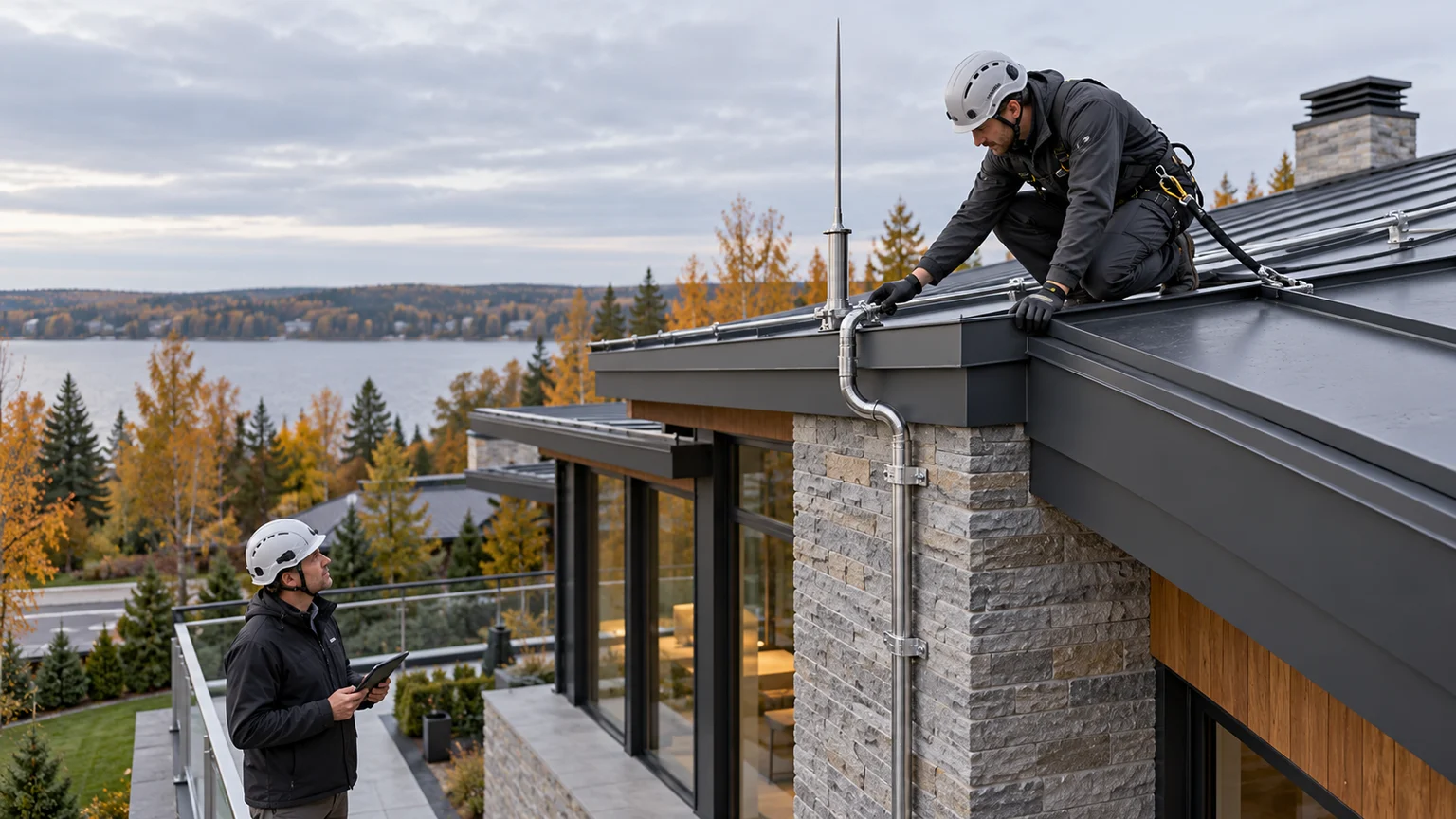
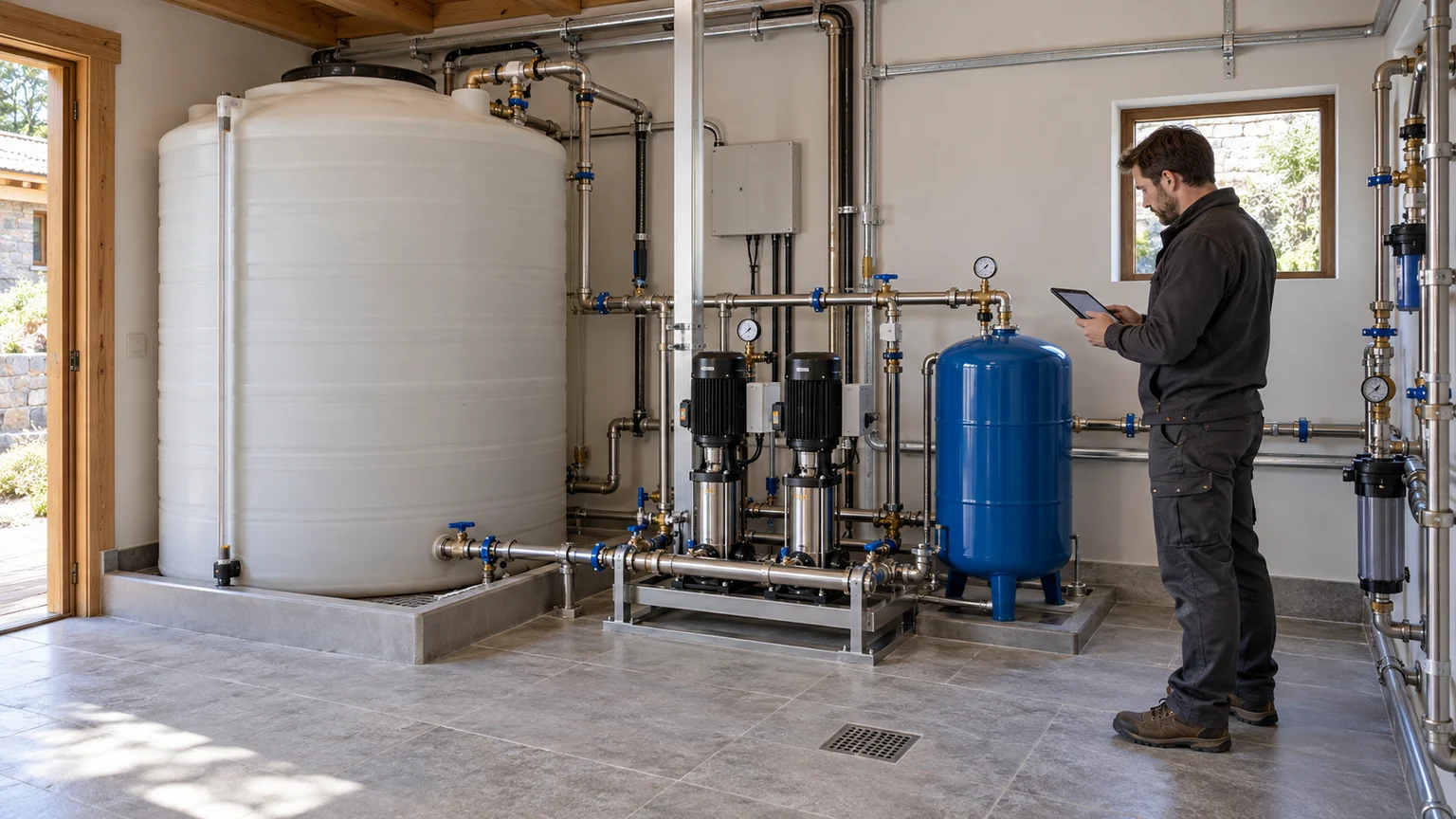
Fireplace and Chimney Due Diligence Before the Heating Season
A practical pre-season audit of a country-house fireplace: records, firebox, flue, roof penetration, combustion air and a controlled operational test.
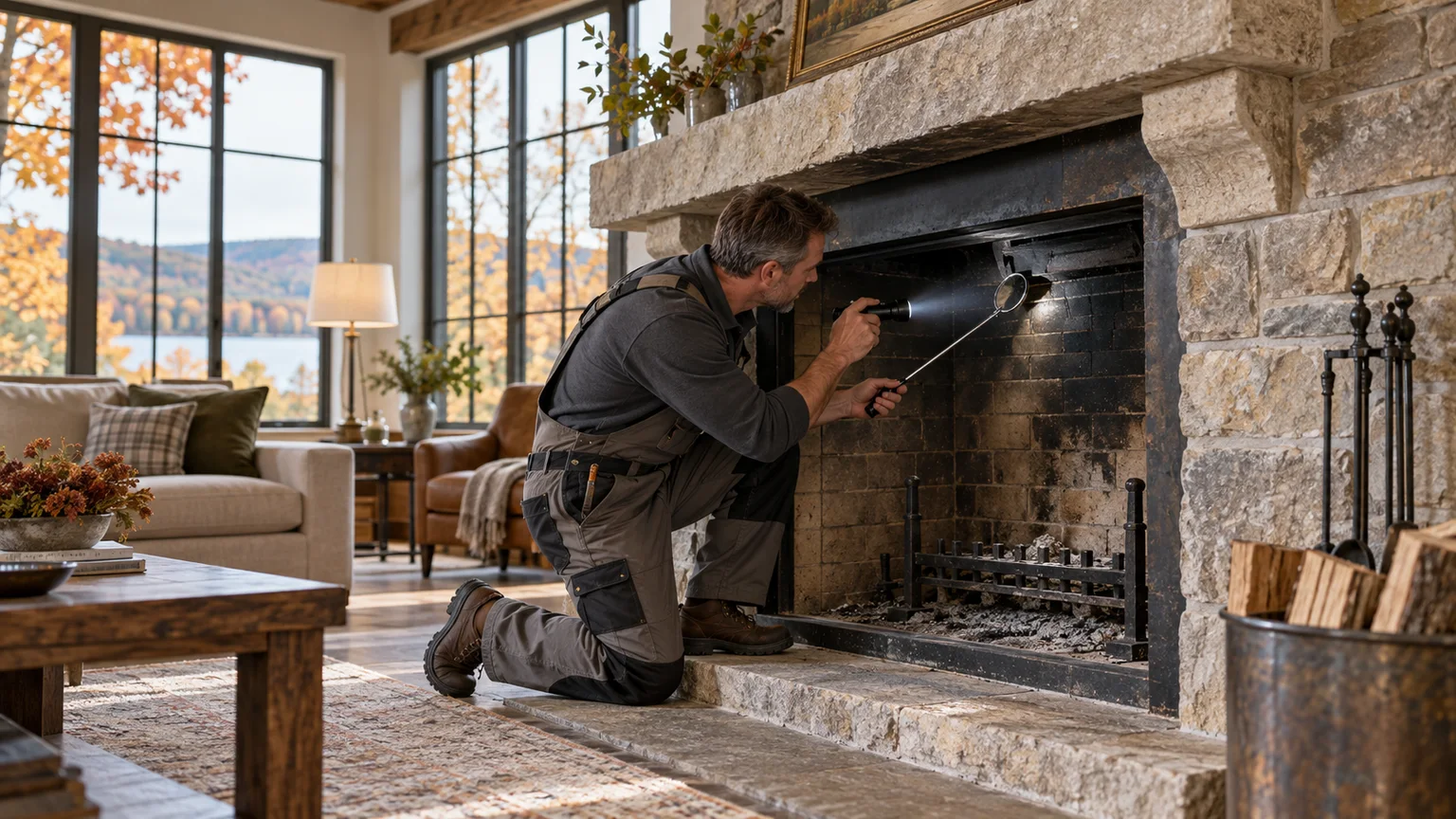
A fireplace in a prime country house may look like furniture: the stone surround is immaculate, logs are arranged neatly and the seller says it worked last winter. Due diligence must treat it as a complete combustion and exhaust system. The firebox, connector, hidden flue, floor and wall clearances, penetrations through combustible construction, roof flashing and terminal all have to work together. A fault may remain invisible until the first cold start, a windy evening, closed windows or simultaneous operation of the kitchen extract.
Russian fire-safety rules require pre-season inspection and repair of fireplaces and other heating equipment and prohibit the use of defective appliances. Rosstandart lists SP 7.13130.2013 as current, with Amendments 1–3 applicable from 1 July 2025. A buyer should use that as a professional review framework, not as a do-it-yourself specification. The appliance type, building construction and applicability of individual clauses must be established for the particular house.
Place the fireplace review inside the wider country-home due-diligence plan. It intersects with the roof, ventilation, electrical supply and interior finishes, but none of those inspections replaces a continuous flue-system audit.
Reconstruct the system record before inspecting the finishes
Ask for the appliance manual, flue design, material and diameter schedule, details of floor and roof penetrations, installation and commissioning records, and the history of inspection, sweeping and repair. For a factory-made modular flue, identify the sections, adaptors, tees, inspection points, supports, insulation and terminal. For masonry, establish the route, lining and all connected appliances.
Then compare the record with the building. A later insert may have been connected to an older chimney. A decorative enclosure may hide an undocumented adaptor. Roof works may have altered the flashing without updating the drawing. Any mismatch is a reason for further investigation, not for an assumption that the concealed detail is acceptable.
- Who designed, installed and subsequently altered the system?
- Which fuel and operating modes does the manufacturer permit?
- Where are the inspection and safe-cleaning access points?
- How is combustion air supplied?
- When was the full route last inspected and what was found?
- Were the insert, roof, surround or ventilation system changed?
- Can concealed joints be reached without destroying valuable finishes?
A recent sweeping invoice proves only that a service was ordered. It does not by itself establish masonry integrity, joint tightness, safe penetrations, support stability or compatibility between the appliance and the flue.
Inspect the cold appliance before any fire is lit
The first physical review should use a completely cold and cleaned fireplace. Examine the lining, joints, door, glass, gasket, hinges, latch, grate, ash area, throat and accessible connector. Look beyond ordinary soot for cracks, burn-through, distorted metal, missing mortar, corrosion, overheating marks and improvised sealants. Pale deposits or damp odours may point to moisture; glossy or sticky deposits require professional assessment and cleaning.
Inspect the surround and adjacent construction as carefully as the firebox. Darkened timber, melted material, unusually dry finishes, cracks or local patching close to the appliance or flue are evidence, not decoration defects. Current Russian fire rules require operation to stop where combustible construction shows thermal damage until the cause and protection have been addressed. A competent specialist should verify the separation and clearance solution for this exact assembly.
Check the stability of the appliance, its base and the protected zone at the opening. Do not approve a glass or stone floor plate merely because it looks substantial; dimensions and material must match the applicable rules and appliance documentation. The log basket, rugs, curtains and furniture should not turn the door-opening zone into fuel storage.
The entire flue route matters
A camera survey through suitable access points can reveal displaced sections, obstructions, constrictions, moisture tracks, deposits and failed joints. Masonry systems require attention to bricks, lining and mortar; modular systems require correct joints, supports, provision for thermal movement and intact insulation. A clean-looking lower section says little about a concealed bend or roof penetration.
Map every inspection point and change of direction. If an access door sits behind fixed cabinetry or a sealed decorative panel, routine maintenance may require damaging the interior. In a complex house, record which appliance uses which flue, whether any connection is shared, where materials change and where the route approaches timber construction.
Draught is an outcome of the whole system and the pressure conditions in the house. Flue condition and geometry, temperature, wind, windows, mechanical ventilation and kitchen extraction all matter. A cold air-movement check is only preliminary; it cannot replace a controlled operational test after the system has passed inspection.
Where the history of the house is unclear, use the guide to ageing engineering behind luxury finishes to investigate whether airtight windows or stronger extraction were added after the fireplace was designed.
Inspect the terminal and roof junction as one assembly
From safe access, a specialist should inspect the chimney’s stability, masonry or outer casing, weather protection, unobstructed exhaust path, flashing, joints, fixings and evidence of leakage. The required terminal position depends on the roof and nearby obstacles. It should be checked against the current design and applicable standard rather than judged from the garden.
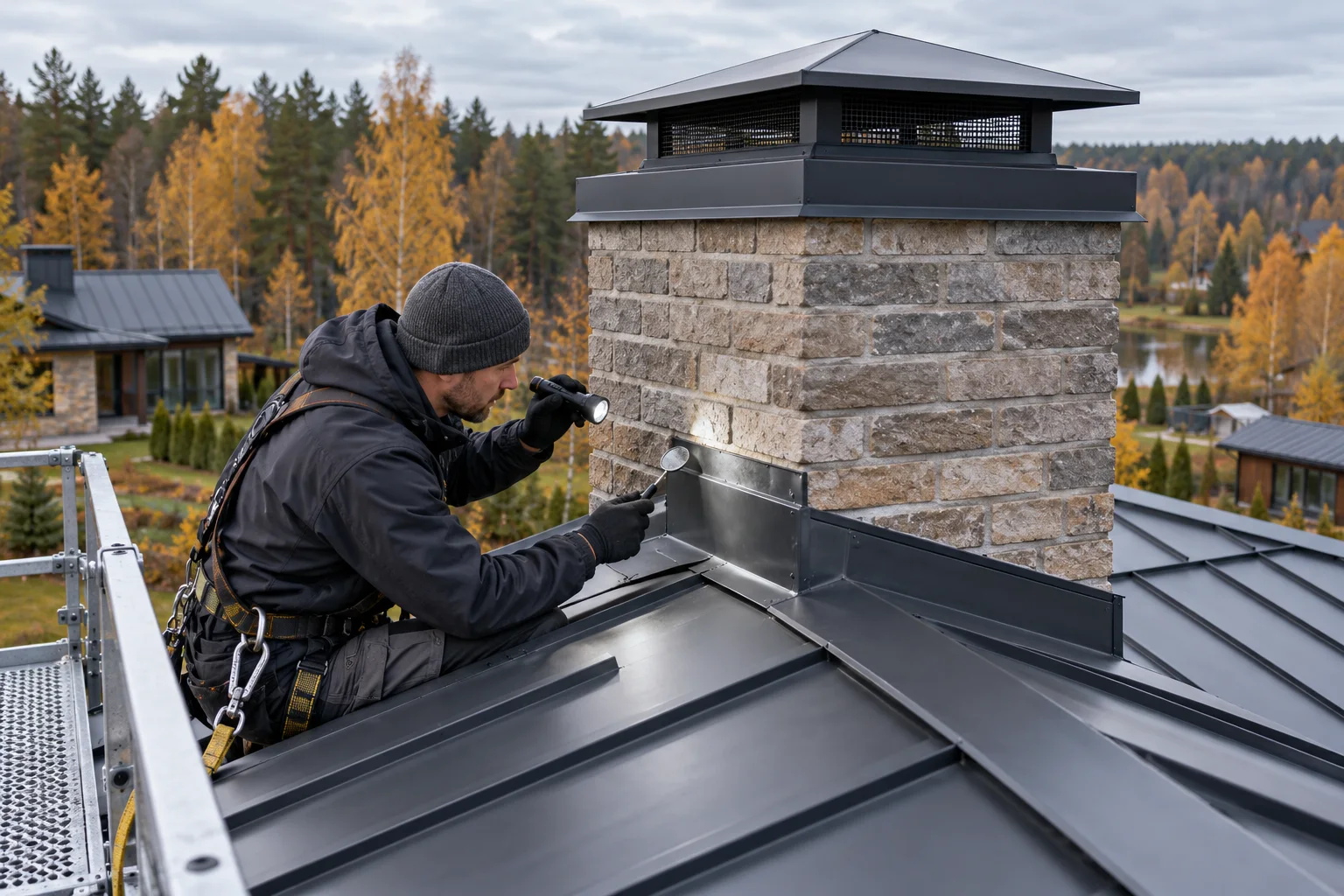
Moisture beside a chimney may originate at the roof junction or from condensation inside the flue. Diagnose the path before selecting a repair: another external sealant layer will not correct an internal temperature problem, while a new liner will not repair defective flashing. Coordinate this work with the broader roof-covering and junction inspection, but report the two causes separately.
Do not climb onto the roof for an informal viewing. A drone can document the cap and obvious damage, yet it cannot test joints, fixings or accessible penetration details. The person inspecting must have a safe platform or other appropriate access and fall protection.
Combustion air and ventilation can change fireplace behaviour
A renovated house may be much more airtight than the building for which the fireplace was conceived. With windows closed, combustion air may be insufficient; a powerful extractor may alter the pressure balance. Warning signs include smoke during lighting or door opening, unstable flame, persistent combustion odour or a need to keep a window ajar.
Ask the engineer to identify the intended combustion-air path. If a dedicated duct exists, inspect its continuity, control and terminal. If the design uses room air, assess the room volume and ventilation together rather than treating the fireplace as an isolated object. The guide to ventilation and indoor-air due diligence provides useful questions; project-specific measurements still belong to the specialist.
A carbon-monoxide alarm is a sensible additional layer when selected, located, tested and replaced according to its manufacturer’s instructions. It does not make a damaged flue safe and does not replace a smoke alarm, inspection or adequate combustion air. Check service life, power source and test records rather than merely noting a plastic case on the wall.
Run a controlled test only after the cold inspection
An operational test is valuable, but a large first fire is not. Once the flue has been inspected, cleaned as necessary and cleared of obvious defects, a competent person can perform a controlled start in the permitted operating mode. Observe establishment of draught, smoke at the door or joints, stability with normal interior-door positions, interaction with the installed ventilation and temperature at accessible surfaces.
- Record the starting condition, damper positions and active ventilation equipment.
- Use only dry fuel permitted by the manufacturer and begin with a small load.
- Observe smoke, odour, combustion stability and appropriate instrument readings.
- Open the door only by the normal procedure and watch for spillage.
- After complete cooling, recheck joints, finishes and accessible flue sections.
- Document the exact test conditions and defects, not simply “draught is good”.
Never use flammable liquids, burn waste or attempt to remove deposits with an abnormally hot fire. Stop the test if smoke enters the room, an alarm operates, a surface overheats or an unusual smell or noise develops. Ventilate by a safe procedure and have the cause investigated.
Turn the findings into a purchase decision
The report should distinguish consequence, not just appearance. Critical findings include thermal damage, a loss of flue integrity, uncontrolled smoke spillage or an inability to verify penetrations through combustible construction. Material findings include leakage, corrosion, inaccessible inspection points, undocumented component compatibility or unstable pressure conditions. Operational findings include missing records, unsafe fuel storage, expired alarms or no defined maintenance routine.
For every item, record the location, photograph, detection method, further investigation and responsible party. Obtain a project-specific scope and quotation from a qualified contractor before committing to the purchase. Costs from another house are not reliable because material, access, height, finish protection and dismantling requirements differ.
When comparing homes along Rublevo-Uspenskoye Highway and Novorizhskoye Highway, do not rank fireplaces by portal size. A sound installation is documented, inspectable, serviceable, coordinated with ventilation, free of overheating evidence and capable of passing a controlled test. That evidence is more useful than the assurance that the fireplace was “hardly ever used”.