Backup Water at a Country House: Storage, Pressure and Testing
A useful water reserve is more than a large tank. This guide explains outage scenarios, booster pressure, water quality and a practical acceptance test.
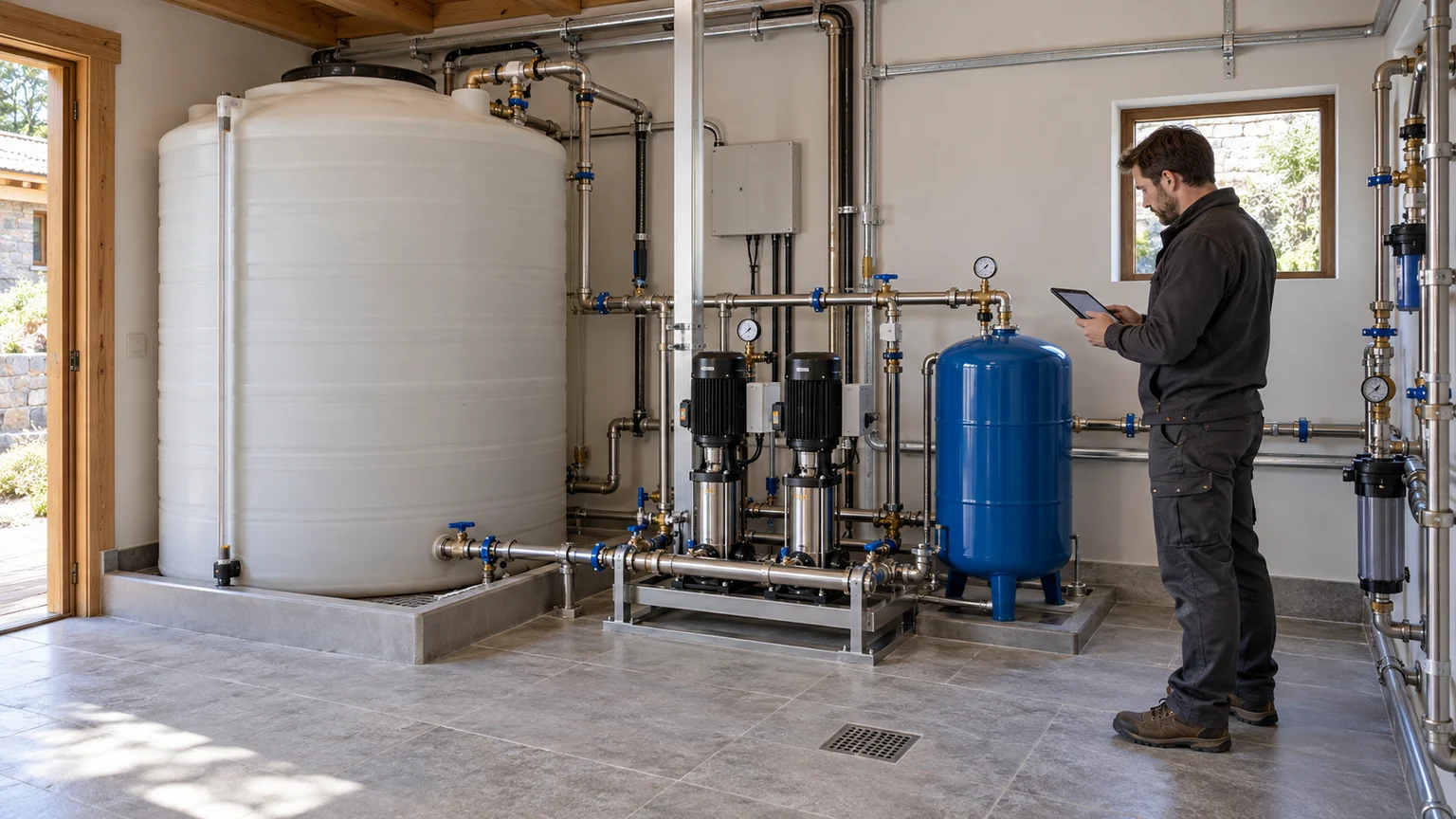
A country house does not gain water resilience merely because a large tank stands in the plant room. A useful reserve must deliver a defined service when the normal source fails: acceptable water quality, usable pressure, controlled pump operation and a safe route for any leak or overflow. Storage, treatment, boosting, controls and power therefore have to be inspected as one chain.
Russia’s current SP 30.13330.2020 treats pumps, valves and internal pipework as parts of the building water-supply system rather than isolated appliances. Where a private well is the source, begin with the separate inspection of well water, records and equipment. A storage vessel cannot cure an inadequate source, unsuitable treatment or missing operating information.
Define the outage before choosing tank capacity
The design question is not “how many litres should a large home have?” It is “which services must continue, for what event and for how long?” A brief interruption at a mains inlet, a failed borehole pump, a power cut and a water-quality alert are different failures. They may require different isolation points, priorities and recovery procedures.
Build a short scenario matrix before discussing hardware:
- Failure mode: no incoming water, failed source pump, loss of electricity, unavailable treatment train or questionable water quality.
- Required autonomy: based on service response, access to spares and the possibility of switching to another source.
- Essential outlets: drinking points, kitchen and sanitary fixtures, heating plant make-up and other systems that genuinely need water.
- Loads that can stop: irrigation, car washing, ornamental water and selected wellness facilities should not silently consume the emergency reserve.
- Occupancy: a permanently occupied residence, a weekend house and a full guest event create very different demand patterns.
- Emergency comfort: decide whether several showers must operate together or whether the reserve supports only basic use.
Useful capacity is derived from the agreed demand over the required autonomy, plus the operating allowance selected by the designer. It is then checked against usable—not merely nominal—tank volume, refill conditions and plant-room constraints. A universal capacity figure would be misleading because similar houses may have different occupants, fixtures, irrigation systems and recovery options.
A storage tank is not the same as a pressure vessel
An atmospheric storage tank holds the principal reserve. A booster set downstream creates distribution pressure. A diaphragm pressure vessel contains water and compressed gas; it cushions pressure changes, reduces pump cycling and provides a limited drawdown between control thresholds. Its shell volume is not the amount of water available when the pump is off.
“There is a pressure tank” is therefore not evidence of meaningful autonomy. Ask for the exact model, pre-charge, pump cut-in and cut-out settings, calculated drawdown and maintenance record. Manufacturer instructions link pre-charge to a system setpoint or cut-in pressure, and the relationship varies by product. A factor borrowed from another pump package is not a design. The check also follows a model-specific procedure on an isolated, depressurised system; a live gauge reading during draw-off is not a substitute.
A legible flow path normally shows the source, necessary treatment, storage, booster set, pressure vessel, manifolds and outlets. Alternative arrangements may be valid, but the as-built diagram should still identify flow direction, bypasses, non-return valves, drains and the boundary of each package.
Inspect the potable-water storage tank as a serviceable asset
The vessel and every wetted component should be documented as suitable for potable water. Russia’s GOST R 51232-98 extends relevant quality-control methods to non-centralised and autonomous supplies, so clear-looking water and a verbal assurance do not replace sampling and a control plan.
During the plant-room inspection, look for:
- a secure lid and protected vent that do not admit dust, insects or plant-room odours;
- access to the hatch, level sensors, valves and internal surfaces that require cleaning;
- a designed overflow and drain route, with the required separation from drainage connections;
- dry-run protection plus independent high- and low-level safeguards;
- a bund, waterproofed area, floor drain or another engineered way to contain a leak;
- a base and floor structure designed for the filled mass, with room to replace the vessel;
- protection from solar gain, heat sources and chemicals that could affect stored water.
Review these details alongside the wider guide to country-house plant-room serviceability. A tank that fits through the construction programme but cannot later be opened, cleaned or removed is an operational defect waiting to surface.
Pressure depends on the whole booster system
Downstream of an atmospheric tank, the pump set must serve the calculated flow at the hydraulically least favourable outlet. For a large residence, ask for the operating point of the complete installation rather than a catalogue headline: required terminal pressure, simultaneous demand, losses through treatment and pipework, static lift and the control sequence all matter.
Redundancy means that a single failure need not disable the house. A critical installation may use duty and standby pumps, automatic alternation, manual control and a maintainable bypass. Duplication is superficial, however, when both pumps depend on one unprotected circuit or one common sensor. Compare the water strategy with the guide to generator, UPS and backup-power scenarios. The selected power source must start the real pump load, while controls must recover predictably after transfer.
Rapid cycling, pronounced pressure swings, cavitation noise, vibration, leaking joints and a slow pressure recovery are warning signs during a draw-off test. No single symptom proves one cause. Incorrect vessel pre-charge, leakage, entrained air, a blocked filter, unsuitable settings or a mismatched pump all require systematic diagnosis.
Stored-water quality depends on turnover and access
Reserve water should turn over during ordinary operation. If the tank is connected only for emergencies, stagnant water may remain unnoticed until the day it is needed. The operating plan should explain how turnover occurs, where samples are taken, how the vessel is emptied and cleaned, who performs sanitary work and which documented procedure applies.
There is no automatic rule that storage must always sit before or after every treatment stage. The correct position depends on source quality, the purpose of the reserve and the stability of the treatment equipment. What is essential is prevention of backflow and unintended cross-connections between potable and technical lines.
Request the latest laboratory report and identify the exact sampling point on the as-built diagram. A sample collected upstream does not prove the condition of water after storage. Following work, extended stagnation, contamination, or a change in taste or odour, rely on the applicable sanitary procedure and a fresh analysis rather than masking the symptom with another filter.
Run a controlled outage test
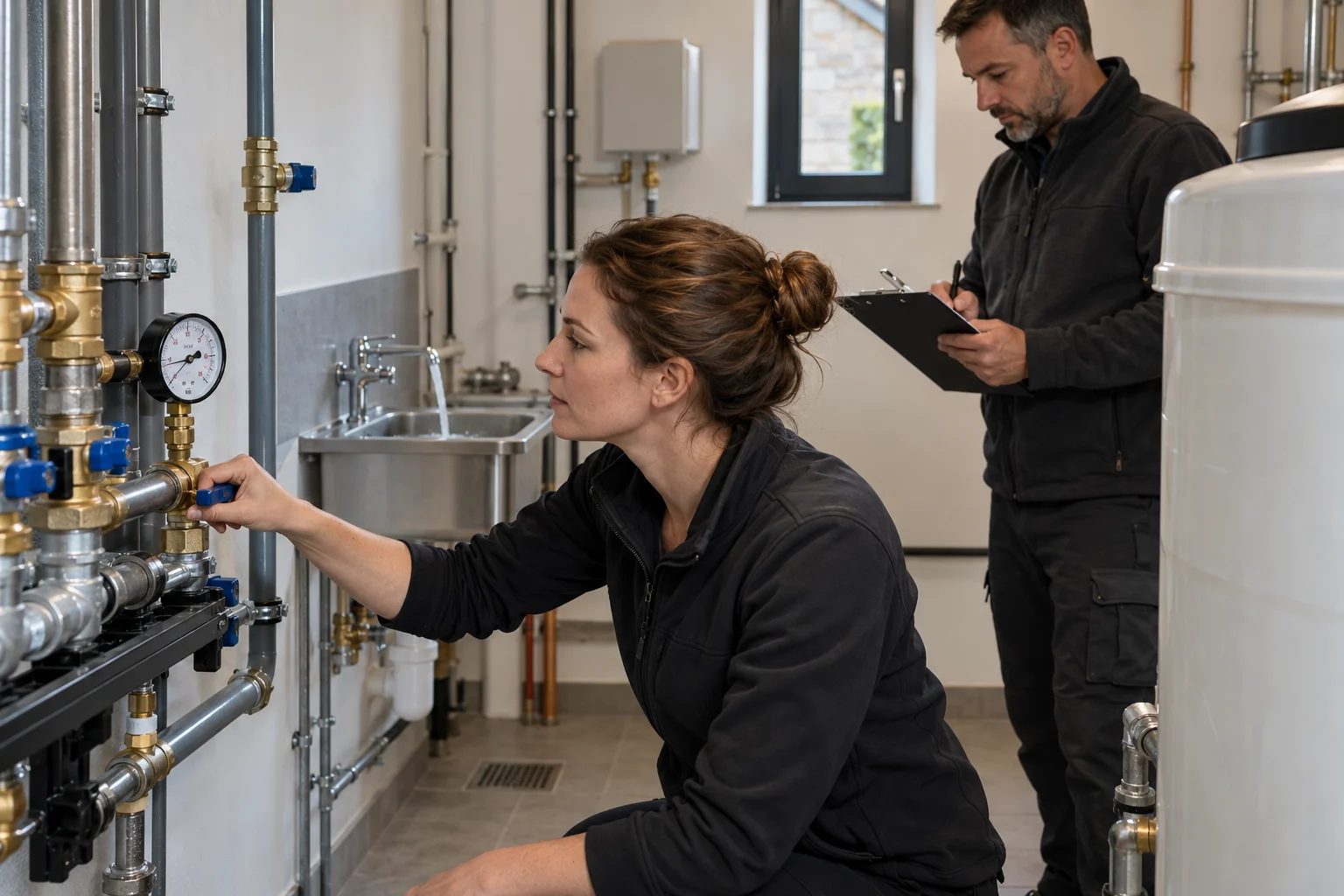
Do not accept the system from equipment photographs alone. Test it with the responsible engineer after confirming dry-run protection and agreeing which valves and controls may be operated. An unfamiliar booster room is not the place for an improvised failure simulation.
- Record the initial tank level, pressure, pump state and active controller messages.
- Close the normal source by the designed method or use the formal test mode without disabling safety controls.
- Open the agreed outlets and observe transfer to storage, pressure stability and pump sequencing.
- Check low-level alarms, dry-run response and standby operation where the approved test procedure permits it.
- Restore the source and confirm controlled refill, air removal, level shut-off and the absence of leaks.
- Record times, readings and defects. A short video of the gauge and control panel is stronger evidence than “it worked last time.”
The test need not exhaust the reserve. Its purpose is to prove the change of operating mode, expose poor settings and establish a credible autonomy estimate from measured demand and usable storage.
Buyer’s handover checklist
Finish with information that an owner and service team can actually use, and include water resilience in the broader technical and documentary due diligence of a prime home.
- as-built diagram showing isolation valves, bypasses, drains and sampling points;
- the outage scenario and usable-volume calculation, not just nominal tank capacity;
- manuals for the storage tank, pumps, pressure vessel, sensors and controller;
- pressure and level settings, pre-charge data and the date of the last check;
- commissioning records, water analyses and cleaning and maintenance logs;
- manual-mode instructions, leak response and competent service contacts;
- evidence that backup power starts the pumps under their real load.
The same discipline applies to homes along Rublevo-Uspenskoye Highway and Novorizhskoye Highway: equipment prestige is less important than a repeatable failure response. A credible reserve combines verified water quality, accessible storage, stable pressure, functioning controls and a tested path to the source and power that remain available during the outage.