A Pond on the Property: Liner, Banks, Safety and Winter Operation
A private pond should be assessed as one system: purpose, water balance, basin and penetrations, stable banks, equipment, water quality, human safety and a documented winter strategy.
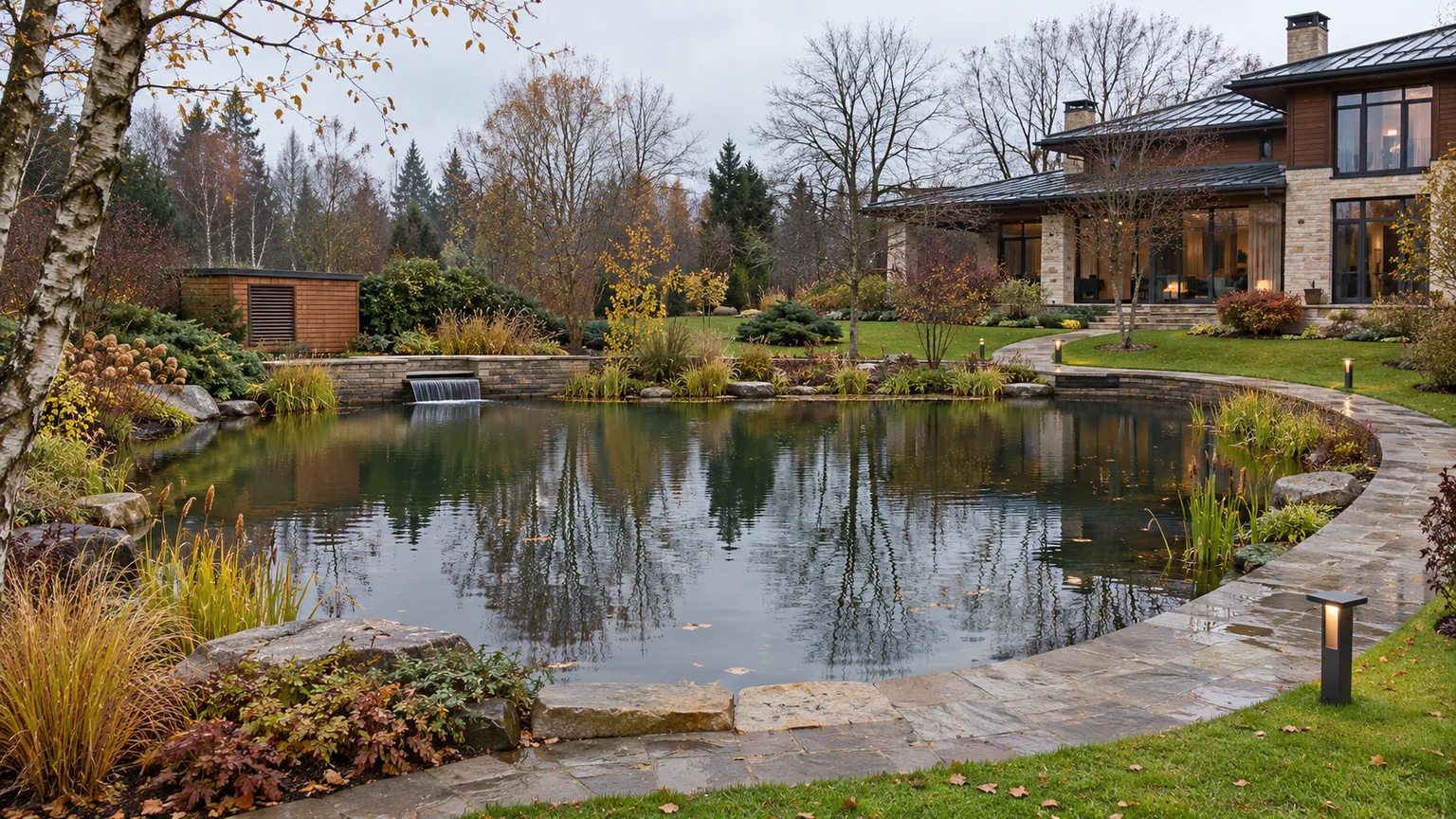
A private pond may look like landscape, but it operates as an engineered and biological system. Water enters and leaves, soil loads the basin, ice affects edges and equipment, plants and fish alter water quality, and the bank must remain stable, serviceable and safe. Clear water on a viewing day proves very little: it may have been recently replaced, treated or temporarily supported by hired equipment.
Begin with intended use. An ornamental water feature, ecological pond, koi system, storage pond and swimming pond have different requirements for depth zones, circulation, equipment and safety. If one pond is said to do everything, ask for design criteria for every function. Swimming cannot be accepted as a convenient extra to a decorative basin; it needs a separate review of water, bottom, entry, rescue arrangements and operating rules.
Russian references include SP 82.13330.2016 for territory improvement, GOST R 56586-2015 for polyethylene waterproofing geomembranes and SP 58.13330.2019 for hydraulic structures. A competent designer must determine which provisions apply to the particular construction and local context. A small garden pond should not inherit a major-reservoir solution blindly, but it is also more than a hole lined with film.
Define the purpose and create a pond asset record
Request an operating record rather than a lifestyle description. It should include purpose, plans and sections, water and bank levels, volume and depth zones, basin construction, penetrations, make-up source, overflow and emergency discharge, equipment, electrical diagram, plants and animals, maintenance regime and winter strategy. Unknown information belongs in the inspection scope rather than being guessed.
Separate claims from evidence. A “self-cleaning” pond needs an intelligible balance between biological load, circulation, planted zones and sediment removal. “No topping up” requires a seasonal level history, not one high reading after rain. “Winters perfectly” means the species, unfrozen volume, equipment duty, oxygen monitoring and failure response are known.
- What is the primary use and which activities are prohibited?
- Who designed the basin, banks, electrical installation and water movement?
- What changed after construction?
- Where does make-up water come from and where does overflow go?
- Which tasks require partial or complete drawdown?
- Who owns water quality, fish, plants and winter operation?
This is different from inspecting a home beside a natural body of water. There the external shoreline, wider hydrology and legal context dominate; here the owner controls an artificial basin and its equipment.
Establish the water balance before diagnosing leaks
Rainfall, runoff, groundwater, evaporation, seepage, irrigation use, filter backwashing, overflow and topping-up all move the level. Without a balance, every fall is blamed on heat and every rise on rain. A useful record identifies inputs and outputs, seasonal operating modes, control levels and the system response expected at each limit.
The USDA NRCS Pond 378 standard frames pond work around suitable topography and soil, reliable water supply, safe runoff conveyance, water quality, erosion protection and lifetime maintenance. It is not a Russian design code, but the discipline is valuable: a pond cannot be evaluated independently from the land that feeds it.
Trace stormwater. Roof, driveway or fertilised-lawn runoff can carry sediment, de-icing residues and nutrients. A concentrated inflow erodes the edge; an uncontrolled overflow sends water towards foundations, paths or neighbours. Coordinate the pond with the wider assessment of drainage and seasonal water beneath the plot.
For an existing pond, log water level, rainfall, make-up and equipment operation. Compare similar weather and pump regimes. A change after construction or gardening can indicate damage; a steady loss may be leakage, evaporation or an unrecorded draw. Measurement and localisation must precede continuous topping-up.
A basin is only as reliable as its layers and details
The material name alone is not a warranty. A membrane basin depends on prepared subgrade, removal of sharp objects, separation and protection layers, welded or bonded seams, perimeter anchorage, protection from ultraviolet and mechanical damage, and compatibility with soil and water. GOST R 56586-2015 addresses polyethylene waterproofing geomembranes and test methods, but a compliant roll does not automatically create a sound seam, pipe penetration or shoreline detail.
Critical locations include penetrations, skimmers, bottom intakes, lights, overflow, stone and concrete interfaces, steps, terraces and the variable-level zone. Ask for as-built photographs before concealment, a drawing of every penetration and quality-control records. An unlocated hidden fitting can turn a local repair into a large excavation.
Clay, concrete and composite basins use different methods but follow the same logic: construction must suit soil, movement, water and drawdown. A concrete crack cannot automatically be solved with a coating, and seepage through an earth basin should not be treated by adding random material without understanding the subgrade.
- Compare the design water level with the observed wet line.
- Inspect the edge at normal and service level when a safe method is available.
- Locate every penetration and confirm access to its external connection.
- Check membrane protection beneath stone, planting and service routes.
- Reconcile the as-built record with installed equipment.
- Map repairs, patches and recurring leakage.
Make the shore stable, maintainable and safe
The edge holds soil, conceals waterproofing, tolerates level changes, manages runoff, supports planting and provides maintenance access. An attractive overhanging stone may hide washout, a void or exposed membrane. Lawn brought directly to the water complicates maintenance and can transport nutrients into the basin.
Walk the full perimeter after rain. Look for settlement, cracked paving, loss of fine material, tilted stones, exposed layers, external ponding and places where machinery drives too close. Review roots of major plants and whether the edge can be repaired without removing mature landscaping. Seasonal defects can be compared with our method for reviewing landscape quality after its first winter.
Service access is not the same as a promenade. A technician needs a safe position for reaching a skimmer, taking samples, lifting a pump and removing sediment. A narrow wet slab with no place for tools forces poor practice beside deep water. Drawdown maintenance also needs a machinery route and a location for temporary components.
Use layered safety rather than one warning sign
Russian emergency-services guidance emphasises continuous adult supervision when a child is near water. On a private property, supervision should not be the only layer. Access must remain controlled when a parent is distracted, a contractor gate is open or guests do not know the depth. The strategy depends on the household but may include controlled doors, barriers or dense boundaries at risk areas, visibility, slip-resistant approaches, an intelligible shallow edge and immediately available assistance equipment.
Do not disguise a sudden depth transition with uniform dark water and stone. Check every slab, avoid entrapment gaps, provide a credible exit from the water and ensure equipment can be isolated quickly. Decorative bridges, decks and boulders are not diving platforms. If swimming is planned, accept it as a separate function rather than assuming equivalence with a private indoor pool; open water has different visibility, bottom, biology and seasons.
Winter ice does not turn a garden pond into a path. Strength varies around aeration, inflows, plants, pipes and equipment. The property plan should prevent accidental access by children, guests and animals. Technicians work from the bank or a designed platform and should not improvise by striking ice over overwintering fish.
Require accessible, documented equipment
The system may include circulation pumps, skimmers, bottom intakes, mechanical and biological filtration, ultraviolet treatment, aeration, automatic make-up, overflow, lighting and monitoring. More hardware is not proof of better design. A hydraulic diagram should show flows, working duty, head losses, valve positions and safe failure states.
Open every service chamber. It should be dry under the design condition, ventilated, lit and accessible without dismantling heavy landscape features. Pumps and filters need identifiers, isolation, working clearance and a removal route. A qualified electrical specialist should review the wet external environment, protective devices, bonding where required and test evidence.
Ask for a live filter-cleaning cycle: removal of solids, return to service and disposal of dirty water. Backwash must not flood planting, return contamination to the pond or create a risk near the house. Overflow and failed make-up controls also need operating scenarios.
Consumables, response times and ownership belong in an auditable engineering service agreement. “The landscape gardener looks after it” is incomplete if no one owns water quality, fish, electrical safety and emergencies.
Read water quality as a trend
Clarity is one observation. The owner should understand temperature, dissolved oxygen, acidity, mineral content and other parameters relevant to the chosen life and equipment. USGS explains that dissolved oxygen is influenced by temperature, photosynthesis and biological oxygen use. One afternoon result cannot describe a daily or seasonal cycle.
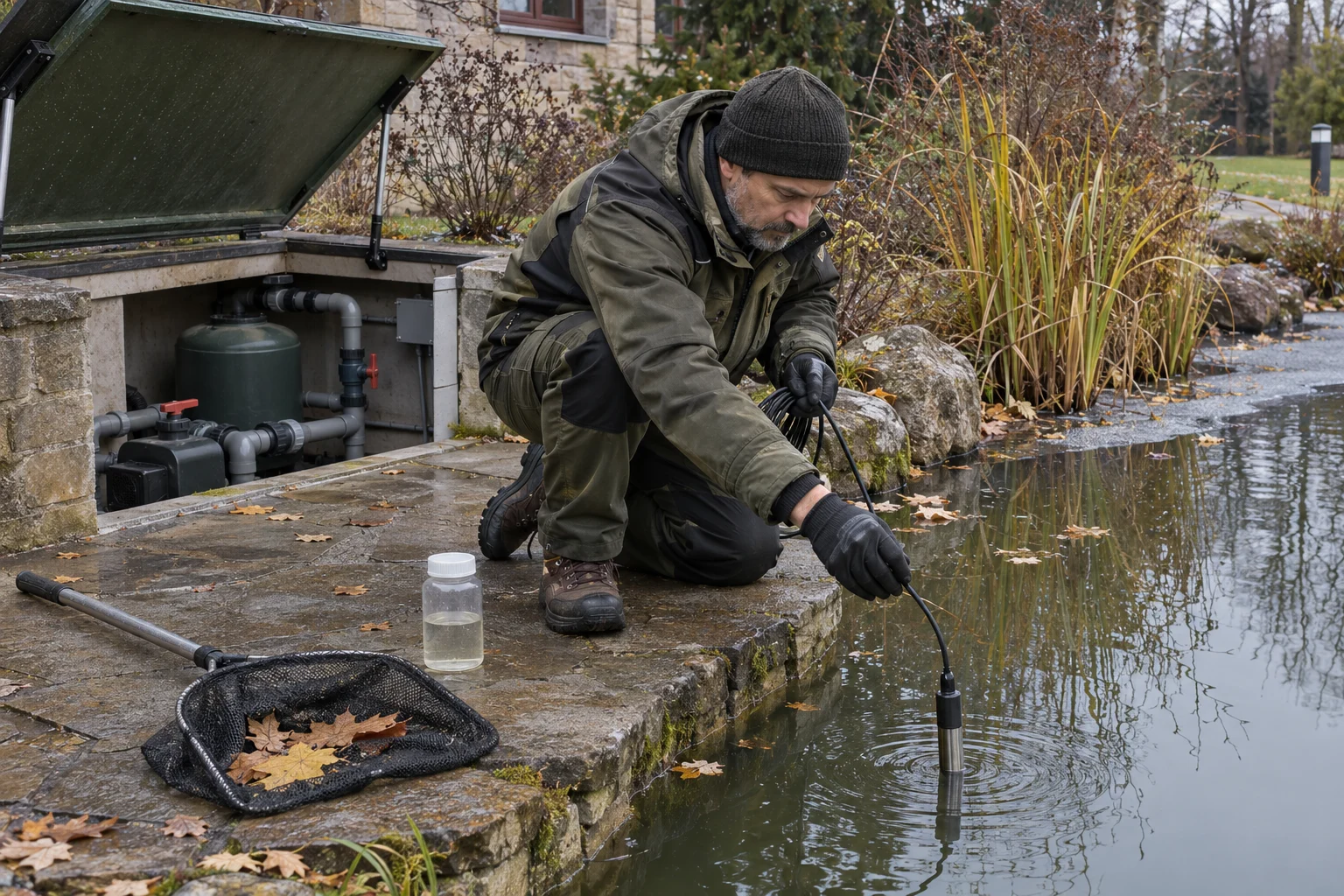
Map nutrient and organic inputs: leaves, feed, fertiliser, runoff, bottom sediment and dying vegetation. An algal bloom is a reason to investigate light, nutrients, biological loading and circulation. Chemical treatment without diagnosis may hide the symptom, harm pond life and complicate future management.
For a fish pond, preserve a species and stock register, feeding history, water results, disease events and winter losses. Do not import universal stocking density, temperature or oxygen targets from another installation. A specialist must set them for the actual species, volume, depth and equipment.
Prepare winter operation before ice forms
The winter plan starts with an inventory: which plants are cut or moved, which fish remain, which pumps operate, which lines are drained, which filters are isolated, and where level and oxygen are measured. Follow the design and equipment documentation rather than simply switching everything off or leaving the summer configuration unchanged.
Before sustained cold, remove excess organic matter, clean accessible areas and review anchors, cables, valves, overflow and chamber protection. External lines exposed to freezing need a proven drain-down or winter-operating method. Test make-up controls and sensors at low temperature instead of assuming summer accuracy continues.
Snow and ice change light, gas exchange and oxygen demand. Aeration, an open-water zone and monitoring points must therefore follow depth, biomass, planting and measurement. Aggressive mixing that helps one pond may disrupt another pond’s winter temperature structure. Define alarms and actions for power loss, falling level and adverse water trends.
Commission and purchase through live tests
Do not accept a freshly cleaned pond by appearance alone. Useful tests include observation after rain, normal and service-level inspection, pump start and stop, filter cleaning, overflow and make-up checks, chamber inspection, water measurement and a simulated loss of power. Plan every action so fish and equipment are not harmed.
The owner handover package should contain:
- current plans, sections, levels and volumes;
- basin-layer, penetration and shoreline details;
- as-built photographs and seam quality-control records;
- hydraulic and electrical diagrams;
- equipment manuals, settings and spare parts;
- water-level, make-up, test, treatment and repair history;
- plant and animal registers;
- summer, emergency and winter procedures;
- contractor contacts and responsibility boundaries.
Include these records in the wider operational handover of the residence. Warning signs include an unknown make-up source, no defined overflow, wet service chambers, concealed electrical work without drawings, repeated membrane patches, an eroding edge, water treatment by guesswork, missing winter-loss records and a seller unwilling to run the equipment.
Ponds at residences along Rublevo-Uspenskoye and Novorizhskoye Highway differ in soil, topography, planting and maintenance history. Location does not prove quality. A reliable pond has a documented water balance, accessible basin and plant, stable banks, measured water and a safe plan for every season.