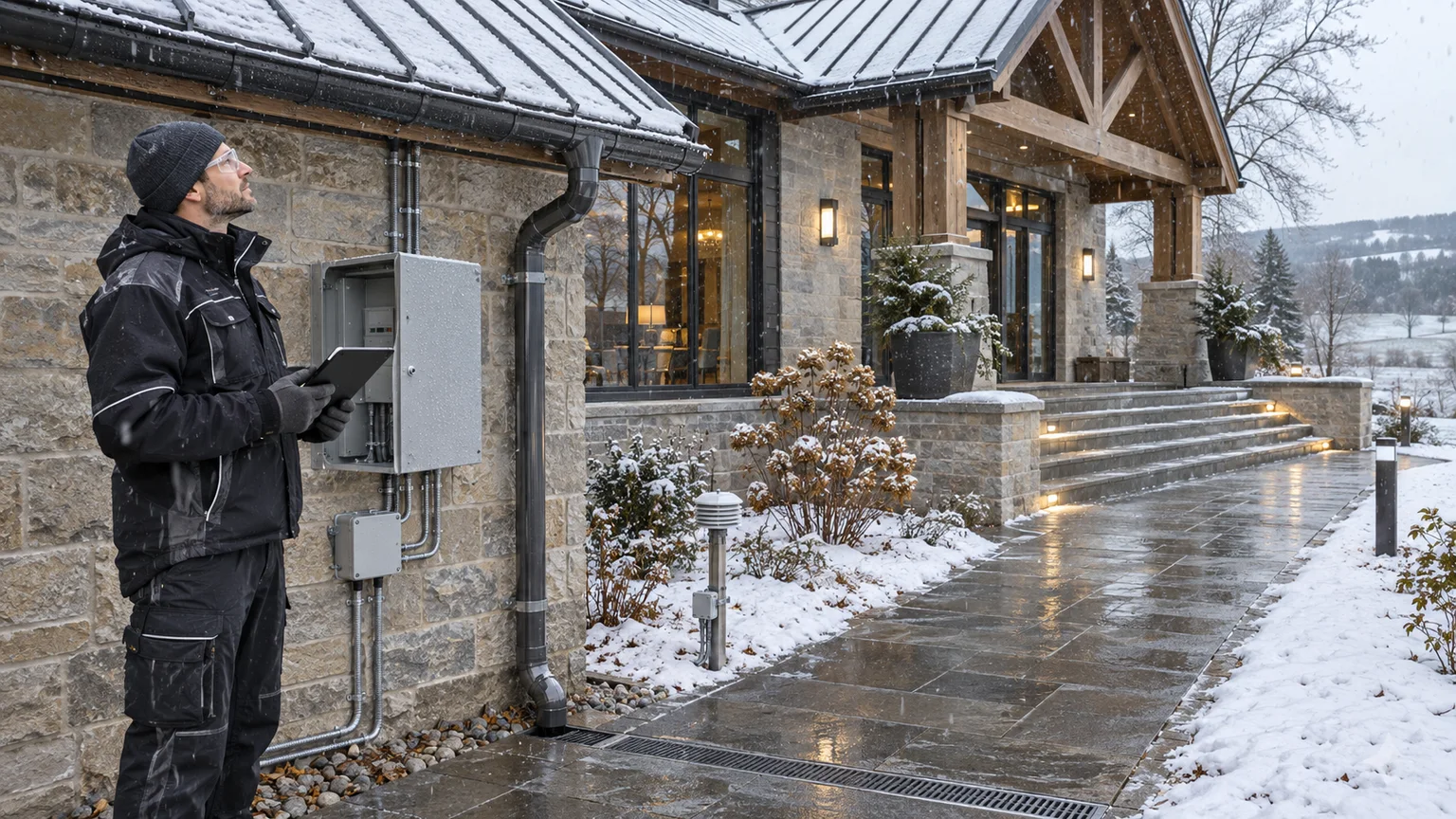
Heat Pump Retrofit for a Country House: Source, Peak Load and Backup
A practical framework for retrofitting a heat pump into an occupied country house without guessing the load, emitter capacity or backup strategy.
Retrofitting a heat pump into an occupied country house is not a like-for-like generator replacement. It changes the water-temperature regime, electrical demand, hydraulic balance, control sequence and the role of the existing boiler. A proposal based only on floor area and the boiler nameplate therefore leaves the essential question unanswered: will the system maintain comfort in every critical zone at design conditions, and what happens during peak load, defrost, a component failure or a power interruption?
Russian SP 525.1325800.2023 applies heat-pump design rules to reconstructed and modernised buildings as well as new ones. For an owner, the practical implication is simple: the retrofit needs a documented baseline, calculations, a coordinated design, commissioning and an operating strategy. A catalogue efficiency figure cannot substitute for a model of the actual house.
Establish the load before choosing equipment
The output printed on the existing boiler is rarely the building heat loss. The boiler may have been oversized, may also serve domestic hot water or a pool, or may simply short-cycle. Selection should start with room-by-room design loads, then be checked against evidence from the operating system.
Prepare an input package covering:
- plans, wall and roof build-ups, glazing areas and any completed insulation work;
- target temperatures and rooms that must never be allowed to drift into setback;
- fuel or electricity records, outdoor temperature, burner runtime and supply/return temperatures where available;
- radiators, convectors, underfloor loops, air-handling coils, pool exchangers and hot-water cylinders;
- the confirmed electrical service capacity, main-board arrangement and loads intended for backup power.
If no reliable history exists, collect instrumented observations during cold weather: outdoor temperature, valve positions, circuit flow where measurable, supply and return temperatures and representative room temperatures. Our guide to checking winter readiness helps distinguish envelope defects from heating-system faults. A heat pump cannot cure air leakage, poor balancing or failed controls.
Select the heat source together with the site
Air, ground and water sources differ in far more than the equipment price. Each option imposes its own spatial, civil-work, access, maintenance and reinstatement requirements.
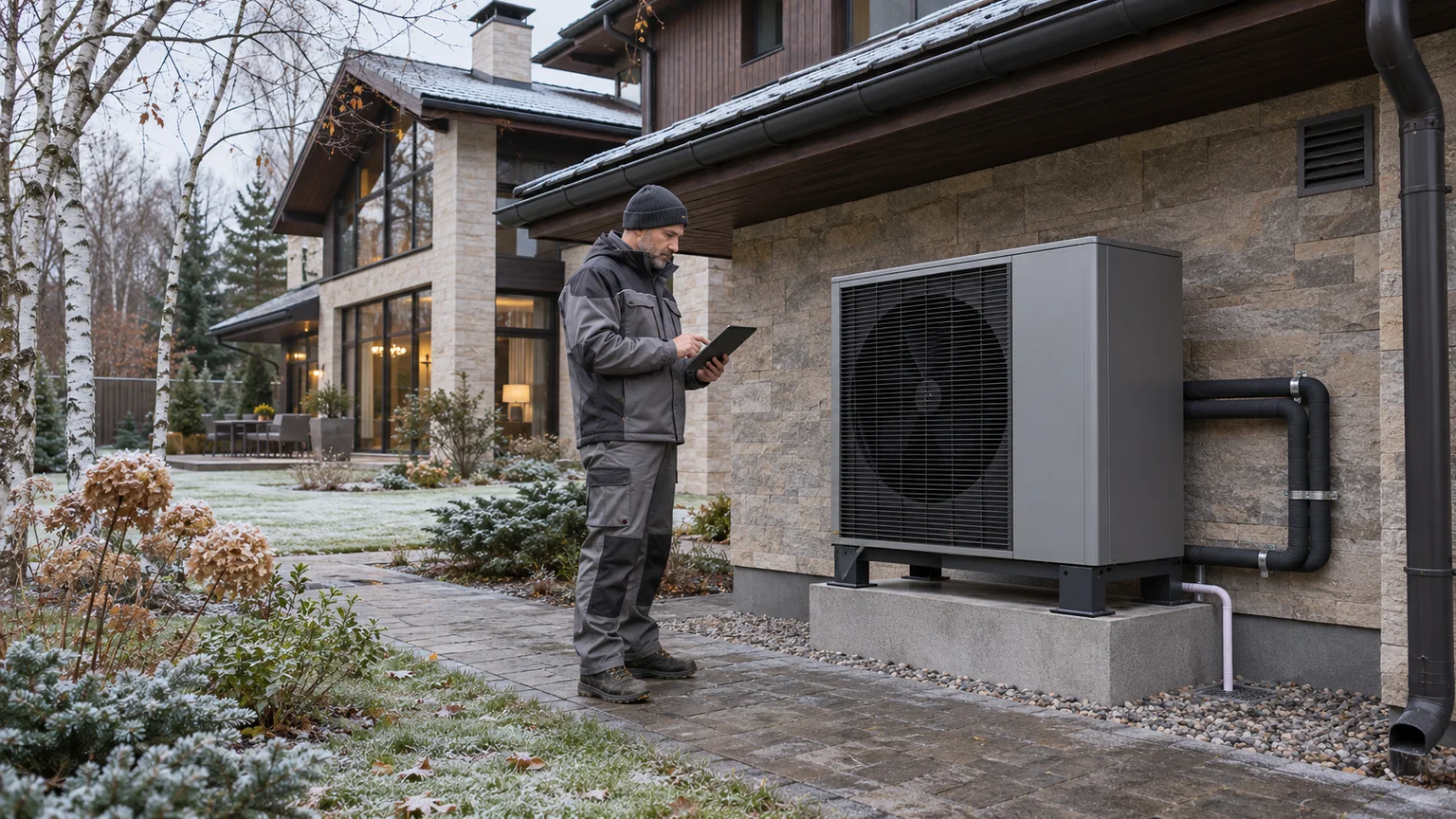
Air-to-water is often the least disruptive retrofit, but available capacity and electrical input change with outdoor and leaving-water temperatures. The outdoor unit needs unobstructed airflow, a deliberate defrost-water route, snow protection, vibration isolation and service access. An architectural enclosure is acceptable only if it respects the manufacturer's airflow clearances.
A ground loop reduces short-term weather exposure at the source, but it requires a heat-exchange design, a justified borehole or horizontal-field configuration, machinery access and an accurate as-built survey. Loop length must not be guessed from house area. Existing drainage, utilities, gas lines and valuable tree roots must be mapped before work begins.
Water-source arrangements need verified yield and water quality, a lawful abstraction and discharge concept, exchanger protection and a maintainable pumping strategy. The presence of a well does not prove that it is a suitable heat source.
Test existing emitters at lower water temperatures
The higher the required supply temperature, the more demanding the compressor duty and the weaker the case for carrying a headline efficiency number into the annual budget. The relevant question is not whether the house has radiators, but how much heat each emitter can deliver under the proposed temperature regime.
Audit emitters by room, verify circuit flows and run a controlled low-temperature trial during sufficiently cold weather. Record room temperature, valve position, supply and return values and any comfort failure. Glazed rooms, corners, spaces above a garage and remote branches deserve separate attention.
If a zone falls short, raising the whole-house curve is only one option. A designer may increase emitter area, add a low-temperature unit, rebalance flow, correct an envelope defect or retain a different heat source for that zone. The broader audit of ageing engineering behind an expensive interior is useful before opening finishes or routing new services.
Put peak load and backup on the same chart
For an air-source heat pump, the designer overlays two relationships: building heat loss rises as the weather becomes colder, while the selected machine's available output changes with outdoor and water temperatures. Where the curves cross is not a verdict on the product; it is the boundary of the selected system strategy.
Three approaches are possible in an existing house:
- Full design coverage. The heat pump carries the design peak and backup exists for failure. Minimum modulation still matters, because an oversized machine may cycle excessively in mild weather.
- Parallel bivalent operation. The pump covers the base load and a boiler or electric heater supplies the shortfall. Controls must define whether sources can run together and how water flow is shared.
- Alternative operation. Below defined conditions, the heat-pump circuit stops and backup assumes the full load. Available backup capacity and the transition sequence must be calculated and tested.
The decision is not reduced to one outdoor-temperature setting. It also reflects energy availability, electrical-service limits, boiler turndown, domestic hot water, defrost and acceptable recovery time after an outage. Where backup relies on a generator or UPS, coordinate it with the house's backup-power strategy. Compressors, pumps, controls and boilers impose different starting and power-quality requirements.
Hydraulics make the retrofit controllable
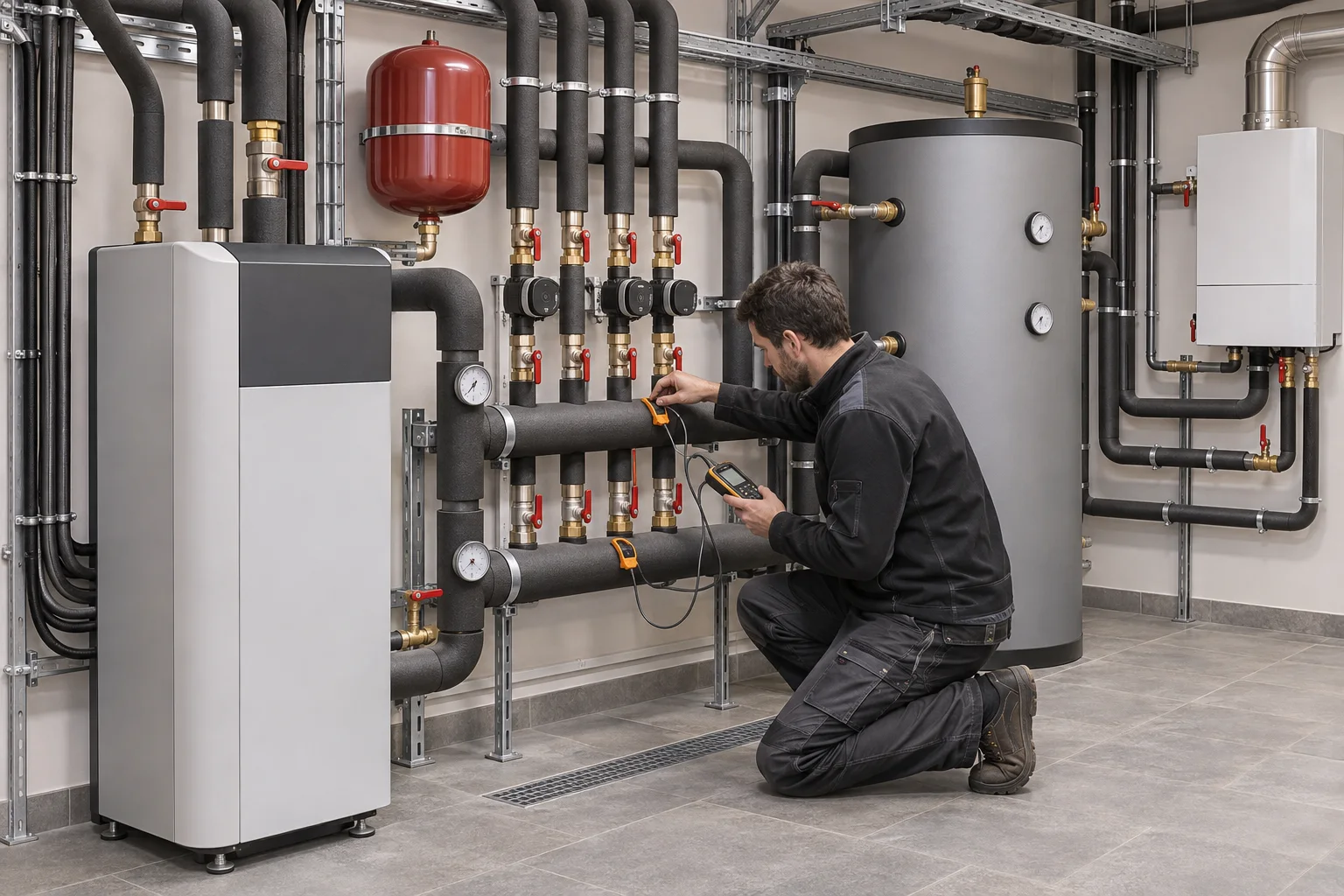
An established plant room may contain several temperature circuits, a low-loss header, mixing groups, a hot-water cylinder, ventilation coils and controls from different generations. Adding a heat pump without recalculating flows can create a hydraulic short circuit, inadequate flow through the exchanger or pumps fighting each other.
The design should identify primary and secondary boundaries, explain whether a buffer is required and what function it serves, ensure minimum flow, assign control of mixing valves and define the domestic-hot-water sequence. Buffer volume is not a universal number per unit of capacity; it depends on system water volume, minimum machine output, permitted cycling, defrost logic and manufacturer requirements.
Maintainability is equally concrete. Filters, pumps, heat exchangers, safety devices and sensors need removal space. The guide to serviceable plant rooms helps test access before new pipework blocks existing equipment.
Electrical capacity, noise and defrost belong in the heating design
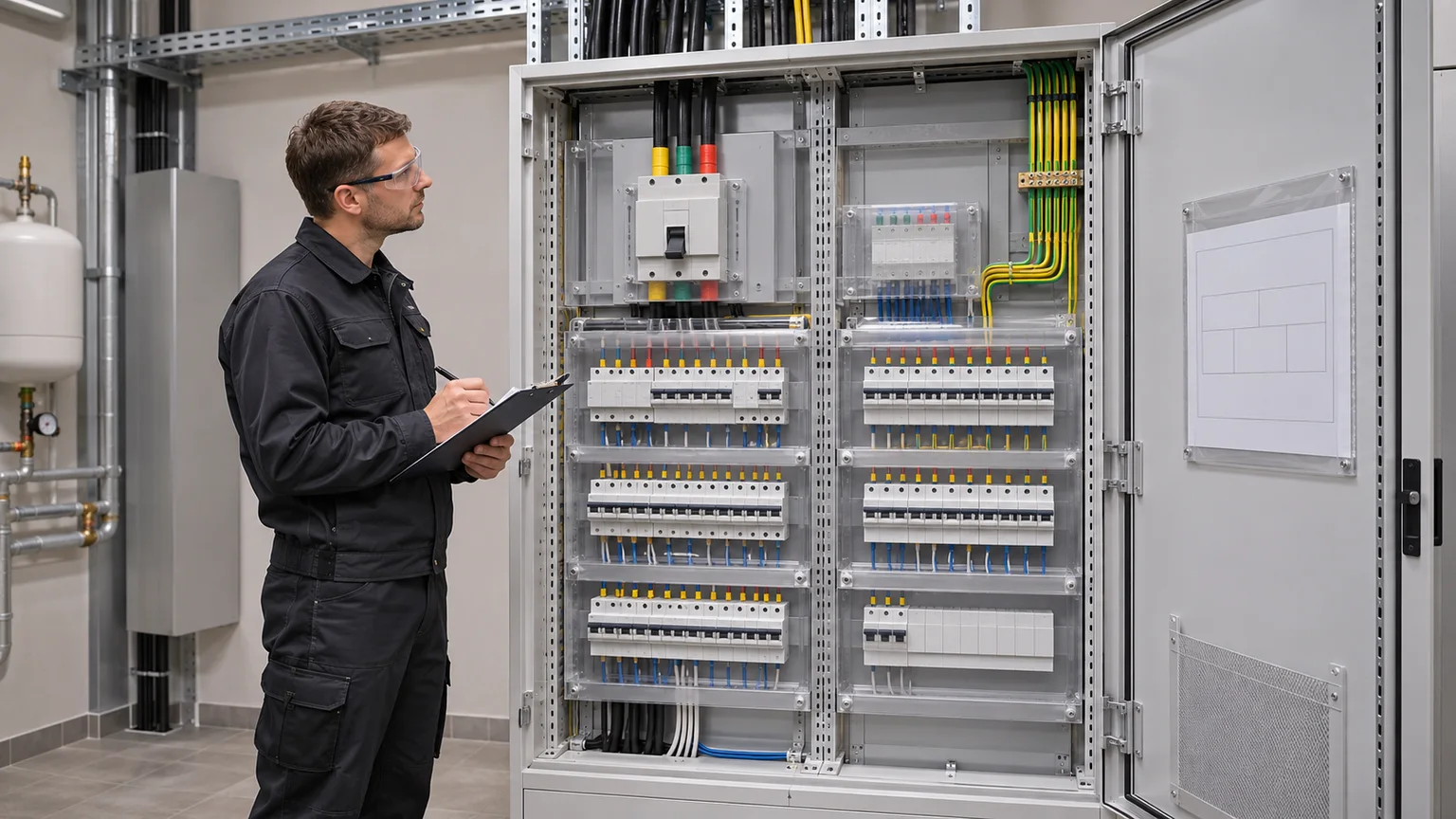
The electrical review goes beyond compressor rated input. It includes circulation pumps, integral heaters, controls, sump or drain heating and other coincident loads. The engineer checks phases, protection, cables, voltage quality, service limits and behaviour on backup supply. Safety is governed by the coordinated design, equipment instructions and applicable rules, including GOST IEC 60335-2-40-2020.
An outdoor unit also needs an acoustic and drainage scenario: declared sound data, bedrooms and neighbours, reflective facades, night operation, structural vibration and the destination of defrost water. A screen must not restrict airflow. Meltwater must not freeze across a path, service zone or foundation edge.
Ground- and water-source systems have different failure modes: brine pressure loss, leakage, exchanger fouling or source-pump failure. Each should have a defined alarm, response threshold and service route.
Commission the system, not just the compressor
GOST R 59510-2021 covers installation, commissioning and work-control rules for building heat-pump systems. An owner should receive an acceptance package that links design decisions to measured settings on site.
Before final payment, request:
- the approved schematic, specification, cable schedule and as-built routes;
- load calculations and manufacturer performance tables at the actual source and leaving-water design conditions;
- pressure-test, flushing, filling, air-removal and heat-transfer-fluid records;
- measured flows, supply/return temperatures, electrical values and weather-compensation settings;
- functional tests for backup transition, simultaneous source operation, hot-water priority, defrost and recovery after power loss;
- alarm lists, notifications, remote-access ownership and manual actions for the house team;
- a first-season monitoring plan stating what may be adjusted, by whom and with what evidence.
Judge performance from trends, not a single cold day or a polished mobile interface. Useful data includes outdoor, supply, return and room temperatures, compressor runtime, backup runtime and energy input. Seasonal results are shaped by part-load operation, which is why GOST R 70829-2023 addresses testing and assessment under partial-load conditions.
Owner's decision checklist
- Room-by-room heat loss is documented; selection is not based on area or old-boiler capacity.
- Performance comes from manufacturer tables at the actual source and delivery temperatures.
- Existing emitters have been tested at a lower water temperature.
- The source fits the site, noise limits, drainage and service access.
- Peak and backup are calculated as one system, including electrical capacity.
- The hydraulic schematic explains flow, buffer function, hot water and two-source control.
- Commissioning criteria and first-season monitoring are agreed before installation.
- Responsibility for refrigerant, hydronic, electrical and control work is not lost between contractors.
After handover, include the installation in a structured engineering service agreement with an asset register, alarm priorities, response logic, setting history and access rules. The heat pump then becomes a measurable part of the house operating system rather than an experiment attached to the boiler room.