Who Owns the Roads and Utilities in a Gated Community?
A buyer-side method for tracing ownership, access rights, operating responsibility and costs for the roads and utility networks serving a gated community.
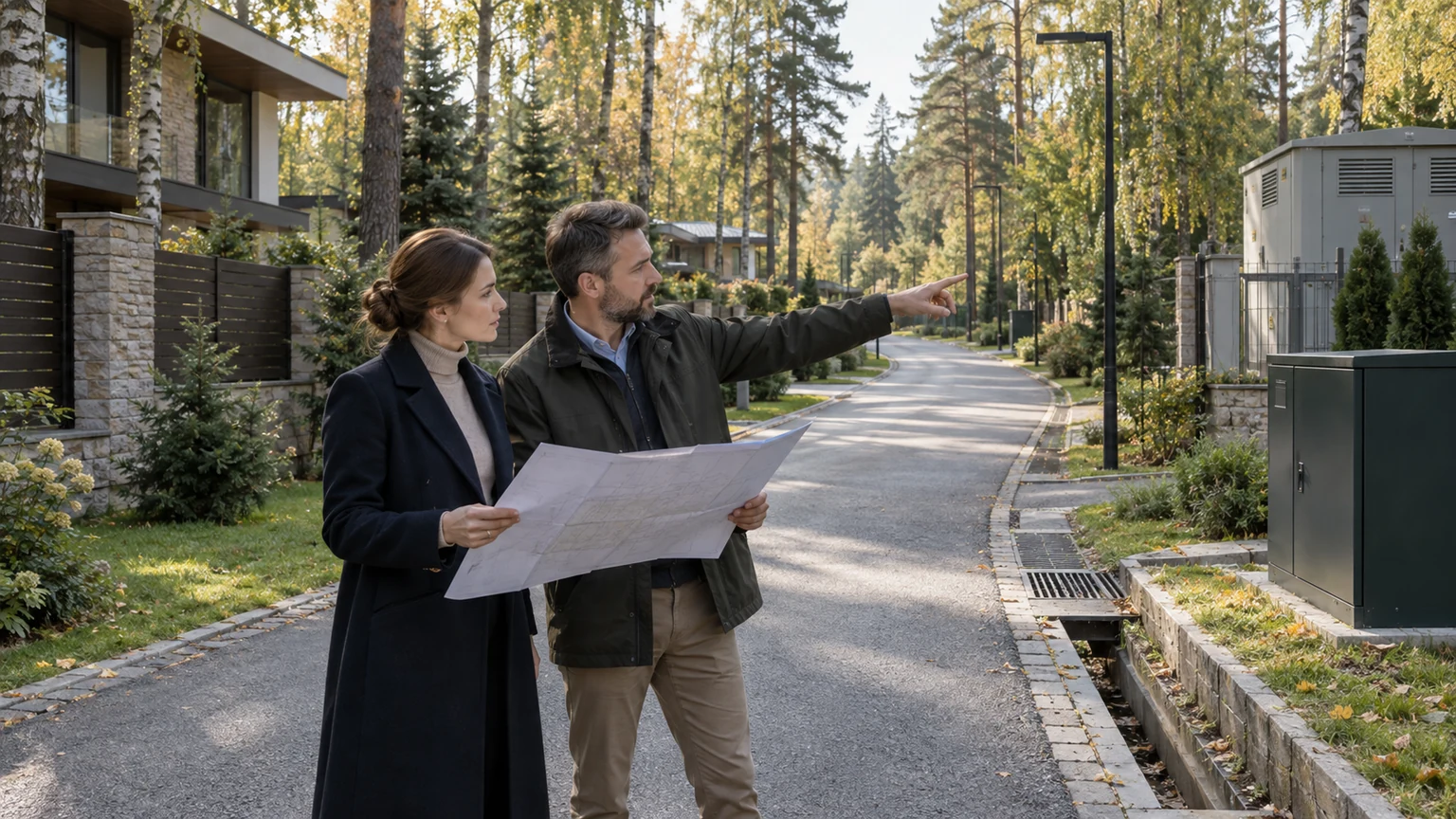
In a well-kept gated community, the roads, lighting, drainage, transformer, gas pipes and water system appear to form one estate. Legally, they may be a collection of assets with different owners, operators and rights of use. The road land could belong to one company, the surfacing could have been funded by residents, the electricity network could sit with a regulated network operator, and the water plant could remain with a developer affiliate. A sales statement that everything is “on the management company’s balance sheet” does not establish title, access rights or emergency responsibility.
This review complements the broader process of choosing a gated community and the separate analysis of phased construction and future infrastructure. The question here is not whether a road or network has been promised. It is who owns each essential asset now, why the selected property may use it, who maintains it and what remains enforceable if the developer, operator or landowner changes.
Identify the legal model before relying on the community name
“Gated community” or “cottage village” is a market description, not a single Russian legal form. Similar-looking developments may involve a horticultural non-commercial partnership, commercial companies owning the roads and utilities, common ownership among plot owners, municipal assets, resource-company networks, or a combination of these. The statutory regime for shared property in an SNT must not be assumed to govern every private residential development.
Where the land is genuinely within a horticultural territory, Federal Law No. 217-FZ contains a special framework. Article 25 addresses common ownership of qualifying shared immovable property and links the creation of registered title to the state registration system. It also allows certain property to be held by the partnership and, subject to statutory conditions, transferred to relevant utility organisations. A commercial development held through limited-liability companies may follow a different structure. Current EGRN records, contracts and the corporate chain—not the marketing label—determine the due-diligence conclusion.
Request a written map of the model: territorial boundaries, title holders of common land, the residents’ organisation, owners of infrastructure and the contracts under which the operator acts. Counsel should test that description against registry evidence. Community rules, articles and service agreements matter, but they do not replace registered title to immovable property.
Build an asset register, not a one-line infrastructure certificate
Review the estate asset by asset. A statement that “roads and utilities belong to the community” conceals the distinction between land, structures and services. Separate at least the following:
- land beneath the external access, internal streets, turning areas and emergency routes;
- road surfacing, kerbs, bridges, culverts, surface-water drainage, pavements and street lighting;
- electricity source and distribution assets, including substations, cables, cabinets and meters;
- gas-distribution pipes, pressure equipment and the segment leading to each property boundary;
- wells, abstraction facilities, treatment plant, water mains, sewers and wastewater treatment;
- communications, CCTV, barriers, gatehouses, fire-water assets, amenity land and the maintenance base.
Give every asset six fields: precise description or cadastral identifier; owner; evidence of title; lawful users; maintenance and repair operator; and the party funding routine work and capital replacement. Add the evidence date and its connection to the particular home. If the asset cannot be identified, that is not an administrative detail. Its title, encumbrances, service boundary and potential transfer cannot be tested reliably.
Distinguish the legal owner, accounting balance holder, physical operator and contracting counterparty. Four separate entities may fill those roles. “Maintained by the management company” describes a function, not ownership of the land or network, access rights after the service contract ends, or capacity to fund major replacement.
Trace the road land and prove continuous access
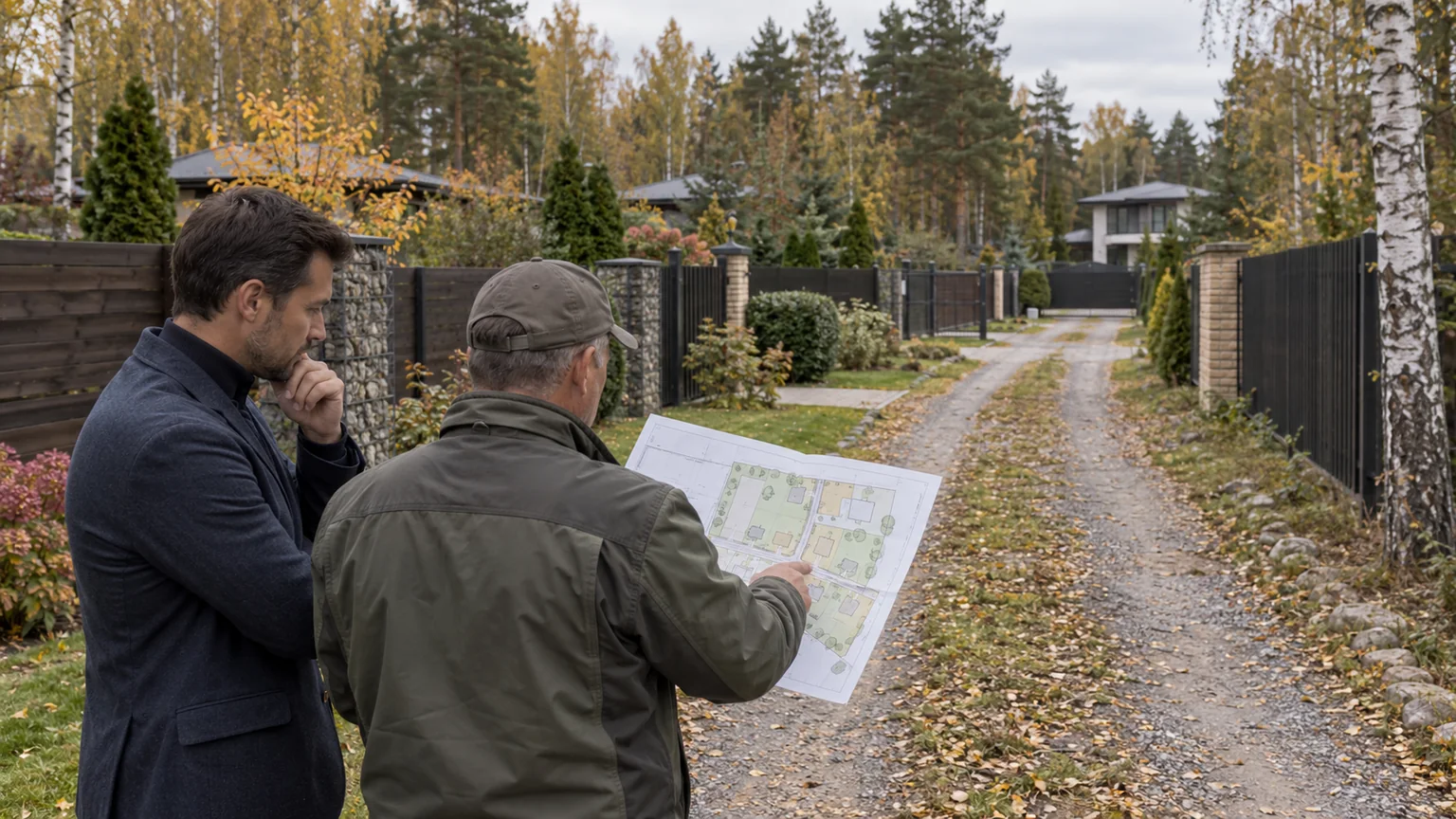
Follow the route from the public highway to the gate of the selected property. Mark every crossed parcel on the cadastral plan and obtain current EGRN evidence for the material links. Identify title, permitted use and registered restrictions or encumbrances. Rosreestr’s EGRN information service is the starting point for official records. Online map layers are useful for orientation, but critical findings should be supported by dated documents for the exact parcels.
Owning the house does not invariably provide a complete legal route across third-party land. Article 274 of the Civil Code provides for an easement, including where passage, vehicle access or the operation of linear infrastructure cannot otherwise be secured. A visible roadway does not prove that an easement exists, covers the required strip, has been registered or permits the necessary use. Counsel should check its content, duration, payment, beneficiaries and survival when the burdened land changes hands.
- Draw the actual route and a contingency route to the public road network.
- Compare documented width and geometry with gates, bends, bridges and winter narrowing on site.
- Establish the basis on which residents, guests, deliveries, contractors and emergency vehicles may pass.
- Check that a critical link does not rely on revocable consent or an agreement personal to the seller.
- Identify responsibility for snow clearance, surfacing, drainage and dangerous defects.
High-quality paving cannot cure a weak right of access. The external approach beyond the gate deserves particular attention because it may sit outside the community’s management plan and cross land owned by an unrelated party. Longstanding informal use is evidence of practice, not a substitute for a defensible route.
Trace every utility from source to the house boundary
Electricity, gas, water, wastewater and communications require a chain of rights and responsibilities, not a photograph of installed equipment. Request a readable schematic showing the source, connection point, main segment, internal distribution system, meter, boundary of the selected home and resilience arrangement. Mark the owner, operator, supply contract and responsibility document for each segment.
For electricity, separate the supplier, regulated network organisation, owner of the internal distribution assets and maintenance contractor. Russian Ministry of Energy guidance summarising the transfer of SNT electricity assets to territorial network organisations illustrates that transfer is a documented process involving technical evidence; it is not an automatic consequence of cables being present. Its applicability and the actual transfer status must be checked for the particular community.
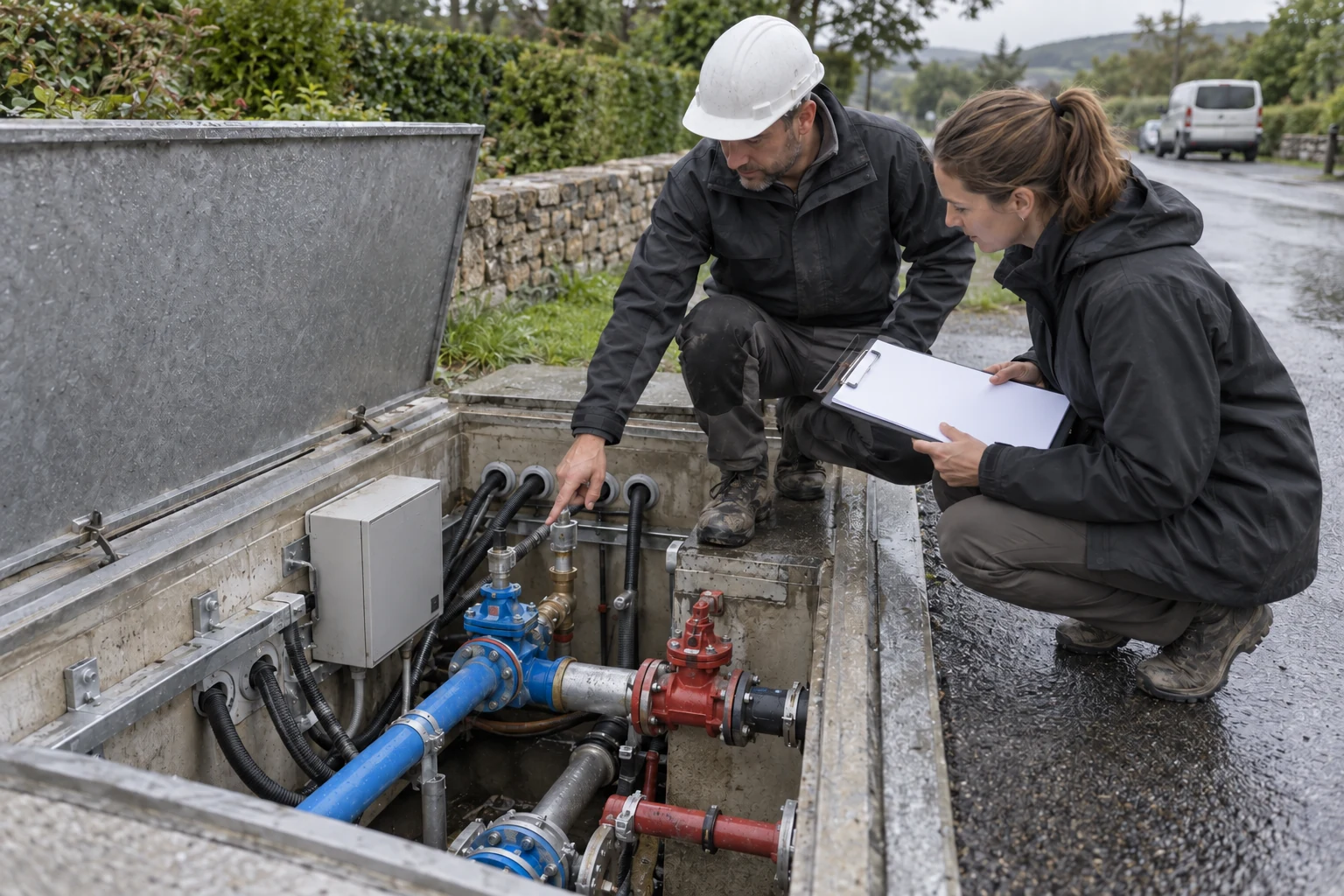
Apply the same discipline to water and wastewater. Ownership of a pipe does not establish the right to abstract water, operate the source or receive effluent. Identify who owns the well and treatment plant, controls water quality, receives wastewater, operates the treatment works and supplies the service under contract. For gas, confirm not only a pipe near the plot but the operator of each relevant segment, service agreements, responsibility points and maintenance access.
A technical adviser should reconcile drawings with the site: cabinet and meter identifiers, routes, isolation points, chamber condition and access for repair teams. Generic claims about capacity, pressure or throughput do not establish suitability. The buyer needs project-specific parameters and evidence for the selected house under the current operating arrangement.
Separate the right to use an asset from the service contract
A robust acquisition has two layers. The first is an enduring right to use the essential asset: a common-property interest, easement, statutory entitlement, contract or another basis that attaches properly to the property and survives the sale. The second is an operational system defining who receives calls, inspects plant, buys resources, plans repairs and responds to failures.
A management agreement does not necessarily provide the first layer. If the operator leases roads or networks from a developer company, check the term, termination rights, rent, subcontracting powers and the consequences when that lease ends. Even where owner and operator are group companies, treat them as separate legal persons. An obligation of one does not automatically bind the other.
Reconcile the findings with the dedicated guide to the 17 questions for a community management company. Request emergency procedures, contractor agreements, staffing, liability insurance, inspection records and a capital programme. Ask who will pay for and reinstate the water main, road surfacing and landscaping after a buried-pipe failure. A usable answer must connect owner, operator and source of funds.
Understand what each payment funds and what transfers to the buyer
A monthly estate charge may combine security, cleaning, lighting, roads, network operation and administration. Require it to be separated by work and legal basis. For each item, identify the recipient, contract, calculation method, approval process and reporting. Keep utility consumption, operating service, routine repair, capital renewal and construction of new assets distinct.
If the buyer is expected to join an organisation, sign with an operator or acquire a common-property interest, those steps must align with one another and with completion of the home purchase. Establish which obligations arise automatically, which require an application, whether debts relate to the property or the former owner, and whether major expenditure has already been approved. Payment of a contribution is not by itself proof of title to infrastructure.
- Transparent model: assets are identified, rights are registered or documented, budgets map to work and decisions are made by an identifiable body.
- Transition model: the developer temporarily subsidises services or retains assets pending transfer; milestones, reserves and delay scenarios are required.
- Risk model: one company collects charges, another owns the asset, durable access is missing and capital renewal has no funding route.
When comparing homes along Rublyovo-Uspenskoye Highway and Novorizhskoye Highway, do not copy a tariff or governance model from one community to another. Neighbouring projects may have different landowners, resource sources, operating structures and service packages.
Stress-test an ownership change and a major failure
The structure is tested by loss of control, not routine operation. Model the sale of the road-owning company, operator insolvency, withdrawal of a developer subsidy, a dispute between affiliates, a major network failure and complete replacement of a critical segment. In each scenario ask whether access survives, who can commission work, who can enter the plant room, where repair funding comes from and who can appoint a replacement contractor.
Focus on assets essential to occupation that are mortgaged, arrested, unregistered or located on land with uncertain rights. An EGRN extract is a dated snapshot and should be combined with corporate, contractual and litigation checks. Integrate this work into the wider prime country-home due-diligence process, allocating registry, cadastral and technical questions to the appropriate advisers.
The buyer does not need an abstract promise of “community infrastructure”. The required chain is an identified asset, evidenced right, protected access, competent operator and credible repair funding.
A pre-deposit decision checklist
- Identify the territory’s legal model and do not assume the SNT regime applies to a commercial development.
- Obtain a plan of the land and infrastructure assets with usable identifiers.
- Order current EGRN information for external and internal road land, structures and critical utility sites.
- Prove continuous vehicle access and review the scope of registered easements.
- Trace each utility from source to the home boundary, naming the owner and operator of every segment.
- Reconcile drawings, responsibility documents, supply contracts and physical equipment.
- Separate property-use rights from the agreement providing maintenance services.
- Verify the manager’s authority, emergency procedures and physical access to plant.
- Split charges into resources, services, routine repair, capital works and new construction.
- Check how debts, common-property interests, membership and service contracts move on completion.
- Model an infrastructure-owner change, operator insolvency and a major failure.
- Reflect critical protections and document delivery in the transaction after specialist review.
A sound outcome does not require one owner for every asset. A mixed structure can work where assets are identifiable, rights and responsibility boundaries align, resident access is protected and operations have documents and funding. Complexity is manageable; the real risk is a polished single image made from assets that are not legally connected.