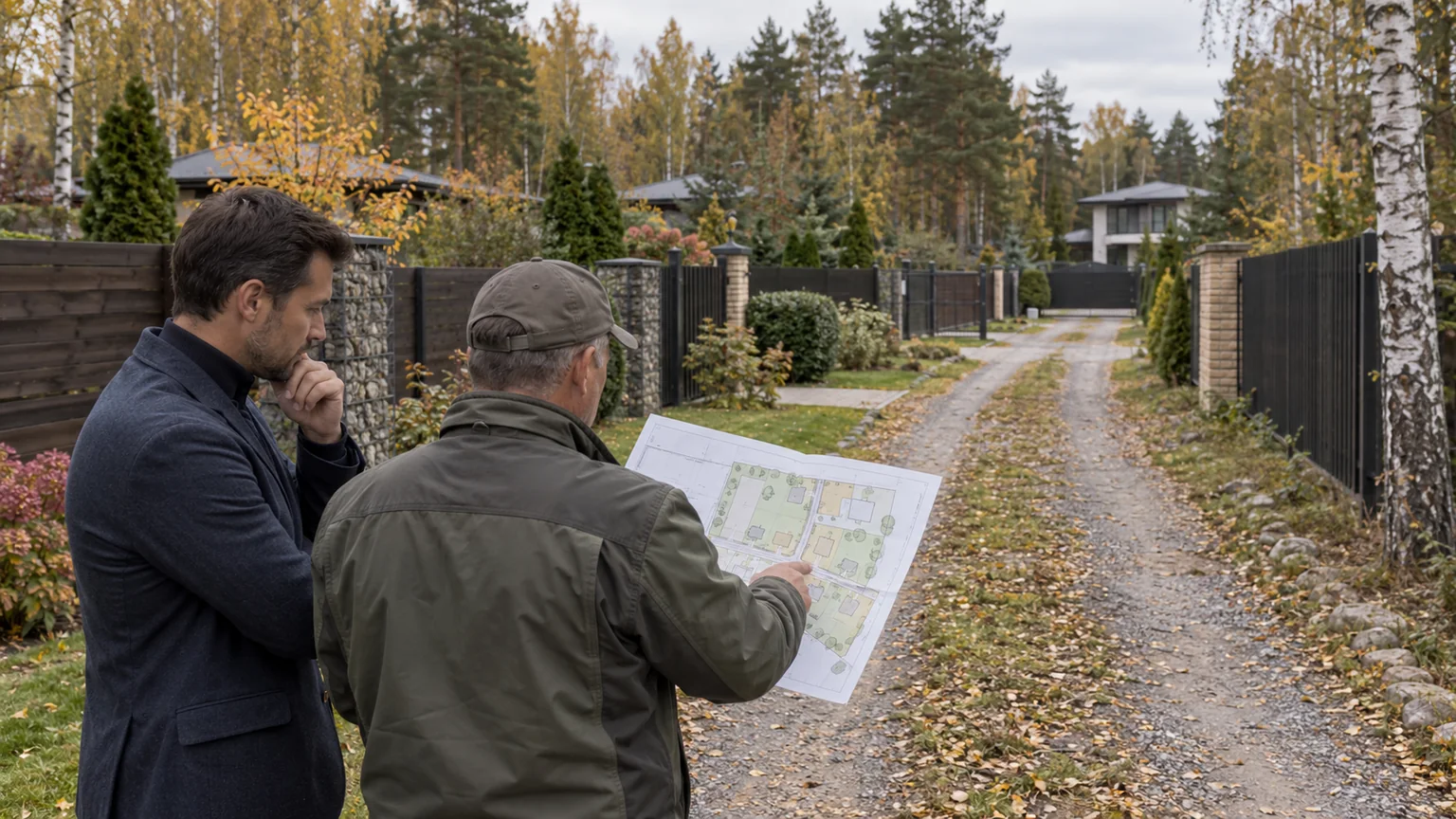
Buying in a Phased Community: How to Assess What Comes Next
A buyer-side method for separating completed works from sales plans, testing infrastructure evidence and defining contractual milestones in a phased country-house community.

A newly launched country-house community is usually sold as a finished image: a gatehouse, club facilities, landscaped walks, complete streets and mature planting. At exchange or completion, only part of that image may exist. One phase is occupied, another has utility works under way and a third remains on a master plan. The buyer’s plot may depend on a road, substation or drainage route scheduled for a later package. The asset must therefore be assessed as a transition from today’s condition to a liveable environment, not as a brochure’s final frame.
This is narrower than a general guide to choosing a gated community and different from investigating future development beyond a boundary. The subject is the community project itself: what exists, what is technically and legally prepared, what depends on later sales, who must complete it and what happens if the sequence changes. A tour of the best-finished phase cannot answer those questions on its own.
Separate completed works, binding commitments and concepts
Begin with status, not promised dates. The first layer is physically complete, operating and available to the particular house or plot being acquired. The second is work required under the buyer’s contract, dated schedules, utility agreements or another document with an identifiable responsible party. The third is concept: visualisations of a school, restaurant, park, second exit or expanded club that do not create a sufficiently clear obligation to the buyer.
List every part of the living environment: external access, gatehouse, internal roads, pavements, lighting, surface-water drainage, electricity, gas, water, wastewater, communications, shared landscape, waste collection, emergency access and the maintenance base. Give each item one status and an evidence reference. “Shown in the project” is not a status. Ask which document, who approved or signed it, whether it covers the buyer’s phase and whether it creates an enforceable commitment.
- Complete: inspected, ownership identified, operation evidenced and access does not depend on an informal permission from the developer.
- Committed: responsible party, scope, milestone, acceptance test and consequence of non-performance are identifiable.
- Conceptual: an intended outcome without adequate buyer protection; assign it no value in the acquisition model.
This prevents a common substitution. The sales team demonstrates a mature first phase while the buyer acquires in another section with a different access route, utility sequence and landscaping date. Compare the rights and working systems attached to the selected phase, not only the community brand.
Reconcile phase boundaries with land and planning records
Request a whole-project plan showing cadastral boundaries, plot identifiers, roads, utility corridors, common areas and the limit of every phase. Reconcile it with current EGRN information, the planning material relevant to the plot and information available through the Moscow Region’s planning information system, ISOGD. The region’s official construction-support centre explains that approved planning documentation and constraints can be obtained through ISOGD and that the approved part of a territory-planning project must be reflected in design work.
A sales master plan and approved planning documentation are not interchangeable. Equally, the absence of one particular document does not prove that every part of the development is unlawful: different objects and works follow different procedures. A property lawyer and technical adviser should map which records apply to each component rather than treating the brochure as either a permit or evidence of an offence.
- Identify ownership of the buyer’s land and the land beneath roads, networks, gatehouses and shared amenities.
- Check whether essential access or services cross third-party land and establish the legal basis for that use.
- Determine which capital works require permits and which register entries actually correspond to them.
- Reconcile the phase boundary in the contract, cadastral material and the physical site.
- Record land retained by the developer that is necessary for ordinary occupation of the buyer’s property.
The Moscow Region registers of construction and commissioning permits are useful for checking references. A permit for one building must not, however, be treated as approval or completion of an entire gated community. Commissioning evidence likewise concerns the particular capital asset and applicable procedure; it does not prove that every promised road, planting scheme or service has been delivered.
Build a phase dependency matrix instead of accepting one completion date
“The community will be finished next year” is too broad for an acquisition decision. Break the project into work packages and dependencies. For every phase record its scope, current status, responsible company, supporting document, funding route, control date, completion test and effect on the selected house. Give special attention to assets without which an otherwise complete building cannot be used normally.
- Access: the route available now, whether it is permanent, who maintains it and whether construction traffic can be kept separate from residents.
- Capacity: the electricity, water, wastewater and communications arrangements available to this property now and what changes later.
- Drainage: not only the channels beside the plot but the downstream route to a lawful outfall or receiving structure.
- Safety: separation between occupied streets and works, lighting, emergency access and understandable wayfinding.
- Landscape: work that can only follow heavy construction and the party responsible for restoring damaged surfaces and planting.
A date becomes useful when attached to a measurable outcome. Replace “road by December” with a defined section of permanent surface, operating drainage, lighting, handover to the operator and resident access. Where delivery depends on another phase, show that dependency explicitly.
Distinguish temporary services from permanent infrastructure
A site can appear connected while relying on a temporary arrangement. Electricity is a clear example. The official Rosseti Moscow Region guidance treats temporary connection and permanent supply as distinct and links completion of the connection process to the required works and final connection documents. Technical conditions, a connection agreement, physical energisation and completion evidence are separate stages; a working socket during a viewing does not prove the entire chain.
For each service, request a buyer-readable schematic showing the source, connection point, responsibility boundary, resilience, meter, route to the property and owner of the internal distribution asset. A technical adviser should confirm that the drawing reflects the buyer’s plot and current site condition rather than only the occupied first phase.
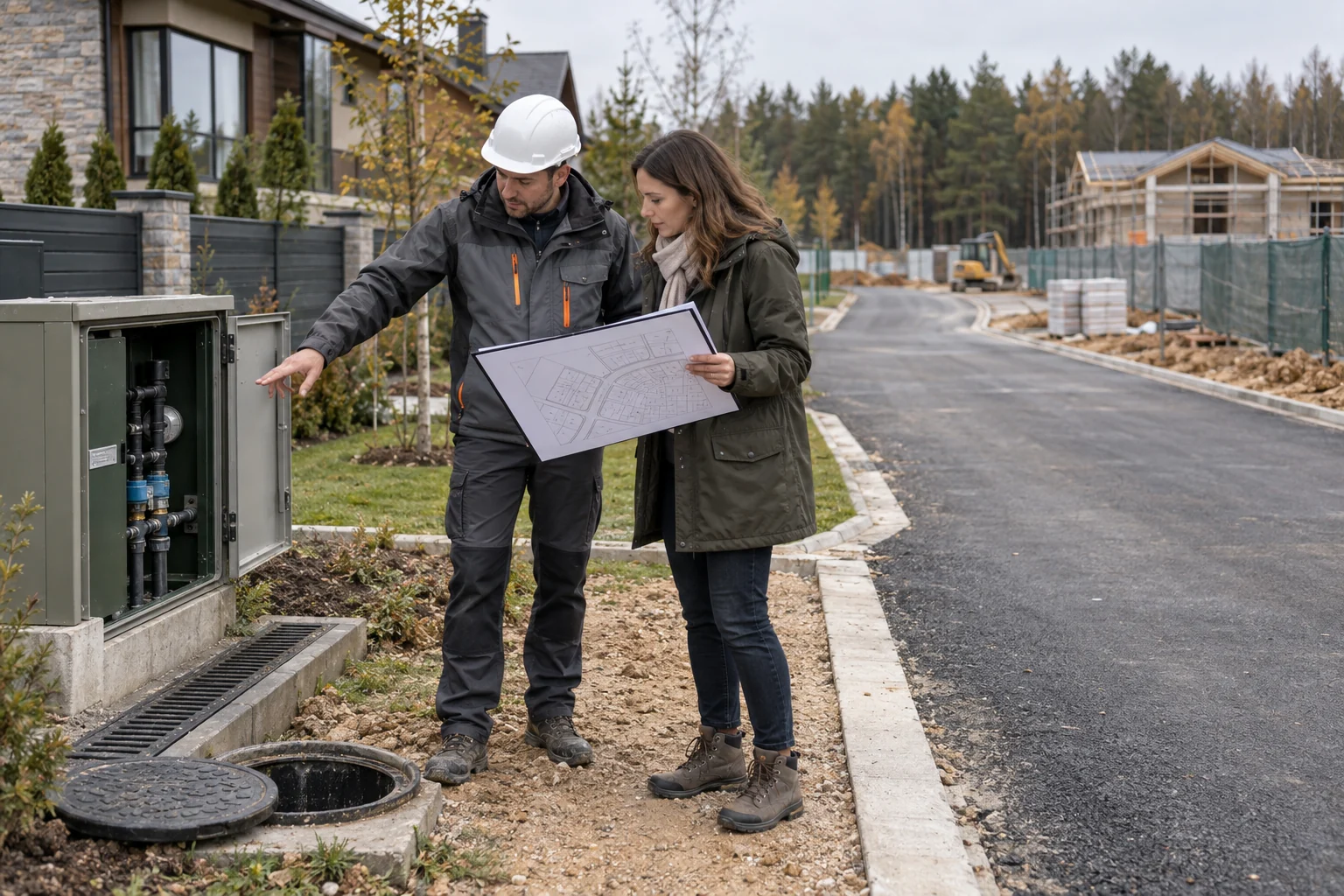
Do not rely on a quoted capacity or pipe size. Ask what establishes the right to the service, which obligations have been completed by the applicant and network operator, who will sign the supply agreement, what transfers with the property and what arrangement applies before permanent connection. Project-specific values, dates and costs must come from project documents; generic benchmarks are not a substitute.
Assess daily life during construction, not only the end state
A feasible development can still be inconvenient for several years. Follow a resident’s route on a working morning, in the evening and after rain. Note conflicts with heavy vehicles, wheel washing, dust, temporary lighting, noise, material storage, route closures and verge condition. Test whether an ambulance, fire appliance, delivery vehicle and family car could reach the property while the main street is under construction.
Request the construction operating rules: working hours, vehicle routes, fencing, access control, cleaning, reinstatement and the route for complaints. Do not extrapolate from a quiet Sunday viewing. Inspect the edge of the occupied phase separately; temporary fencing, an open excavation or a material compound can be significant for children, pets and household staff.
Existing residents can provide valuable evidence, but tie each account to dates and locations. The first phase may have used a different connection route, while early buyers may have negotiated special terms. Ask for observable events rather than reassurance: how often access moved, how damage was repaired, who cleared snow, which interruptions occurred and how reports were logged.
Test governance and the cost of the transition period
A completed community is usually easier to budget: there is a service schedule, operator, recurring charge and expenditure history. In a phased scheme, the developer may temporarily subsidise security, cleaning or utility operation and later transfer those functions. A sales slowdown or phase delay can change that balance, so the current invoice should not be treated as a permanent tariff.
Use the questions in the dedicated guide to the gated-community management company, then add transition scenarios. Who maintains unfinished roads, secures the works, responds to a failure on a temporary network, decides when residents begin paying for a new amenity and controls the operator handover?
- Are construction costs separated from resident services?
- Does the occupied phase have a viable standalone operating budget?
- Who owns maintenance equipment, technical rooms and dispatch systems?
- How does the charge change when a club, park or second gate opens?
- Who funds defect correction before handover?
- Could a dispute between group companies interrupt maintenance of an essential road or network?
Request agreements and calculations, not only the latest invoice. Model the present phase, transition and completed community separately. Unknown amounts should remain explicit risks with an allowance; optimistic estimates create false comparability.
Convert material promises into contractual milestones
A sales statement becomes decision-grade only when it identifies who must do what, by which point, how completion is evidenced and what follows from non-performance. Counsel should determine which agreement creates the obligation, whether its schedules are consistent with the main text and whether the undertaking survives a change of landowner, project company, operator or contractor.
Keep dated copies of the plan and schedule for every critical asset. If configuration may change, define acceptable limits. A promised park should not silently become undefined landscaping, and a permanent exit should not be satisfied by a temporary earth road. Important parameters should be objective enough for an independent adviser to inspect.
Pay a premium for an existing environment or a defensible obligation. A polished plan without a responsible party, milestone and acceptance test is a scenario, not a buyer’s asset.
Link transaction payments to milestones only after legal advice on the mechanism. Do not copy retentions or penalties from another acquisition; the correct structure depends on the seller, title, contract and applicable law. Integrate the result into the wider prime country-home due-diligence process.
A decision gate before paying a deposit
- Obtain a dated whole-project plan with cadastral boundaries and an infrastructure schedule.
- Classify each item as complete, contractually committed or conceptual.
- Verify rights to the land beneath roads, utility corridors, gatehouses and shared amenities.
- Match relevant EGRN, ISOGD, planning and permit records to the specific phase and asset.
- Confirm whether each service uses a permanent or temporary connection and inspect the evidence.
- Trace drainage, construction traffic, resident access and emergency routes.
- Obtain the transition-period budget and rules for operational handover.
- Revisit on a working day and after rain, and interview residents of the occupied phase.
- Place material promises in dated contract schedules with measurable completion tests.
- Model delay: what remains usable, who is responsible and which costs move to the buyer.
When comparing country homes on the Rublyovo-Uspenskoye and Novorizhskoye Highway corridors, a young project is not inherently weaker. It may offer current engineering and a coherent architectural language. Its value comes from a transparent sequence, documented land rights, functioning services, durable governance and a contract that does not ask the buyer to treat the final rendering as present reality.