Winter Driveway Access: Slope, Snow, Ice and Drainage Checks
A practical pre-winter inspection of a country-house driveway: gradients, transitions, meltwater routes, snow storage, traction, gates and safe pedestrian access.
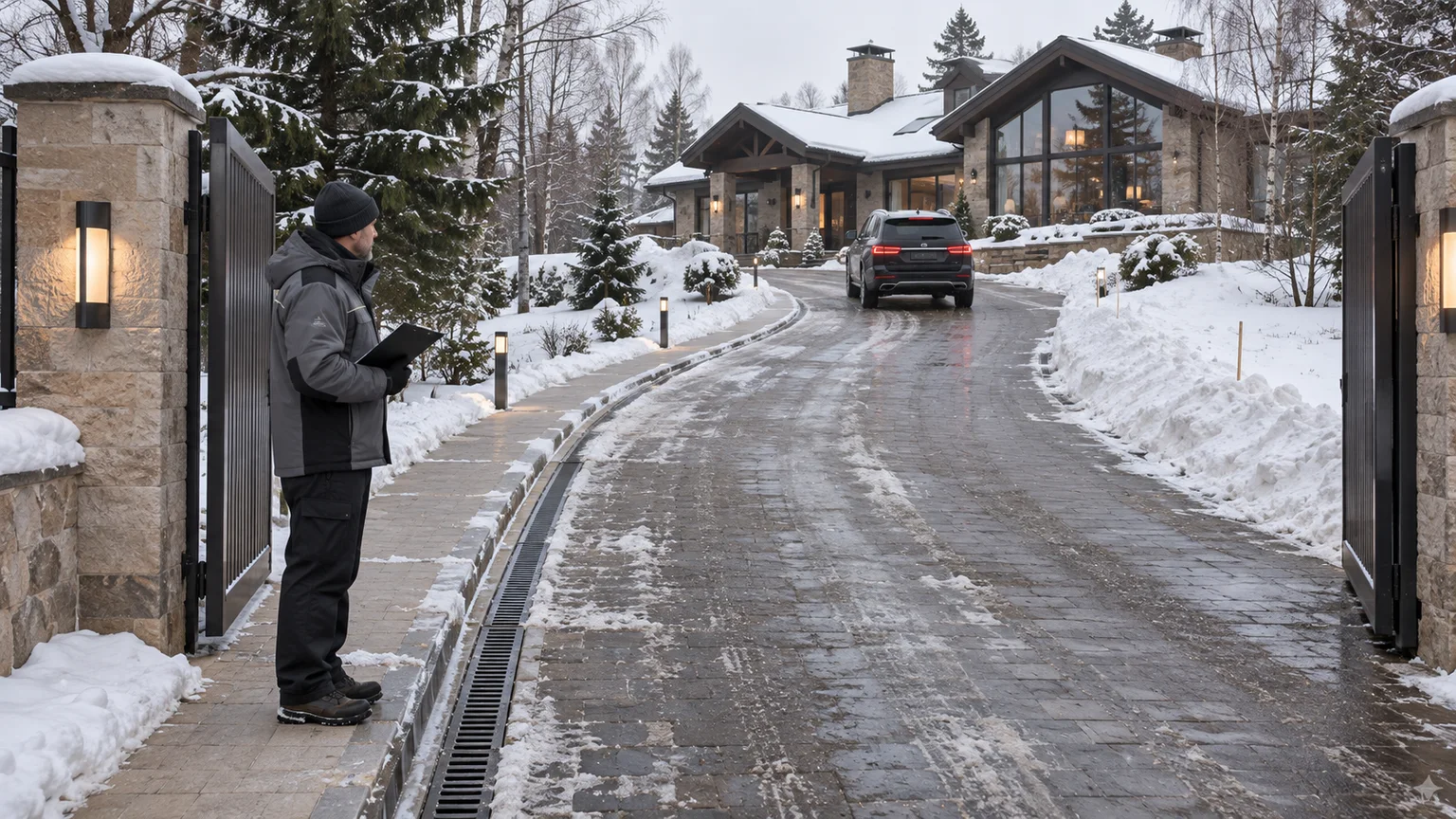
A country-house driveway may look immaculate in summer and become the property’s main operational risk after the first snow–thaw–freeze cycle. Loss of traction is not caused by a steep surface alone. A short grade break at the gate, meltwater in a low point, a snowbank blocking sightlines, ice across the pedestrian route or a gate with no winter operating space can each stop normal access.
The assessment must cover the entire route from the estate road to the garage or turning court. The practical questions are whether family vehicles, service vans and emergency responders can reach the house in difficult weather, where meltwater goes and where cleared snow can physically be stored. There is no universal gradient that makes every private driveway safe: geometry, transitions, drainage, surface, maintenance and vehicle use work together.
Map the complete access sequence
Walk from the public or estate road toward the house and identify every boundary of responsibility: road junction, waiting area, gate, longitudinal climb, bends, passing points, turning court, garage entrance and pedestrian path. Where the estate controls part of the route, establish who clears it and how faults are reported. Our guide to gated-community entrances and checkpoints explains the operating questions at that shared interface.
For every section record:
- usable width and the space that snowbanks will remove;
- longitudinal and crossfall geometry, including short grade breaks;
- turning path and the need to reverse on a slippery surface;
- surface type, condition and repair access;
- channels, inlets, ditches and the confirmed discharge point;
- gates, sensors, lighting and manual opening arrangements;
- a pedestrian line separated from snow-clearing equipment.
Photograph the route in both directions. Entry logs, winter photographs, contractor requests and gate-fault history are more useful than recollection. If access is critical every day, combine this inspection with a wider route map from the country house: a fast main road does not compensate for an impassable final approach.
Measure transitions, not only an average gradient
An average rise from gate to garage can conceal the exact points where a vehicle loses clearance or traction. Build a simple longitudinal profile with levels at the road junction, start and end of the climb, bends, drainage grates, garage threshold and stopping areas. Check crossfall separately. It should lead water toward the designed collection system rather than the façade, pedestrian gate or inside of a bend.
Transitions deserve particular attention. A moderate driveway can still fail where a low vehicle grounds on a short crest, a gate stands on a slope or the driver must stop for access control at the slipperiest point. Conduct slow trial movements with representative vehicles in both directions. Mark wheel position while waiting, door-opening space and visibility. Dry-weather trials do not prove winter performance, but they expose geometric conflicts.
On sloping land, driveway geometry cannot be separated from retaining structures and surface runoff. Our article about a country house on a slope describes signs that require specialist review. If later landscaping changed levels, obtain an as-built survey: a new kerb or planting edge may have blocked the original water path.
Trace rainwater and snowmelt to the final outlet
Winter ice often forms below a source that is not immediately visible. Water may arrive from a roof, lawn, retaining wall or upper court, cross the driveway and freeze at the gate or in a shaded bend. Read the levels in dry conditions, then observe rain or perform a controlled water test without creating flooding.
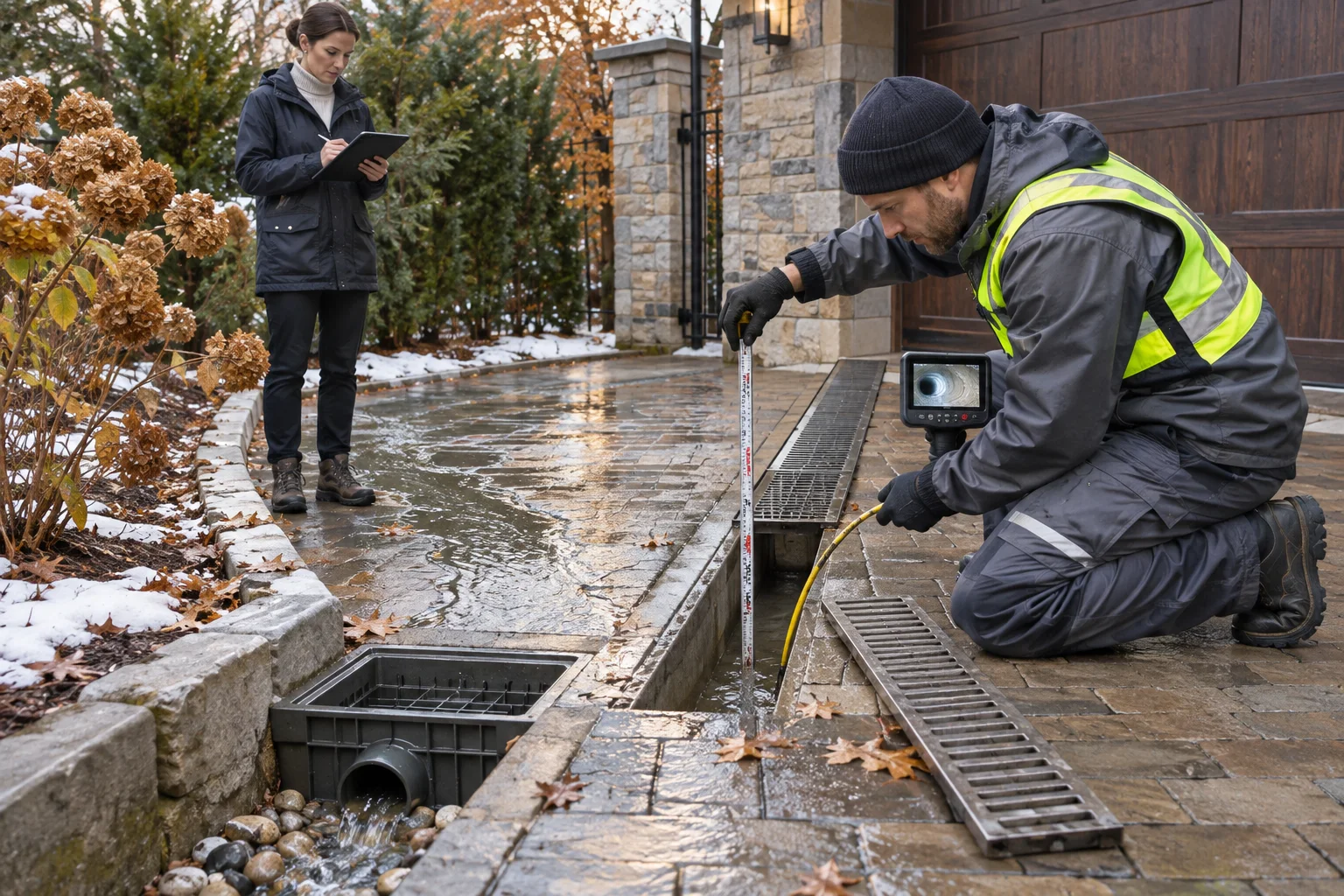
Confirm that water enters each channel or inlet and then reaches a known outlet. A neat grate with no understood downstream route is not a drainage system. Open accessible silt traps, inspect deposits and joints, and verify that they can be cleaned. Look for backing-up, settlement around chambers, damaged edges, overflow marks and an outlet that now sits above the true low point.
SP 32.13330.2018 covers permanent systems for rainwater and snowmelt and treats surface drainage as a connected network rather than isolated grates. The correct private-property solution depends on levels, soil, the receiving network and estate rules. Runoff should not simply be diverted to a neighbour or shared road. Review the broader site context with our guide to drainage, groundwater and seasonal risk.
Designate snow storage before the first storm
Cleared snow does not disappear. It occupies space, blocks views, loads planting and returns as water during a thaw. Mark primary and reserve storage zones on the site plan. They should not block gates, paths, lighting or emergency equipment, load delicate fences, cover drainage inlets or release meltwater toward the building.
Give the contractor a route and sequence rather than the vague instruction to “clear the driveway”:
- restore access to the gate and manual release;
- clear the vehicle line while preserving usable width;
- open the pedestrian route and entrance court;
- keep channels, inlets and sightlines free;
- place snow in the agreed zone without damaging kerbs and planting;
- after thawing, inspect the outlet and remove refrozen ridges.
Check whether larger equipment can turn without striking gate automation, bollards or lights, and where its blade must be lifted before paving and grates. Smaller machinery still needs storage, power or fuel and a safe operating route. The effect of snow clearance on lawns and planting can be assessed with our post-winter landscape inspection.
Traction is an operating system, not a chemical product
A textured surface cannot compensate for uncontrolled water and compacted snow. Grip changes with cleaning, ice film, shade, temperature, vehicle speed and the timing of treatment. Polished stone, a metal access cover and a local patch may behave very differently within the same wheel track.
GOST R 50597-2017 and GOST R 59434-2021 apply to public roads and streets, so their road classes and response limits should not be copied into a private residence specification. Their control logic is valuable: distinguish loose snow, compacted snow and winter slipperiness; define a measurable service condition, method of inspection and response time. A private estate should put its own criteria into the maintenance plan and contractor agreement.
Agree treatment materials with the paving supplier, drainage designer, landscape team and, where relevant, animal-care requirements. More product will not correct a defective profile. Residue also needs managed removal where it accumulates, followed by a spring inspection of joints, metal, stone and planting.
Treat gates and pedestrian access as separate systems
Powered gates must work during snowfall, icing and a power failure. Inspect the sweep of each leaf, tracks, photocells, cables, drive drainage and manual release. Establish who holds the key and whether the mechanism remains reachable when a car is already waiting outside. Backup power should support a tested operating scenario, not merely appear on a diagram.
The pedestrian line should not be the leftover edge of the vehicle lane. It needs its own lighting, maintainable width, visible boundaries and a safe exit at the wicket gate. Focus on steps, metal inserts, decking, access covers and points where water drips from canopies. Lighting should reveal changes in level without producing glare from wet paving.
Commission the driveway in real winter conditions
Complete the assessment after a meaningful snowfall followed by a thaw. Walk the route, conduct a controlled vehicle trial, test clearing, gates, lighting, meltwater drainage and access to service components. Repeat photographs from fixed viewpoints so that different weather events can be compared.
The owner’s acceptance checklist is practical:
- the profile records local gradients and transitions, not one average figure;
- the source and final destination of each runoff path are known;
- channels, chambers and outlets remain accessible for winter cleaning;
- primary and reserve snow-storage areas are marked;
- the contractor understands equipment routes and exclusion zones;
- gates have tested powered and manual opening scenarios;
- pedestrian access is cleared and lit separately;
- photographs, response times and responsibility are defined after snowfall.
Reliable winter access is the combined result of levels, surface, drainage, snow management and automation. If one weakness must be compensated repeatedly by chemicals, manual labour or vehicle momentum, the underlying problem remains. The best time to correct it is before persistent snow, while the drainage system can still be cleaned, levels checked and a controlled flow test completed.